
- HOMEGROWN WORLD
- HGCREATORS
- HGEXPLORE
- HGVOICES
- HGSHOP
- CAREERS
- ABOUT US
- CONTACT US
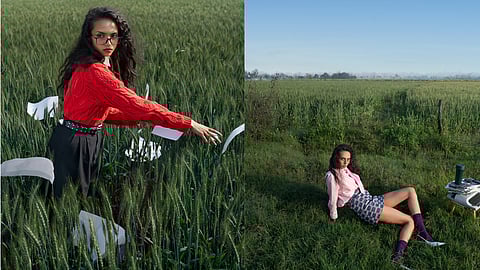
'Silly Work', an editorial led by stylist Saloni Gupta, captures Gen Z’s evolving relationship with work, identity, and ambition. Challenging hustle culture, the series uses colour, structured silhouettes, and outdated office props to reflect the tension between conformity and self-expression. Rather than offering solutions, it portrays a generation navigating inherited workplace systems while prioritising balance and mental health.
Being constantly busy has become a ‘flex.’
People have been working hard while also making time for life beyond being employees of an institution for years. But now, hustling has become a way of being, not just a means to reach a goal or “make it,” but an aesthetic in itself. Everything has to be productive; every hobby must be monetised. Every goal, both long-term and short-term, must be set and broadcast to an audience, whether that’s your family of four or a follower count of 400k.
And when a generation tries to push back against this hustle-culture epidemic, by setting boundaries and keeping work lighter and more intentional, they’re often labelled lazy, quirky, or simply unprofessional. For Gen Z, success is less about relentless output and more about sustainability. They’re more likely to question the idea that worth is tied to productivity, to resist the pressure to monetise every passion, and to prioritise rest, mental health, and a sense of self that exists outside of work. This doesn’t mean they lack ambition; rather, it reflects a shift in what ambition looks like. It’s no longer just about climbing ladders, but about choosing which ladders are worth climbing at all.
To highlight this dissonance, an all Gen-Z team with stylist, Saloni Gupta put together ‘Silly Work’. “Silly Work’ is a series that reflects the ‘crossroads’ every younger person entering the workforce must grapple with. A NIFT graduate, Gupta wanted to portray how in between trying to fit in during an age where self-identity and perception are warped and trying to maintain a sense of self without letting the work consume you, Gen-Z is stuck in the middle.

By using colourful pieces paired with more structured silhouettes, the series captures a subtle tension, between conformity and self-expression. It reflects how this generation is negotiating its identity within workplaces that often feel bland and almost sterile, where individuality is expected to be muted in favour of uniform professionalism.
Colour, becomes more than just an act of resistance. A red jumper becomes a declaration. A flash of colour peeking through a pair of otherwise subdued green tights feels intentional. These moments of vibrancy interrupt the monotony of corporate palettes, suggesting that even within rigid systems, there is room, however small, for personality to surface.
Additionally, the inclusion and placement of outdated office equipment like a typewriter or older versions of the telephone, introduce a pointed commentary on the persistence of legacy work cultures. These objects, no longer functional yet still present, act as visual metaphors for systems and expectations that continue to shape the modern workplace long after their relevance has faded.
Their presence alongside contemporary subjects suggests a kind of temporal dissonance. While the generation inhabiting these spaces is forward-looking, adaptive, and digitally native, the structures they operate within often feel inherited, rooted in older ideologies of labour that prioritise obedience, endurance, and invisibility. The message of “keep your head down and do the work” stays, subtly embedded in the environment itself.
Silly Work resists offering a neat resolution, and that feels intentional. There is no clean break from the systems that came before, no singular way to reconcile ambition with rest, or individuality with expectation. Instead, what the series captures is a generation in negotiation.
In these in-between spaces, Gen Z isn’t just reimagining its place within work, but learning how to inhabit structures it didn’t build. By bringing in moments of humour, irony, and play, they introduce a sense of lightness into spaces that have long been defined by rigidity. In making it “silly,” they are reclaiming agency within it without trivialising any of the work.
Team behind the project:
Photographer: Aman Raj
Stylist: Saloni Gupta
MUA: Sonali Gupta
Model: Sudiksha (@featartists)
Art director: Anupam Barrick
Production: Abraham Joshua
Production Assistant: Pankaj Kashyap
Photo Editor & Retoucher: Selva Kumar
