
- HOMEGROWN WORLD
- HGCREATORS
- HGEXPLORE
- HGVOICES
- HGSHOP
- CAREERS
- ABOUT US
- CONTACT US

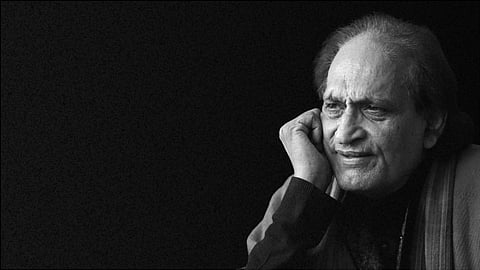
Raghu Rai — photographer, photojournalist, and the man who arguably did more than anyone else to show India to itself and to the world — passed away in New Delhi in the early hours of Sunday, April 26, 2026. He was 83. He is survived by his wife, Gurmeet Rai, and their four children, Nitin, Lagan, Avani, and Purvai.
A black and white photograph of a young donkey. That’s how Raghunath Rai Chowdhry — better known as Raghu Rai, one of the greatest photographers of all time — began his storied career spanning over six decades. The youngest of four children, Rai was born in Jhang, Punjab (now part of Pakistan), on 18 December 1942, and belonged to a generation shaped by the ruptures and migrations of Partition. After training as a civil engineer despite wanting to be a musician, Rai first picked up a camera in the 1960s while living with his older brother, photojournalist S. Paul, in New Delhi. When Paul saw the photograph of the donkey, he sent it to the London-based British newspaper The Times, where it appeared as a half-page picture with Rai’s byline. The rest, as they say, is history.
Raghu Rai joined The Statesman in New Delhi as the newspaper’s Chief Photographer in 1966, producing images of great rigour and beauty over the following decades. In 1971, he became one of the key witnesses to the Bangladesh Liberation War. His stark black-and-white photographs from that year captured the brutality of Pakistan’s military crackdown on Bengali nationalists, the trauma of East Pakistani refugees who migrated to India, and the sorrow and triumph of the allied Indian Army and the Mukti Bahini forces’ victory at the end of the war, which led to the birth of Bangladesh. He received the Padma Shri — one of India’s highest civilian honours — for his exceptional coverage of the Bangladesh war and the refugee crisis. He was only thirty years old at the time.
In 1976, Rai left The Statesman to work as picture editor for Sunday, a weekly news magazine published in Calcutta. In 1977, he became the first Indian photographer invited to join the prestigious Magnum Photos collective, after being nominated by Henri Cartier-Bresson. The recognition placed him in the company of some of the world’s most celebrated image-makers, yet Rai remained rooted in Indian streets, neighbourhoods, and political theatres. “For me, my country is my whole world. Even if I close my eyes, I can feel it,” he told India Art Fair in 2021.
He left the Sunday magazine in 1980 and joined India Today as Picture Editor, Visualizer, and Photographer during the news magazine’s formative years. From 1982 to 1991, he worked on special issues and designs, contributing trailblazing photo essays on social, political and cultural themes, many of which became talking points for the magazine.
His 1984 photographs of the Bhopal Gas Tragedy — one the world’s deadliest industrial disasters — for Greenpeace captured the aftermath of the methyl isocyanate (MIC) leak from the Union Carbide India Limited (UCIL) pesticide plant which resulted in the death of an estimated 20,000 local residents and injured over 570,000 people. Rai’s haunting photograph, ‘Burial Of Unknown Child, 1984’ — which depicted the burial of a child with their bloodshot eyes still open — became the face of the disaster across the world. In 2002, Rai returned to Bhopal to photograph the survivors suffering from diseases caused by the toxic fumes. This body of work led to the book ‘Exposure: A Corporate Crime’, and three exhibitions that toured Europe, America, India and Southeast Asia.
Rai’s genius was not confined to catastrophe alone. He had an equal gift for the intimate, the still, and the revelatory environmental portrait. His decades-long documentation of ordinary and extraordinary lives across India represents a vast photographic archive which captured a country in transition. His subjects ranged far and wide. He photographed Indira Gandhi with unusual access, made deeply moving images of Mother Teresa and the Dalai Lama, profiled Hindustani classical musicians such as Ustad Bismillah Khan, Hari Prasad Chaurasia, Bhimsen Joshi, and M.S. Subbulakshmi, as well as workers, pilgrims, politicians, children, mourners, lovers, and wanderers alike. He was, truly, a master of light and shadow.
In 2003, he switched to a digital camera while on assignment for Geo Magazine in Mumbai and never looked back. He was rare amongst the great photographers who emerged in the 20th century in his preference for digital cameras and zoom lenses. He liked the flexibility of zoom lenses over the rigidity of fixed focal length prime lenses because they allowed him to decide on the specific focal length to “capture the space he has in mind” without wasting time while making images.
Beyond photojournalism, Rai was an “explorer of life” in its fullness. His books such as ‘Raghu Rai’s Delhi’, ‘The Sikhs’, ‘Calcutta’, ‘Khajuraho’, ‘Taj Mahal’, ‘Tibet in Exile’, ‘India’, and ‘Mother Teresa’, are masterclasses in documenting life. In 2017, his daughter Avani Rai made a documentary about his life and work, ‘Raghu Rai: An Unframed Portrait’, following him on a trip to Kashmir. In recent years, Rai mentored young photographers, served in the jury of the World Press Photo and UNESCO’s International Photo Contest, and continued in his role as a correspondent of Magnum Photos until his death. He is survived by his wife Gurmeet Sangha Rai, and their children, Nitin, Lagan, Avani, and Purvai.
Watch Raghu Rai speak about his photography here:
Learn more about Raghu Rai’s life and works here.
