
- HOMEGROWN WORLD
- HGCREATORS
- HGEXPLORE
- HGVOICES
- HGSHOP
- CAREERS
- ABOUT US
- CONTACT US

Hosted at the historic Belgadia Palace, The Mayurbhanj Residency is a collaboration between the Mumbai-based contemporary art gallery Art + Charlie and The Mayurbhanj Foundation, connecting contemporary artists with local craft communities. Through Kumar Misal’s collaboration with sabai grass weavers in Rangamatia, the residency raises important questions about authorship, craft, ecology, and the long-standing distinction between artists and artisans.
The northeastern part of Odisha is a forested paradise. From the Bichitrapur Mangrove Reserve at the mouth of the Subarnarekha River to the Simlipal National Park and the Eastern Ghats hills tract, the region is rich in ecological diversity and the deep-rooted cultural heritage of the forest-adjacent tribes. Until 1949, these hinterlands were part of the princely state of Mayurbhanj, ruled by the Bhanj Deo dynasty from their seat of power in Baripada. Today, they are part of modern-day Mayurbhanj, the largest district of Odisha.
I visited the 18th-century Belgadia Palace in Baripada — which now serves as a boutique hotel and the residence of the Bhanj Deo family — as part of a group of journalists, art writers, and curators to cover the conclusion of The Mayurbhanj Residency near the end of June. A collaboration between the Mumbai-based contemporary art gallery Art + Charlie and The Mayurbhanj Foundation, run by the erstwhile royal family, the residency aims to blur the line between contemporary art and the region’s centuries-old craft traditions, such as dhokra (non-ferrous metal casting) and sabai grass weaving craft.
“I first met Akshita (Princess Akshita Bhanj Deo, director of The Mayurbhanj Foundation) sometime last year, and she invited me to visit Mayurbhanj and the Belgadia Palace. During that visit, we discussed what it might mean to establish an artist residency here,” Ayesha Parikh, the founder of Art + Charlie, told me.
“The residency was created to engage with Mayurbhanj’s rich history, living traditions, and craft practices. The region is home to remarkable artist communities working across a wide range of material traditions, including sabai grass, dhokra, textiles, bamboo, Khiching black stone, and many others,” she said. “Yet, for far too long, these histories and practices — particularly those of Mayurbhanj — have not received the attention they deserve. Before meeting Akshita, I knew very little about the region and its extraordinary cultural legacy. We were interested in understanding what it means to engage with an ancient culture that exists within its own unique microcosm, and how contemporary art might help amplify its stories and significance.”
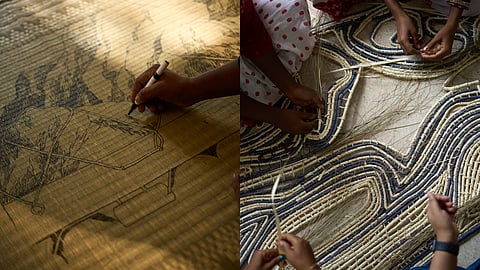
For the first edition of The Mayurbhanj Residency, multidisciplinary artist Kumar Misal spent the entire month of June at Belgadia Palace. Hailing from an agrarian family in Kohlapur, Misal’s practice is rooted in the agricultural cycle, crafting sheets of paper from banana, corn, and sugarcane fibres, which he then uses to produce autobiographical images. During the residency, he worked with the sabai grass craft cluster in the nearby village of Rangamatia and collaborated closely with the women weavers there to produce a new body of work examining the effects of mining on the region’s people and ecology.
“There are many similarities between the Kumbhoj region in Maharashtra, where I come from, and Mayurbhanj,” Misal said while presenting one of the works he began during the residency. “As these regions are deforested for road construction and mining, human-animal conflict involving leopards, tigers, and buffaloes is increasing. For this body of work, I took detailed Google Earth satellite images of the mining areas surrounding Mayurbhanj and recreated them using hand-woven sabai grass and bamboo leaves, in close collaboration with the local women weavers,” Misal said.
On my second day in Mayurbhanj, I visited Rangamatia and watched the women at work. It was surprisingly easy to work with the women artists, Misal told me when we spoke on the way. “When I first visited the cluster, I showed them some drawings and outlines of what I wanted and asked if they could make it. Several women, led by Jayati Mahato, were enthusiastic. We found a ‘vibe’,” Misal said.
It is here that The Mayurbhanj Residency raises a pertinent question in the art world that we don’t often talk about: the distinction between ‘artist’ and ‘artisan’. In the conventional sense, what separates an ‘artist’ from an ‘artisan’ is intent — the idea that an ‘artist’ creates without an inherent need for utility, while an ‘artisan’ is a craftsperson who makes functional objects that serve a practical purpose.
But art does have utility, purpose, and function: it shapes, challenges, or legitimises power. And craftspeople do far more than simply follow traditional techniques: they innovate within those living traditions, shape cultural memory, and often create works of extraordinary originality and skill. That their labour is often relegated to the realm of craft, while contemporary art receives greater visibility, value, and authorial recognition, is an indictment of the hierarchical order of the contemporary art industry.
The Mayurbhanj Residency aims to bridge this gap. By bringing contemporary artists into dialogue with practitioners of sabai grass weaving, dhokra casting, stone carving, textiles, pottery, woodwork, and other local craft traditions, it proposes a more equitable model of artistic exchange in which knowledge moves in multiple directions and where both practices are understood as forms of artistic production deserving equal recognition and institutional support.
As I look back on the time I spent at The Belgadia Palace, listening to Akshita share her family history and the larger history of Mayurbhanj, observing the women’s work at Rangamatia, and talking to Kumar, Mihir, and Ayesha about how the body of work which began during the residency will continue to evolve in the coming months, I want to believe The Mayurbhanj Residency is the manifestation of an idea whose time has come. But what I had the privilege of witnessing was only the seed. What that seed will bloom into — only time will tell.
The body of work produced by Kumar Misal in collaboration with the women artists of the Rangamatia craft cluster during The Mayurbhanj Residency will be showcased in a special presentation during the Mumbai Gallery Week, scheduled for January 14 to 17, 2027.
Follow @ayesha.parikh, @mhrthkkr, @artandcharlie, @kumarmisalstudio, @thebelgadiapalace, @themayurbhanjfoundation and @abhanjdeo for the latest updates on The Mayurbhanj Residency.
If you enjoyed reading this, here’s more from Homegrown:
Rambha Palace Is Where Odisha’s Craft Traditions Meet Lakefront Luxury
Palace Stays, Heritage Villages, & More: A Homegrown Guide To Mindful Travel In Odisha
Inside Raghurajpur, The Odisha Village Where Everyone Is An Artist
