
- HOMEGROWN WORLD
- HGCREATORS
- HGEXPLORE
- HGVOICES
- HGSHOP
- CAREERS
- ABOUT US
- CONTACT US

Art and literature remind us that grief is not an aberration but a shared condition of being human. In 'Circa Full Circle', Sanjana and Kalpana Shah resist the familiar grammar of overcoming. Together, their works refuse resolution, insisting instead that healing is incremental, ambiguous, and inseparable from time.
“You think your pain and your heartbreak are unprecedented in the history of the world, but then you read. It was books that taught me that the things that tormented me most were the very things that connected me with all the people who were alive, who had ever been alive,” the American novelist and civil rights activist James Baldwin said in an interview for LIFE magazine in 1963.
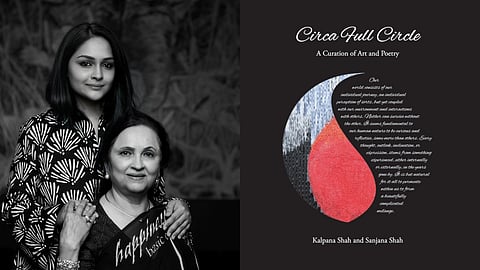
Art and literature remind us that grief is not an anomaly but a shared condition of being human. When we encounter a poem, a painting, a novel, or a song that articulates the ache we struggle to name, our private sorrow becomes legible and perhaps bearable. They teach us that others have stood where we stand, survived what we are surviving, and felt what we feel, and that recognition is often the first step toward healing. In recognising our own grief in someone else’s words or images, we begin to see that loss is connective; it binds us across time, geography, and circumstances. “The circumstances are subjective, but the experience is universal,” Sanjana Shah — creative director and one-half of the mother-daughter duo behind Tao Art Gallery — says during our conversation about ‘Circa Full Circle’, a collection of Sanjana’s poetry and her mother Kalpana Shah’s paintings recently published by Penguin Random House India.
In ‘Circa Full Circle’, Sanjana and Kalpana resist the familiar grammar of grief narratives. There is no rising moment of triumph over grief; no tidy moral extracted from catastrophe. The book, a collection of paintings and poetry, emerges from the seismic rupture of the 26/11 Mumbai terror attacks, in which Pankaj Shah — husband, father, and co-architect of a formidable cultural legacy — lost his life. Yet instead of framing the collection as an act of overcoming this profound personal loss, the Shahs position it as something more demanding: the work of continuing.
For the Shahs — a family deeply embedded within Mumbai’s art ecosystem through their art gallery — this is a significant pivot. Tao has long been a site of engagement with the arts through landmark exhibitions, workshops, and patronage. ‘Circa Full Circle’ turns that curatorial gaze inward. The collection questions what happens when the custodians of an aesthetic space must confront an interior landscape fractured by violence.
The collection is structured as a conversation between Kalpana’s abstract paintings and Sanjana’s poetry. The pairing was not premeditated, they say. For Sanjana, writing is inseparable from incomprehension. She began as a teenager, using language to process an event that defied logic. Her poems were not conceived for publication; they were private negotiations with absence, temporality, and the fragility of attachment. “I see a direct correlation between the loss and the triggering of that expression in my experience,” Sanjana says. “Instead of fighting with the external world, I went into an internal space and started asking: how can something like this happen? What does it say about the temporary nature of everything?”
Kalpana’s relationship to art predates the tragedy. A self-taught painter who had already mounted a solo show during her husband’s lifetime, she describes art as something that “came naturally”. After his death, however, the studio assumed a different significance. Against the pressures of business and the practical demands of sustaining a cultural institution like Tao, the studio became a space of inner clarity. “The happiest time I felt was when I was in my studio painting,” she says.
If there is a governing metaphor that stands out, it is the idea of the work of art as an oasis. Creativity, their work suggests, is not escape from the desert but preparation to re-enter it — to pass through it. The artist’s studio and the poet’s pen do not erase the brutality of the world; they provide the psychic resources to withstand it. One creates because of rupture; the other creates through it. Together, they complicate the idea of art as therapy. Healing is neither immediate nor sentimental, they argue. It is incremental, often invisible, and inseparable from time.
At its philosophical core, ‘Circa Full Circle’ is preoccupied with dualities: pain and joy, doubt and revelation, attachment and impermanence. Yet they refuse to treat these as opposites. Instead, they are mutually constitutive. Joy is sharpened by its vulnerability; love derives luminosity from the knowledge of loss.
This resistance to fixed meaning is the collection’s most radical gesture. The Shahs frame ambiguity as an ethical stance. To claim resolution in the aftermath of terror would be disingenuous. Identity is not fixed but porous, shaped by encounter and erosion. Sanjana’s poems return repeatedly to the instability of the self when faced with insurmountable grief — the “making and breaking of particulars”. Kalpana’s paintings echo this fluidity: forms appear to coalesce and dissolve; colours suggest structure but resist definitive interpretation. The visual and the verbal operate differently — one withholding, the other probing — but they converge and complement each other in their refusal of certainty.
The mother–daughter dynamic adds another layer of complexity. Both are attuned to nuance, to the philosophical undercurrents beneath surface events. Grief altered the architecture of their family, but their creative outlets reconfigure it again, this time through partnership. The work of art, in this context, emerges as a container: it creates a space where devastation can be held without being reduced to a simple narrative. If the title suggests completion; the act and process of life coming full circle, then the text undercuts that expectation. The circle here is not a closed loop but an ongoing motion — a return to self, to dialogue, to the unfinished labour of meaning-making through art and literature.
