
- HOMEGROWN WORLD
- HGCREATORS
- HGEXPLORE
- HGVOICES
- HGSHOP
- CAREERS
- ABOUT US
- CONTACT US

This article examines Kanu Behl’s 'Agra', a provocative drama that dissects the intersections of desire, repression, and space within the confines of an Indian household. Premiering at Directors’ Fortnight, Cannes 2023, and later screened at MAMI, the Indian Film Festival of Melbourne, and the New York Indian Film Festival, the film will release theatrically in India on November 14, 2025. Starring Mohit Agarwal, Priyanka Bose, and Rahul Roy.
Space is a scarce commodity in India be it physical or the private corners of the self. From early adolescence we learn that Indian homes largely aren't familiar with the concept of boundaries. As a growing young adult in one of these homes, this scarcity is physical, social, architectural and even psychic. Families can be simultaneously nurturing and intrusive, with their authority simultaniosly dictating behaviour and policing desire. The fault lines that this regime of control creates are what Kanu Behl puts under the microscope in his provocative new film.
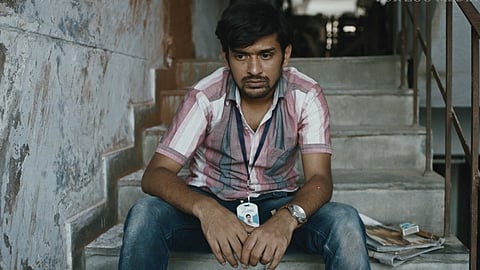
'Agra', which premiered in the Directors’ Fortnight at Cannes in 2023 and received international festival acclaim, is an unsparing drama about a cramped household and the corrosive forces that live in it. Set in a small Agra house, the story follows Guru, a twenty-five-year-old who shares a room with his mother while his father keeps a mistress on the floor above. The film stars debutant Mohit Agarwal as Guru, with Priyanka Bose and Rahul Roy in pivotal roles. 'Agra' had its world premiere at the 2023 Cannes Film Festival. The film won the Special Jury Award at MAMI 2023, the IFFM Award for Best Indie Film and Best Actor at the Indian Film Festival of Melbourne in 2023, and Best Film and Best Actor at the 2024 New York Indian Film Festival (NYIFF).
Director Kanu Behl speaks of a deeper anger and sadness that shaped the metaphorical skeleton of the film. He had often watched his parents’ and relatives’ houses being built, observing from a distance as people poured their desires into every brick and fixture, yet somehow grew less happy in the process. The joy of having less and being together, he felt, was slowly replaced by the scramble for a “better” future.
On the surface 'Agra' charts a sexual coming-of-age: Guru moves from an imaginary fiancée he daydreams about, to online sexting with strangers, to an unlikely relationship with a middle-aged, physically disabled woman. But the narrative is structured around a second, tangible object of desire — a terrace room promised by the house’s renovation. The terrace is both literal and symbolic: it is the private square footage Guru imagines as the site of his liberation, and it becomes a battleground where bodies, rights and material claims are measured.
"Growing up, in my late teens and even till my mid twenties, I had personally felt a certain sexual repression and an inability to express myself to the opposite sex, shares Kanu. "Even worse, I'd seen many boys from the mohallas around me who were perhaps not as privileged - they were stuck with 5 family members in a single room while I still had a room of my own - struggle with trying to bottle anger and violence because of this vortex of the relationship between space and sexuality." The filmmaker was interested in telling this story from the inside and perhaps start a conversation leading to some sort of 'holistic solution to sexual violence at large.'
In the film, he traces how childhood abuse and sustained repression can metastasise into aggression, self-harm, and morally compromised choices. At the same time, the father’s parallel promiscuity — a second domestic arrangement in the same house — exposes a systemic hypocrisy. In whatever way male desire is manifested: be it the desperation of Guru who cannot find a partner or the indulgence of his father who can't be satisfied with just one, it's always the women who are at the brunt of that hunger. 'Agra' locates these distortions within the broader conditioning that denies men and women equal autonomy over their bodies, their desires, and their boundaries.
In this balancing scale of coveting body and property, the film shows us how victims can become perpetrators, how desire conflates with ownership, and how the economics of marriage — emotional, familial and civil, bend human behaviour into transactional forms. Threaded through this is the question of consent and its place in the social contract of relationships.
Formally, 'Agra' is a difficult watch by design. Its abrasive imagery of visceral food and sex sequences, the claustrophobic undertone, and performances that refuse to soften the characters’ disagreeable and subhuman impulses, insist on discomfort as an instrument of insight. In its willingness to name the ugly bargains we live with and the deprivations that make ordinary lives so vulnerable, the film sketches a portrait of the distorted appetites that are often produced by cramped living across rooms, dependencies, and expectations.
Follow Kanu Behl here and watch the trailer for 'Agra' below:
If you enjoyed reading this here's more from Homegrown:
India’s 'Two Sinners' Could Bring A Stark Meditation On Revenge To The BAFTA Stage
3 Times Indian Filmmakers Lived Their Own Versions Of Lily Allen's 'West End Girl'
Indian Film 'Secret Of A Mountain Serpent' Turns Folklore Into A Study Of Female Desire
