
- HOMEGROWN WORLD
- HGCREATORS
- HGEXPLORE
- HGVOICES
- HGSHOP
- CAREERS
- ABOUT US
- CONTACT US
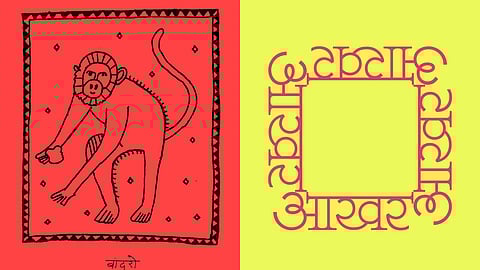
Project Aakhar, initiated by Jaipur-based Studio Damu, explores the deep connection between language and culture by reimagining Rajasthani words in contemporary contexts. Founded by Damini Rathore and Sandeep, the project brings together a multidisciplinary team to document and reinterpret colloquial expressions, idioms, seasonal references, and sounds of the region. Organised into thematic categories, from nature and emotion to folklore and everyday speech, the archive captures the lived realities embedded in language. Through print formats like stickers, posters, and postcards, Aakhar transforms spoken words into visual artefacts, making them accessible and relevant. Moving beyond preservation, the project emphasises continuity, allowing language to evolve through design.
Language holds the cultural texture of a place, one of the most important threads of its cultural fabric. It carries the nuances of relationships that often cannot be translated without losing something essential, it becomes a mode of seeing how a community understands the world. A single word can hold geography, climate, caste, class, memory and certain emotions exist more fully in one language than another.
To pay attention to language is to magnify culture at its more textured, everyday form and to notice how identity is spoken into existence. Project Aakhar, commissioned by Jaipur-based Studio Damu the initiative brings together a multidisciplinary team to attempt to translate not just language, but its living, breathing context.
Started by Studio Damu’s founder, Damini Rathore and her friend Sandeep, Project Aakhar is an attempt to bring regional languages into contemporary contexts. Starting with the Rajasthani language, which is where the studio is based out of, Aakhar means ‘word’ in English. The multidisciplinary team researched heavily on the colloquial words of the region. As Shah puts it, “The culture of Rajasthan is truly unique, with a deep connection to its language, dialects, and traditions. Through this initiative, we present Rajasthani words, sayings, and sounds in refreshing new forms, so that they become a part of everyday life.”
The words and phrases themselves are organised into six distinct categories, reflecting the breadth of everyday life they emerge from. There are those rooted in the natural world, like plants and animals like खेजड़ी, रोहिड़ा, or the descriptive कंठी पर मोर बोले. Others explore emotion and intimacy, with phrases such as काळजे री कोर or लाज घणी आवे, alongside more conversational expressions like काई करे छे? The different phases of the year appear in seasonal words like सियाळो, ऊनाळो, and चौमासा, while the voices of Rajasthan come alive through folk instruments such as the रावणहत्था, कमायचा, and मोरचंग. There are also categories dedicated to reading and writing, like किस्सा खा’णी, and to idioms and proverbs that are indicative of the —phrases such as अकेलो चनो भाड़ कोनी फोड़ सके or आशा अमर धन. Together, these categories map not just language, but an entire ecosystem of thought, memory, and lived experience.

In its first phase, Aakhar explores these words through print applications, stickers, posters, and postcards that translate spoken language into tangible, visual forms. These formats make the project accessible and portable, allowing language to move beyond conversation and into everyday spaces. The next phase looks to expand both the archive and its materiality, delving deeper into the lexicon while also experimenting with traditional print techniques such as screen printing and block printing, building on the digital formats the project began with. This shift is it mirrors the project’s larger intent to bridge the old and the new, not just in content but in process.
What makes this effort particularly compelling is its refusal to treat language as a relic. Too often, conversations around regional dialects are framed in terms of loss, what is disappearing, what must be saved. While Aakhar acknowledges this fragility, it also shifts the focus toward continuity. It recognises that language survives not just through documentation, but through reinvention and relevance. By placing these words within contemporary design practices, the project ensures that they are not frozen in time, but allowed to evolve
Aakhar reminds us that language is one of the most intimate ways in which culture persists. It lives in small, everyday moments: in a phrase overheard in a marketplace; in a saying passed down within a family; in the texture of a word that feels untranslatable but deeply understood. To engage with language, then, is to engage with memory, identity, and community all at once. And perhaps that is what makes projects like this necessary. They restore the immediacy of language, bringing it back into circulation, where it can once again be spoken, seen, and felt, threading itself powerfully through the fabric of everyday life.
The team behind Project Aakhar:
Mumal Tanwar - Researcher
Pavitt Kaur, Illustrator
Sandeep Ratnoo - Researcher
Shreya Maheshwari, Type Designer
Sourav Kumar, Type Designer
