
- HOMEGROWN WORLD
- HGCREATORS
- HGEXPLORE
- HGVOICES
- HGSHOP
- CAREERS
- ABOUT US
- CONTACT US

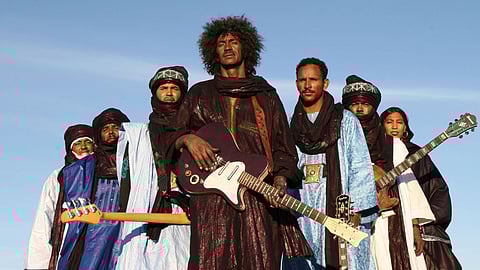
Born in exile and shaped by war, Tinariwen transformed the music of the Sahara into one of the most influential global sounds of the 21st century. From cassette recordings in Muammar al-Gaddafi’s military camps to a Grammy-winning career, the Tuareg collective’s hypnotic ‘desert blues’ chronicles displacement, resistance, and survival. Tinariwen are historians of a stateless people — carrying the memory, rhythm, and rebellion of the Tuareg people across borders and generations. The band will return to India for the inaugural edition of the India Jazz Project in February 2026.
The sound of Tinariwen is the sound of the vastness of empty space. It is the sonic equivalent of a horizon that stretches to infinity; a rolling, hypnotic groove of interweaving guitars that mimics the gait of a camel across the Saharan desert. But take a closer look at the men behind the tagelmusts or traditional veils of Tuareg, and you’ll see more than musicians: you will see survivors of a history written in blood; a histroy of migration, displacement, and resistance.
For over four decades, this Blues collective from northern Mali and southern Algeria has been the voice of the Tuareg people. They are the architects of Tishoumaren, or ‘desert blues’ — a genre born around campfires in refugee camps and, paradoxically, within the military training grounds of the late Libyan autocrat Muammar al-Gaddafi.
Today, Tinariwen stands as one of the most vital bands on the planet — they are cultural ambassadors who have counted Thom Yorke, Carlos Santana, and Bono among their disciples. With their acclaimed 2023 album Amatssou and a major tour of India slated for February 2026, Tinariwen are proving that while the geopolitical maps of the Sahel may shift, their music remains eternal.
Children of War
To understand the enduring mystique of Tinariwen, one must understand the trauma that birthed it. The band’s founder, Ibrahim Ag Alhabib, was only four years old when he witnessed the execution of his father during the 1963 Tuareg uprising in Mali. It was a brutal introduction to a life defined by exile.
Wandering between refugee camps in Algeria and the deserts of Tamanrasset, the young Alhabib constructed his first instrument from a plastic water can, a stick, and fishing wire. It was a testament to the resourcefulness that defines the Tuareg spirit. Influenced by Western films featuring cowboy guitarists and the traditional melodies of his people, Alhabib began to forge a sound that was entirely new: a fusion of the ancient and the electric.
The Guitar as a Weapon
By 1979, Alhabib had acquired a real acoustic guitar and formed the kernel of the band with Alhassane Ag Touhami and the Ag Ablil brothers. They called themselves Kel Tinariwen — meaning ‘The People of the Deserts’. But the true crucible of their formation was Libya in the early 1980s. Recruited into Colonel Gaddafi’s military camps along with thousands of other young Tuareg men, they were promised a future fighting for an independent Tuareg state.
In the barracks, they held Kalashnikovs by day and Fenders by night. They built makeshift studios and recorded on blank cassettes provided by anyone who wanted to hear them. These tapes traveled along the “ghetto-blaster grapevine”, circulating through the Sahara like contraband. They didn’t just carry music; they carried news, poetry, and calls to arms. In a region without a written press, Tinariwen became the journalists of the revolution.
The Invention of Desert Blues
Critics have long sought terms to categorise Tinariwen’s sound, variously described as ‘Saharan Rock’; ‘Assouf’, meaning nostalgia or longing, or the ubiquitous ‘Desert Blues’. The music shares a DNA with American blues, a fact often attributed to the genre’s West African roots coming full circle. But Tinariwen’s approach is distinct. It lacks the standard 12-bar structure, replacing it with cyclical, trance-inducing grooves.
Their style is a cat’s cradle of melody: rhythm guitars lock into a galloping beat, mimicking the motion of travel, while lead lines ululate and growl, answering the call of the vocals. It is music that feels ancient, yet bristles with the swagger of Jimi Hendrix and the raw electricity of Ali Farka Touré.
For decades, this sound was a local secret. But that changed with the turn of the millennium. Their appearance at the inaugural Festival au Désert in 2001 and the release of The Radio Tisdas Sessions (2002) exploded their nomadic isolation. Suddenly, the Western rock elite realized that the coolest band on earth wasn’t from Brooklyn or London, but from Kidal.
From the Tassili Desert to Grammy Glory
If the early 2000s were their introduction to the world, 2011’s 'Tassili' was their ascension to becoming Blues legends. Seeking to reconnect with the essence of their art, the band retreated to the Tassili n’Ajjer plateau in southeastern Algeria — a lunar landscape of rock and silence.
Recording outdoors in a tent, with acoustics provided by the canyon walls, Tinariwen stripped away the electric feedback for a warmer, acoustic-driven sound. The album was a masterpiece of atmosphere, capturing the intimacy of the campfire sessions where they began. It earned them the 2012 Grammy Award for Best World Music Album, a win that cemented their status not only as world music curiosities but as peers to the rock giants they once admired from afar.
Beyond Fear: 'Amatssou' and the Future
Tinariwen has never had the luxury of being just a band. In 2012, as they celebrated their Grammy win, their homeland collapsed into chaos again. Islamic fundamentalists and separatist rebels seized northern Mali. The music that had fueled the revolution was suddenly banned by extremists who saw it as Satan’s music.
The band was forced into exile once again, recording albums like 'Emmaar' and 'Elwan' in exquisite sadness away from home. Yet, their creative fire remains burning. Their latest offering, 2023’s 'Amatssou' (meaning ‘Beyond Fear’), sees them traversing new frontiers. Produced by Daniel Lanois (U2, Bob Dylan), the album draws a fascinating line between the Sahara and the American South, incorporating banjo, fiddle, and pedal steel. It is a record of ‘outlaw country’ in the truest sense — songs from men who exist outside the law, in the liminal spaces beyond sonic, social, and geopolitical borders.
The band’s evolution continues as they look toward the East. Tinariwen has announced a highly anticipated return to India for the inaugural India Jazz Project in February 2026, with dates in Delhi NCR, Mumbai, and Bengaluru. The band has spoken of a strong connection with Indian audiences, noting a shared understanding of the intricate grooves that transcend language.
The Legacy of the Empty Spaces
Today, Tinariwen’s influence is undeniable. They have paved the way for a younger generation of Saharan rockers like Mdou Moctar and Bombino, creating a viable global market for Tuareg music. But their greatest legacy is the message they carry.
In their lyrics, the call for armed struggle has largely given way to pleas for unity and the preservation of culture. Songs like ‘Assadagh Tamasheq’ urge their people to wake up to a changing world, to hold onto their identity amidst the encroaching void.
Tinariwen remains a miracle of modern music: a band born in war, forged in exile, and sustained by the sheer power of the groove. They remind us that in the ‘empty spaces’ (the literal translation of Tinariwen, the Tuareg word for the desert), there is boundless life, there is resistance, and above all, there is the blues.
Listen to Tinariwen here:
Follow Tinariwen here.
If you enjoyed reading this, here’s more from Homegrown:
Karshni Nair’s New Single Confronts The Politics Of Language, Power, & Consent
Meet The Indian Raga Rock Maestro Who Jammed With Jimi Hendrix & The Doors
Mary Ann Alexander's New Single Lays Bare The Art Of Intimacy
