
- HOMEGROWN WORLD
- HGCREATORS
- HGEXPLORE
- HGVOICES
- HGSHOP
- CAREERS
- ABOUT US
- CONTACT US

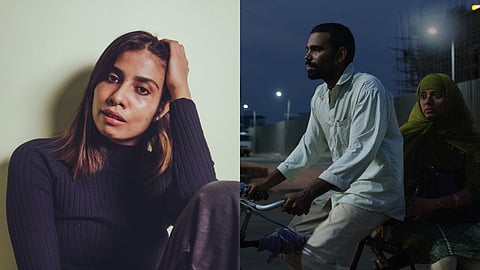
Speaking to Homegrown from Mumbai, filmmaker Anuparna Roy discussed the personal memories, political realities, and encounters with migration, class, desire, displacement, and language that shape her filmmaking as she heads to the Venice International Film Festival for a second consecutive year with her film ‘Lovers in the Blue Night’.
A river runs through Anuparna Roy’s films. You may not see it, but it is always there, flowing below the surface like an undercurrent. It comes from a story about her grandmother — a woman who, Roy says, spent her life talking about rivers. It was only after her death, when her body was taken to a river for her last rites, that Roy found out the old woman had never seen one. “It broke my heart,” she says. “I realised that she had never been allowed to go out and experience that beauty herself.”
In Roy’s telling, this is the origin of her filmmaking: a woman’s radical act of imagining a world society refused her, and the emotional foundation of her first short film, ‘Run to the River’. It has continued to flow through everything she has made since. In her debut feature, ‘Songs of Forgotten Trees’ (2025), a flood forces the protagonist Thooya’s childhood best friend Jhuma’s family to move away, and even after Thooya herself moves to Mumbai from rural Assam, she keeps searching for Jhuma in the chaos of the city.
Last year, ‘Songs of Forgotten Trees’ won Roy the Best Director Award in the Orizzonti Competition at the 82nd Venice International Film Festival, making her the first Indian filmmaker to receive the honour. This year, she returns to Venice with her second feature, ‘Lovers in the Blue Night’ (2026), selected once again for the Orizzonti Competition. Speaking to Homegrown from Mumbai, Roy discussed the personal memories, political realities, and encounters with migration, class, desire, displacement, and language that shape her filmmaking.
Set in Mumbai’s nocturnal margins, ‘Lovers in the Blue Night’ follows four migrants — Karim, a closeted gay man; his wife Ameena, a phone sex worker; the small-time thief and political fixer Sukka; and the pimp Omran — whose lives intersect through deception, intimacy, survival and the persistent desire to become someone else.
“The film draws from my own life as a migrant, watching working-class lives slowly dissolve into the restless pulse of the city,” Roy says. “It is about people who dare to desire in a world that punishes feelings: a gay man bound by duty, a woman yearning to be seen, and a thief craving acceptance. For me, ‘Lovers in the Blue Night’ explores the courage it takes to love for too long, even when the city refuses to look back.”
“As a filmmaker, I have always been drawn to stories that are deeply personal and political,” Roys says. “As a child, I knew a woman named Ameena, who worked as a bonded labourer in my hometown. She became my constant companion. One day, I innocently asked her why she and her husband Karim never slept together. She quietly replied, ‘He doesn’t take me with him.’ I did not understand what she meant then, but the moment stayed with me. Through this film, I wanted to carry that memory into an imagined Mumbai, where Ameena chooses her own freedom and desire, and lives the life she wants — even if that freedom leads her into another kind of loop, one that she finally chooses.”
The remarkable speed of Roy’s mercurial rise risks obscuring the more interesting aspect of her filmmaking practice: her preoccupation with the relationship between private life and public structures. Her films begin in intimate domestic spaces but refuse to remain contained. Their interior lives spill into the city. In Roy’s cinema, the personal becomes political through proximity: cramped apartments, neon-lit brothels, the backseat of a shared cab, and suddenly the vast expanse of the sea and the smallness of a lonely man standing before it.
These are the markers of an auteur in the making — a filmmaker with unusual clarity about her cinematic world, even while she remains honest about still mastering the craft. Her films return to a recognisable constellation of concerns — migration, desire, displacement, intimacy and belonging — while allowing each story to find its own form.
“My mentors taught me to study Third World cinema closely and helped me articulate those ideas. I don’t see writing and filmmaking as two separate selves. They come from the same impulse,” she says.
When ‘Songs of Forgotten Trees’ was selected for Venice, however, Roy was still learning how the system worked.
“When Songs (of the Forgotten Trees) was selected, we were all shocked because we didn’t expect it,” Roy says. “I hadn’t even told the rest of the team that I’d sent the film to Venice. I was so inexperienced that I wrote to them asking, ‘Did you watch my film? Can you give me feedback? It’s okay if it isn’t selected; tell me what you think.’ I was looking for validation in the beginning, and we were all very inexperienced. The whole journey was unpredictable. Now we know a little more about how things work. This time, we’re going with a strategy. We want to meet producers, bring different scripts, and pitch them. In some ways, I’m a little less excited because I understand the process better.”
“The film is also going to Busan, and that journey will probably feel more like our first Venice experience,” she says. “I’m also going to Busan as a juror, which is a huge responsibility. I’m nervous and scared, and I don’t know what’s going to happen, but I hope it will be fun.”
As both a writer and filmmaker, Roy says her films often begin with an image. “The form is sometimes a retrospective discovery. But in my case, I try to understand the most personal element within every narrative I encounter or write. Usually, it begins with a particular image.”
“My first film began with the image of a little girl watching a river with her widowed friend in the 1930s,” she says. “That was the only image I had initially. I had no script. The story developed from there, and the whole team helped me understand how to structure and script it. So, for me, filmmaking often begins with an image.”
This image-led approach explains something fundamental about her films. Roy is less interested in narrative architecture than emotional atmosphere. Her characters emerge gradually through gestures, silences and fragments of biography. She is interested in what people do around each other before they can articulate what they feel.
This is especially true of ‘Songs of Forgotten Trees’, which largely takes place within a Mumbai apartment shared by two women. Roy builds their intimacy through domestic gestures of cooking, washing clothes, singing, and occupying the same space.
“‘Songs of Forgotten Trees’ also came from a very personal experience,” Roy says. “I felt that love exists beyond gender and cannot be bounded by it. Most of the films I write are deeply personal, and after a point, those personal experiences become political.”
‘Lovers in the Blue Night’ extends this approach into more turbulent territory. Its four characters are connected by what Roy calls a world that “punishes feelings”.
“I wanted these characters to collide in the story and explore how survival becomes the most important thing in a country where people are constantly running from one place to another. Nobody really talks about internal migration. People talk about migration across borders, but for me, internal migration is equally, if not more, important.”
Migration is the material condition of the film’s working-class protagonists.
“Who can move freely? Who is forced to move? Who is allowed to belong?” Roy asks. “For me, belonging is critical, and so is migration. As a migrant, I don’t see belonging as a fixed place. I see it as a question of rights, access and dignity. For me, belonging and migration are deeply political.”
This framework complicates the film’s treatment of its Bangladeshi migrant characters, Ameena and Karim. Roy initially considered leaving their origins ambiguous, allowing the possibility that they might be Bengali migrants within India who are assumed to be Bangladeshi and persecuted for their identity. But her experiences documenting climate refugees on Ghoramara Island in the Sundarbans pushed her toward specificity.
“I spent time in Ghoramara in the Bay of Bengal and encountered numerous Bangladeshi families who were continuously migrating from one place to another because of social circumstances, climate change or other forces that compelled them to move in order to survive,” she says.
Language becomes another register of migration. Alongside Hindi, ‘Lovers in the Blue Night’ incorporates Sylheti Bengali and Marathi, resisting the linguistic flattening through which Mumbai is often represented. In ‘Songs of Forgotten Trees’, Roy worked with actor Naaz Shaikh, who is Assamese, to write her character Thooya’s Assamese lines. For ‘Lovers in the Blue Night’, she wrote Karim and Ameena’s dialogue in Bengali and had it translated into Sylheti.
“The actors spent three months learning the language to portray the lives of Sylheti Bengalis,” she says.
Social realism in Indian cinema has long faced the accusation of romanticising poverty. The criticism directed at filmmakers like Satyajit Ray, Ritwik Ghatak, and Mrinal Sen often concerns how images of Indian suffering circulate internationally, suggesting that poverty becomes meaningful only when rendered as an aesthetic image for elite audiences.
Roy is aware of this problem. While making her first short film, ‘Run to the River’, she removed oranges from a tree in the courtyard of a tribal home where she was shooting, believing the abundance did not fit her vision of poverty. She now regrets the decision, recognising how a rigid visual vocabulary had shaped her understanding of deprivation. Her mentors urged her to look beyond “upper-class nostalgia” and understand the social and political context of her characters’ lives.
Her later work reflects this unlearning. The working characters in both ‘Songs of Forgotten Trees’ and ‘Lovers in the Blue Night’ are not simply suffering stereotypes of perfect victimhood; they are flawed, selfish, and ambitious without moral sainthood. In ‘Lovers in the Blue Night’, Omran is an impostor who manipulates others, but Roy resists labelling him as antagonistic or innocent. She believes that portraying infidelity or transgression shouldn’t serve as moral judgment, and characters shouldn’t need to pass a moral test to have depth.
It’s tempting to think of Roy’s cinema as gentle. But while that description is not wrong, it is incomplete. Omran is a great example. A victim of communal violence, he believes in survival at all costs, and Roy refuses to contain him within a familiar moral category. On the surface, he is deceptive, opportunistic and capable of manipulating another person’s emotional life. Yet, Roy insists on looking beyond the “monotonous stereotypes” through which such characters are usually understood in Indian cinema. Roy does not excuse his actions, but neither does she treat them as the sum of his identity. The glimpses of a larger, politically charged history behind him complicate his apparent antagonism, making ‘Lovers in the Blue Night’ more than a straightforward story of victims and villains. In Roy’s hands, Omran becomes emblematic of a new Indian cinema interested in contradiction — examining how survival can demand performance, deception, and moral compromise without erasing a person’s capacity for desire, vulnerability, or interiority.
All these threads come together in Roy’s cinematic re-imagination of Mumbai as a restless landscape of perpetual becoming. Her Mumbai is inhabited by people in transit — across borders, states, languages, genders and versions of themselves — whose lives intersect because the city forces them into proximity. Migration, climate displacement, communal violence, queer desire and economic precarity become inseparable from its geography.
Yet Roy does not reduce Mumbai to a metaphor for suffering. The city’s margins are also spaces of intimacy, deception, fantasy and possibility. Its night allows identities to loosen, if only temporarily, and strangers to imagine other lives for themselves. In bringing together the political histories that shape her characters with the private desires that exceed them, Roy creates a Mumbai that is neither romanticised nor condemned. It is a city of collisions: between survival and freedom, performance and identity, longing and belonging. It is here, within these unresolved collisions, that Roy’s films find their emotional and political force.
Anuparna Roy’s ‘Lovers in the Blue Night’ will premiere at the 83rd Venice International Film Festival on 10 September 2026 for pass holders and 11 September 2026 for the public. Learn more here.
