
- HOMEGROWN WORLD
- HGCREATORS
- HGEXPLORE
- HGVOICES
- HGSHOP
- CAREERS
- ABOUT US
- CONTACT US

‘Wings and Tales’, Vikram Goyal's first solo show in London, celebrates India's craft heritage through repousse furniture, textiles, and carpets. Inspired by the Ramayana, the collection explores themes of loyalty and coexistence. Set in a baithak-style space within a Georgian townhouse in Mayfair, London, the exhibition offers an intimate, interactive experience, blending tradition and storytelling with contemporary design.
Over the years, Vikram Goyal has carved a niche in the luxury home decor space with his signature repousse furniture. After marking a strong presence at the Milan Design Week last year with a capsule collection of meticulously crafted, limited-edition pieces representing a fascinating bridge between India’s ancient artisanal techniques and vibrant contemporary creativity, the Indian designer is presenting ‘Wings and Tales’, his first solo exhibition in London, coinciding with Frieze and PAD London. On view from 12 to 16 October 2026 at 7 Grafton Street, a Georgian townhouse in Mayfair, the immersive installation brings together furniture, decorative objects, textiles and carpets inspired by the mythological world of the Sanskrit epic Ramayana.
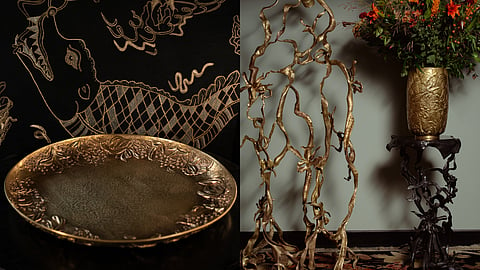
Drawing on the epic’s expansive world of real and mythical flora, fauna, and fantastical landscapes, Goyal explores ideas of friendship, loyalty, empathy, and coexistence through the exhibition. Monkeys, crocodiles, vultures, and the mythical makar — a half-crocodilian fantastic beast — populate the collection, appearing across sculptural brass screens, upholstered seating, tables, vessels, carpets, and decorative objects.
The creatures do not only serve as ornamental motifs: they symbolise moral aspects of the epic’s universe. The Vanara, or forest-dwelling monkeys, evoke collective labour, while the anthropomorphic vulture Jatayu embodies the courage to intervene in the face of danger. Through these more-than-human characters, Goyal builds an imaginative visual language around the epic and its relationship with the natural world.
According to design curator and historian Glenn Adamson, “Goyal’s formal vocabulary, too, is a complex bridge between past and present. The ornamental intensity, fine craftsmanship, and multiplication of motifs in his furniture are all informed by Indian and Ottoman miniature paintings, while his carpets have the bold contours of clouds in Chinese embroideries and porcelains. Throughout the exhibition there are evident affinities to Art Deco, a synthetic movement in its own right, in which geometric and organic, European and Asian idioms were all combined.”
India’s rich and diverse craft heritage remains central to Goyal’s practice. His signature repoussé technique, in which metal is hammered from the reverse to create raised reliefs, is complemented here by handmade brocade upholstery, embroidery, hand-knotted rugs, and mother-of-pearl marquetry. The collection draws from an expansive visual vocabulary encompassing Indian miniature painting, Silk Road textiles, as well as Ottoman and European Art Deco influences.
The exhibition itself is conceived and designed as a baithak — a traditional Indian drawing room and a space for gathering. Across two interconnected rooms, Goyal’s richly textured seating, intricate brass screens, and layered textiles create an intimate domestic setting that gradually opens into a more communal environment inspired by Madhuvana, the sacred forest home of the Vanaras. Unlike a conventional gallery display, the installation invites visitors to sit, spend time, and encounter the works as part of a lived-in interior. A programme of salon-style conversations with writers Sam Dalrymple, author of Shattered Lands, and Gurnaik Johal, author of Saraswati, complements the exhibition which positions design as a vehicle for storytelling and cultural exchange, bringing an ancient epic into dialogue with contemporary life.
‘Wings and Tales’ will be on view from 12 to 16 October 2026, 10 am–6 pm local time, at 7 Grafton Street, Mayfair, London. Follow @vikramgoyalstudio on Instagram for more.
