
- HOMEGROWN WORLD
- HGCREATORS
- HGEXPLORE
- HGVOICES
- HGSHOP
- CAREERS
- ABOUT US
- CONTACT US
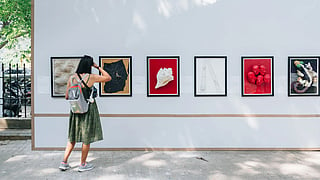

Explore a vibrant end to the year with a curated guide to art festivals, exhibitions, and biennales across India. From Art Mumbai’s modernist showcase to the Bengal Biennale’s ecological explorations and the Serendipity Arts Festival’s multidisciplinary performances, these events celebrate creativity, culture, and community through diverse artistic expressions.
We live in interesting times, as the internet’s favourite Chinese curse goes. As questions of identity, ecological precarity, political polarisation, and the preservation of collective memory increasingly shape India’s cultural landscape, contemporary artists offer ways to examine the anxieties and contradictions of the present. Across the country, a new season of exhibitions, art fairs, and biennales is bringing together artists, institutions, independent practitioners, and the public to engage with these questions, often looking beyond the white cube to the histories, communities, and landscapes that shape creative expression.
From the Bengal Biennale’s exploration of ecology and buried histories to Pampa: Textiles of Karnataka’s examination of craft as a living repository of cultural memory, these presentations reveal how art can make visible the connections between people, place and inherited knowledge. Meanwhile, tentpole events such as Art Mumbai, the Serendipity Arts Festival, and the India Biennale are expanding the possibilities for public engagement with contemporary practices, bringing different disciplines, generations and geographies into conversation. Here are the exhibitions and cultural festivals across India worth making time for before the year draws to a close:
Returning for its fourth edition from 12 to 15 November 2026 at Mumbai’s Mahalaxmi Racecourse, Art Mumbai brings together leading galleries, artists and cultural institutions for a showcase of modern and contemporary art. This year’s highlights include the Kiran Nadar Museum of Art’s continued partnership with the fair’s Speaker Series and learning programme, and Emami Art’s presentation of 18 artists across generations. Great Banyan Art makes its debut with ‘Beneath the Surface: Indian Modern Abstraction’, bringing together 14 modernists, including F. N. Souza, Sohan Qadri and G. R. Santosh. Other notable presentations include LATITUDE 28’s exploration of belonging, land and memory; Blueprint12’s ‘Unknowing’, featuring 11 artists; and Anant Art’s engagement with personal memory and social realities. Art Alive Gallery presents works by 12 artists alongside drawings by modern masters, while The Gujral Foundation showcases Satish Gujral’s monumental bronze sculpture Nandi, Bull. Harpreet Narula also presents new abstract paintings informed by architecture, textiles and memory. Learn more here.
The second edition of the Bengal Biennale returns with ‘Banalata’, a curatorial premise drawing on Jibanananda Das’s 1942 poem Banalata Sen and the Bangla term for a wild forest vine. Exploring the intersections of ecology, buried histories, memory, resistance, and collective survival, this year the biennale approaches the work of art as a way to understand the interconnectedness of human and non-human worlds. Moving beyond conventional exhibition spaces, Banalata will take place across sites in Kolkata and Santiniketan, including former prisons, heritage buildings, museums, studios and parks. Participating venues include the Alipore Museum, Indian Museum, Victoria Memorial, Kolkata Centre for Creativity, Nandan Art Museum & Gallery, Arthshila, Somnath Hore Studio and Santiniketan Society of Visual Art & Design, among others. Co-curated by Ritika Biswas and the Chander Haat collective, the biennale brings together poetics and politics to consider new forms of kinship, solidarity and resilience in an increasingly polarised and ecologically precarious world.
Learn more here.
Exhibit 320 presents ‘Moving Between Fixed and Flow’, a solo exhibition by Delhi-based artist Barkha Gupta, on view till 30 November 2026 at its Lado Sarai gallery. Marking the launch of PLATFORM|Exhibit 320, a new initiative dedicated to showcasing emerging artists, the exhibition brings together works developed during Gupta’s residency at Hampi Art Labs. Drawing on her engagement with the landscape, Gupta explores how memory transforms the experience of place through texture, colour, light, and patterns. Moving between drawing, ceramics, and embroidery, her practice considers the relationship between mark-making and acts of cultivation, with individual ceramic tiles functioning as fragments of terrain that come together to form larger visual landscapes. The works sit in the tensions between structure and spontaneity, repetition and variation, and the fixed and the constantly changing, while reflecting the artist’s ongoing engagement with material histories and traditional craft practices.
Learn more here.
Returning for its seventh edition from 20 November to 20 December 2026, the AMI Arts Festival, an initiative of Kolkata Centre for Creativity in association with Emami Foundation, takes place across 10 venues in Kolkata and Santiniketan. Rooted in the Bengali word ‘ami’ (I), the festival explores how individual identities connect with collective cultural experiences through exhibitions, theatre, music, performances, talks, workshops and residencies. The seventh edition’s highlights include ‘My Gaze’, a photography exhibition by veteran actor Aparna Sen; ‘Jal, Jangal, Jamin: A Gathering of Indigenous Voices’ at the Indian Museum; and ‘Karigari 7.0’, celebrating India’s arts and crafts traditions. The theatre programme features productions directed by Koushik Sen, Seema Bhargava Pahwa, and Lillete Dubey, while the music lineup includes performances by Kaushiki Chakraborty, Parvathy Baul, Sonam Kalra, and The Raghu Dixit Project. The programme also includes a symposium celebrating playwright Badal Sircar, a film-scoring residency facilitated by Neel Dutt, and workshops exploring Rabindrasangeet and Rabindranritya.
Learn more here.
‘Mouth Open. No Time to Breathe’, a group exhibition curated by Jasone Miranda-Bilbao, is on view till 6 December 2026 at Thapar Gallery, New Delhi. Bringing together artists Anna Brass, Billy Crosby, Dheer Kaku, Ole Hagen, Niroj Satpathy, Rai, Roy Voss, and Sonia Khurana, the exhibition examines how speed, bodily sensation, and movement transform our perception of space, distance, and time. Taking the fleeting experience of a skier suspended mid-air as its point of departure, the exhibition explores the paradox of high-speed movement, in which time appears to slow down, and familiar distinctions between near and far begin to dissolve. Extending this experience beyond skiing, the participating artists examine the relationship between the body, its surroundings, and the materiality of the environment. The exhibition invites visitors to reconsider how movement can alter their experience of the world.
Learn more here.
Curated by Lavina Baldota, Mayank Mansingh Kaul, and Nupur Saxena, ‘Pampa: Textiles of Karnataka’ brings together more than 150 textiles, garments, artworks, and installations into dialogue across historical collections and the work of contemporary artists, designers, and master weavers. This exhibition traces four hundred years of handmade and hand-patterned textiles across Karnataka, from the 17th century to the present. On view at the National Gallery of Modern Art, Bengaluru, it is the first major exhibition in the city to examine the histories and current trajectories of Karnataka’s handmade and hand-patterned textiles. The exhibition explores the region’s varied traditions of spinning, weaving, dyeing, printing, embroidery, and surface embellishment through three sections: Materials, Making, and Meaning. Highlights include Ilkal sarees, Kasuti embroidery, Lambani textiles, Khann brocades, and Molkalmuru silks, along with studies of indigenous sheep’s wool, naturally dyed cotton, banana fibre and water hyacinth. Taking its name from an ancient term for the Tungabhadra River and an epithet of the goddess Devi, Pampa presents textiles as stores of cultural memory, community identity and artistic expression, while following how traditional practices shift through contemporary design and material experimentation.
Learn more here.
Returning to Panjim, Goa, from 13–20 December 2026 for its 11th edition, the Serendipity Arts Festival brings together artists and practitioners across disciplines for a week-long celebration of contemporary and traditional artistic practices. This year’s Performing Arts programme spans music, dance and theatre, exploring questions of identity, memory, power and belonging through performances and cross-cultural collaborations. Curated by Ankur Tewari and Aruna Sairam, the music programme features highlights such as Sitar Symphony by Pandit Ravi Chary, bringing together over 20 sitarists, and Trilok Gurtu’s tribute to vocalist Shobha Gurtu, alongside performances by Swarathma, Taba Chake and RANJ x Clifr. The dance programme, curated by Ashley Lobo and Surjit Nongmeikapam, includes Avantika Bahl’s Prime, featuring eight performers over 60, and Rubber Girl by Preethi Athreya. Meanwhile, the theatre programme, curated by Anuradha Kapur and Mahesh Dattani, features productions such as The Queen, Horse Woman River, and Dohri Zindagi, examining inherited histories, gender, and social structures. Learn more here.
The India Biennale 2026 returns for its second edition from 4 December 2026 to 21 March 2027, transforming Delhi into a 108-day cultural landscape centred around Purana Qila and extending across the capital’s historic monuments, museums, galleries and public spaces. Presented by the Ministry of Culture, Government of India, the biennale brings together contemporary art, architecture, and design under the curatorial theme ‘Tat Tvam Asi (You Are That)’, exploring our relationships with ourselves, one another, and our natural and built environment. This edition’s highlights include DAG’s Anant: A Rare 18th Century Mahabharata Scroll, Devi Art Foundation’s The Infinite Circle, and the Gujral Foundation’s A Woven Line of Control at Purana Qila and The Eternal Fold at Lodhi Garden. Other presentations include the Nita Mukesh Ambani Cultural Centre’s Kingdom of Earth, Serendipity Arts’ The Charpai Project, and Kalakriti Art Gallery’s exploration of Cheriyal scroll painting. Beyond exhibitions and installations, the programme features performances, talks, workshops, research initiatives and the inaugural Student Biennale. A new India Biennale Pass will also offer integrated access to participating monuments and cultural institutions across the city.
Learn more here.
If you enjoyed reading this, here’s more from Homegrown:
On The Grid: Two Brown Cells’ Approach To ‘Content’ Feels Like A Conversation With A Friend
‘Between Myth & Matter’ Traces The Relationship Between Myth, Material, & Memory
‘Salted Caviar’ by Parag Tandel Shines An Anthropological Spotlight On Mumbai’s Koli Community