
- HOMEGROWN WORLD
- HGCREATORS
- HGEXPLORE
- HGVOICES
- HGSHOP
- CAREERS
- ABOUT US
- CONTACT US

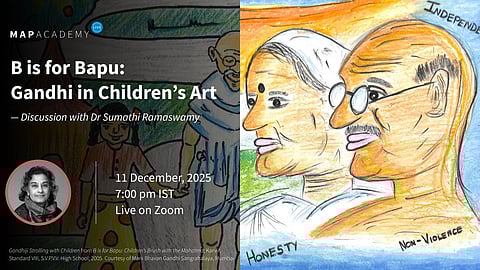
The Museum of Art & Photography’s MAP Academy is hosting a critical online workshop led by visual historian Dr Sumathi Ramaswamy that revisits Gandhi through a rare archive of children’s paintings from Mumbai’s Mani Bhavan. The session explores how young artists reimagine Gandhi through play, imagination, and national memory, while also situating these images within contemporary debates around his fraught legacies: his views on caste, race, colonial loyalty in Africa, and controversial ideas about women and sexuality.
More than seventy years after his assassination, Mohandas Karamchand Gandhi, popularly known as ‘Bapu’ (a term of endearment meaning ‘father’), remains the most reproduced figure in modern Indian history. His visage appears on Indian currency, in schoolbooks, on statues, and across political iconography. However, some of the most subversive images of Gandhi originate from classrooms across India. It is this unusual archive that forms the core of an upcoming online workshop, hosted by the Bengaluru-based Museum of Art & Photography’s MAP Academy and led by visual historian Dr Sumathi Ramaswamy, a James B. Duke Distinguished Professor of History at Duke University, USA.
Titled ‘B is for Bapu: Gandhi in Children’s Art’, the workshop draws from a collection of children’s paintings archived at Mani Bhavan Gandhi Sangrahalaya, the house in Mumbai where Gandhi once lived and directed key phases of the freedom movement. For decades, Mani Bhavan organised school competitions across the country, asking students to “draw Gandhiji”, and unlike most children’s art in India, these works were preserved in the museum’s permanent collection. Dr Ramaswamy came across these paintings by chance in 2016 and later transformed them into a major digital humanities project documenting how Indian children across generations have visually imagined Gandhi.
What emerges through this project is not a singular, historical Gandhi, but many imagined Gandhis. There is the familiar ascetic at the charkha and the iconic figure leading the Dandi march. But there is also Gandhi walking on the beach with a child, playing, cycling, or planting trees. In many of these drawings, children insert themselves directly into his world, depicting Gandhi not as a distant icon but as a companion, a guiding father figure, or a fellow traveller.
Dr Ramaswamy argues that these works are not merely “innocent” images. Indian children grow up saturated with Gandhian imagery — on banknotes, public walls, textbooks, and postage stamps. Their idea of Gandhi is already deeply ingrained in their psyche from a very young age. And yet, within those inherited images, disruptions exist: unexpected inscriptions, whimsical details, and the presence of Kasturba Gandhi appears even when not prescribed by the theme. The B Is For Bapu archive reveals how young imaginations simultaneously reproduce and subtly reshape national memory.
The workshop comes at a time when Gandhi’s legacy as a historical figure and his moral authority has come under sustained scrutiny. Today, public debate increasingly confronts the many contradictions that long softened by nationalist hagiography.
In South Africa, where Gandhi’s political career began, his early writings reveal deeply racist views toward Black Africans. He repeatedly used derogatory colonial language and argued that Indians should not be classed with Africans. During this period, he also organised stretcher-bearer units that served the British during the Boer War and the violent suppression of the Zulu rebellion, aligning himself, at least tactically, with colonial authority.
In India, Gandhi’s record on caste and gender also remains contested. While he campaigned vigorously against untouchability, he defended the broader varna system as a spiritual ordering of society, putting him in sharp and lasting conflict with Dr B. R. Ambedkar. His fast against separate Dalit electorates in 1932 resulted in the Poona Pact — a political compromise still debated for its long-term impact on Dalit political autonomy.
His views on women, sexuality, and celibacy were equally fraught. Late in life, his “experiments” of sleeping naked beside young women as a test of spiritual discipline continue to trouble scholars and feminists, raising serious ethical questions regardless of intent.
Placed against this complex and often complicated history, children’s drawings of the man known as ‘Bapu’ can feel almost dissonant. Yet it is precisely this tension that gives the Mani Bhavan archive its contemporary relevance. These images show how national icons are inherited as pliable figures shaped by emotion, pedagogy, and imagination rather than fixed historical figures.
In revisiting Gandhi through children’s eyes, the workshop opens a critical space where reverence, discomfort, and historical responsibility are forced to coexist. Foregrounding the workshop in children’s visions of Gandhi also invites a larger question: what does it mean to pass down the complicated legacies of history’s “great men” whose moral authority is now openly contested? How do societies teach young people to inherit such figures who were capable of both radical ethical clarity and profound moral blind spots?
Learn more about the ‘B is for Bapu’ project here.
‘B is for Bapu: Gandhi in Children’s Art’ will take place on December 11, 2025, at 7:00 pm IST via Zoom.
If you enjoyed reading this, here’s more from Homegrown:
The Lost Diary Of Kasturba Gandhi Sheds New Light Into The Life Of The Iconic Freedom Fighter
Why Ghana University Is Removing A Statue Of Mahatma Gandhi Following Protests Over His ‘Racism’
When Henri Cartier-Bresson Captured The Birth Of The Nation And The Death Of The Mahatma
