
- HOMEGROWN WORLD
- HGCREATORS
- HGEXPLORE
- HGVOICES
- HGSHOP
- CAREERS
- ABOUT US
- CONTACT US

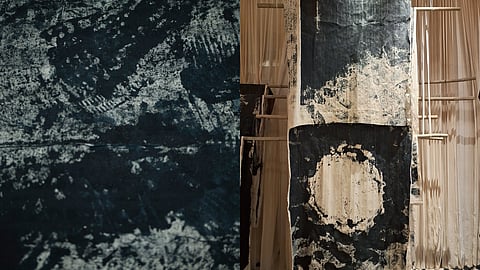
Collage x 11.11 / eleven eleven’s indigo installation, 'The Indigo Flower' places their new plant-based Indigo Paste within India’s long history of indigo cultivation and use. Once vital to the textile economies of colonial Bengal and Madras, indigo symbolised colonial exploitation, culminating in the 1859–60 Indigo Revolt. In Chennai, The Indigo Flower reclaims this pigment through community engagement, turning footprints into acts of expression rather than labour. By linking historical memory with craft, the show redefines indigo as a living, evolving textile medium in India.
Indigo has a long association with the cultural and economic history of the Indian subcontinent. Before synthetic dyes flooded global markets in the late nineteenth century, India was the world’s primary source of natural indigo, with Bengal and parts of Bihar serving as its epicentre. The colonial indigo plantations of the 18th- and 19th centuries extracted not only colour from the land but also forced labour from farmers, culminating in the Indigo Revolt of 1859–60, one of the earliest organised peasant uprisings against British rule. The dye’s luminous blue colour, celebrated by dyers, artists, and artisans for millennia, became, under colonial capitalism, the colour of exploitation.
But indigo’s history in India is not only about oppression; it also highlights indigenous innovation, knowledge systems, and resilience. Different regions cultivated unique dyeing traditions using the plant-based pigment: Bengal was known for its intricate resist-dye textiles and mordant methods, while Madras had a long-standing weaving culture focused on cotton, handlooms, and trade. Both regions played vital roles in British India’s textile economy, creating fabrics that travelled globally and supported local artisan communities and craft traditions.
Presented by Collage — a carefully curated, multi brand luxury fashion store in Chennai — as a parallel show to the Madras Art Weekend 2025, ‘The Indigo Flower’ is an installation that is an embodied reckoning of this history: a return to a pigment that once stained the subcontinent’s soil with both beauty and violence. 11.11’s groundbreaking indigo installation, marking the launch of their plant-based Indigo Paste and the Indigo Flower collection, invites viewers to stand inside a story that India has carried for centuries — one where craft, colonialism, labour, resistance, and revival are all sedimented into a single hue.
The installation is based on more than ten years of research at 11.11’s Colour Lab, which has extensively studied plant-based pigments like indigo, sappan wood, rubia, marigold, pomegranate, and harda. Their experimental approach persists in the FW’25 collection, showcased at Collage, combining abstract shibori, miniature bandhani, and detailed tie-resist techniques on silk, velvet, wool blends, and cotton
By working with Indigo Paste — a material that transforms indigo from a dye to a medium for printing, drawing, and large-format mark-making — the brand opens up a new chapter in the dye’s long and many-layered life. The installation’s centrepiece, titled ‘The Indigo Flower’, invites participants to walk through trays of Indigo Paste to create footprint-driven artworks. Each impression becomes an echo of the very labouring bodies once trapped within colonial indigo economies, now reimagined as agents of expression, community, and play.
“Collage has always been a space where craft meets contemporary culture. Hosting 11.11’s Indigo Installation allows us to highlight the power of materials, the future of sustainable textiles and the evolving language of Indian design. As Chennai’s design landscape grows more engaged with experimental art, we see this installation as a marker of how tradition can be reimagined for a new generation.”
Lata Madhu, Founder, Collage
At Madras Art Weekend, held across Chennai — formerly Madras — from December 3-6, 2025, this activation takes on greater significance. The city has a long history as a textile centre, from its famous Bleeding Madras, exported worldwide, to its strong handloom traditions rooted in South Indian cotton cultures. Hosting the indigo installation here reconnects the dye with one of its historical maritime routes, now in a spirit of collaboration rather than extraction.
By highlighting indigo as a contemporary art material, 11.11 — a craft-driven, natural-dye-focused fashion brand — reclaims the pigment once used for colonial exploitation through craft innovation. Through community, research, and experimentation, the installation offers a counter-narrative: India’s textile heritage is a living, evolving archive that continues to adapt, resist, and reinvent itself in the hands of new makers.
Collage presents ‘रञ्ज् | Rañj’ — meaning ‘to dye’, or ‘to infuse colour’ — unveiling the new Indigo Flower line by 11.11 in a parallel show during Madras Art Weekend, on view from December 3-6, 2025, 11:00 AM to 7:30 PM at Collage, Chennai.
Madras Art Weekend is taking place across Chennai from December 3-6, 2025. For more information, follow @madrasartweekend.
Follow Collage here.
Follow 11.11 here.
If you enjoyed reading this, here’s more from Homegrown:
From Empire To Intimacy: Radhika Surana’s Textile Art Explores The Politics Of Indigo
The Indigo Revolt: When Colonial-Era Bengali Farmers Rebelled Against The British Raj
Auroville’s ‘The Colours of Nature’ is Bringing Indigo Dyeing Back to Life
