
- HOMEGROWN WORLD
- HGCREATORS
- HGEXPLORE
- HGVOICES
- HGSHOP
- CAREERS
- ABOUT US
- CONTACT US
Founded in 2004 by Namu Kini and Vivek Radhakrishnan, KNYKNY’s 'The Urban Biome' is the gallery’s debut Mumbai exhibition. The exhibition presents a very well-curated world of how nothing exists in isolation, and how we, as humans, interact with the various elements in our surroundings.
Through the worlds of Simran Yagnik, Hemanth Kumar, Krisha Bhuva, Sunil K and N Divya and Nivedita Shinde, we see different interpretations of how humans interact with the spaces, objects, animals and landscapes around them.

The curation by gallery co-founder Vivek Radhakrishnan brings together various artistic representations of a central theme: humans interacting with their surroundings and the impact of our existence on them. The artists capture different touchpoints that come together to create a holistic interpretation of the urban biome, while still being deeply informed by their individual practices and points of view.
When you enter the space, the collection starts off with the works of Simran Yagnik. Her works feel oddly familiar, showing stills of our daily lives, scenes that we create and interact with but rarely notice. Works such as Shape of Clutter, Reserved for Later and I've Been Here Before, Haven't I? show very familiar scenes of how we interact with our spaces and the objects we own without really noticing them.
Through the textures, imperfections and creases of sheets, rooms and objects, the paintings create a sense of familiarity. They capture the small details within spaces that we have become accustomed to, making us realise how little attention we often pay to the environments we occupy every day. There is something interesting about seeing these otherwise mundane scenes painted and presented to us, because they make us pause and look at a space we already know.
As I walked further, the next set of works moved from the realistic and familiar to rather innovative ideas, while continuing to explore our interaction with animals. The works by Hemanth Kumar show animals as the occupants of spaces rather than humans. His works capture ideas of change, evolution and metamorphosis in animals, with animals appearing larger and existing without humans around them.
The absence of humans poses the thought of a world without us, while also putting the spotlight on the animals themselves and making us notice how they evolve and transform. The works create a different perspective of the same environment by shifting our attention away from our own existence. Moving from oil to etching, the works also show two different ways of capturing the idea of the urban biome through a very different lens.
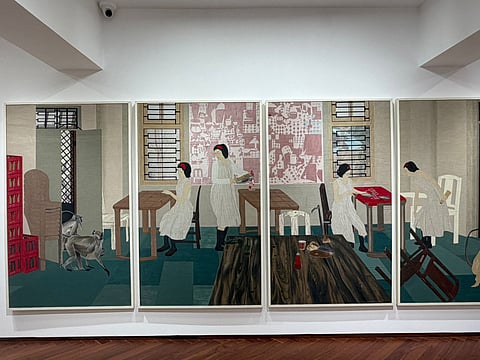
Krisha Bhuva's works, painted over silk, show the influence of East Asian fine art practices in her work. With great detail, her works explore how human beings interact with pets in their surroundings, through stills capturing the pets in action.
In works such as The Cats Keep Walking, Between Gaze and Retreat II and Between Gaze and Retreat I, the absence of humans while seeing cats in distinctly human environments makes the viewer notice the cats themselves. We see them existing within spaces where they have been domesticated, without necessarily seeing the humans who have created these spaces for them. The works simply capture the existence of a pet cat, but in doing so, make us look at the relationship between the animal and the environment around it.
The larger painting that caught my attention, and seemed to catch the attention of most people visiting the gallery, further explores how humans interact with animals by placing monkeys and humans in the same setting. The monkeys entering a restaurant continues the theme of animals becoming a part of distinctly human environments, but this time, with humans present in the scene. The lack of action or interaction from the women in the restaurant towards the monkeys makes us question who the visitor actually is. The monkeys appear to be entering a space that has been designed for humans, yet their presence almost seems natural within the scene.
The works that stood out to me most in this exhibition were those of Sunil K. Painted using gouache as his primary medium, these works explore the life that humans share with smaller pests, while keeping the scenes distinctly Indian through the visual cues of the household.
The works, in sequence, explore very real and everyday interactions that we have with small pests, the spaces we share with them and the way we react to their presence. Showing scenes of how humans react when seemingly smaller creatures appear in their spaces, the works capture very real emotions while using a visual language borrowed from the graphics of video games.
This creates a world that feels removed from reality while showing and capturing very real human reactions. Unlike Krisha Bhuva's works, these paintings place human emotions and reactions directly within the scene. The humorous landscapes are distinctly Indian, making the situations feel familiar while also making us question how we react to creatures that are seemingly small and harmless simply because they enter our spaces.
The works of N Divya and Nivedita Shinde both make the viewer question and notice how we interact with our surroundings on a daily basis, while bringing their own perspectives to the same idea.
In Nivedita's Fleeting Now works, we are shown how our daily life looks across nature and cities. Her background in architecture reflects in the way she captures these scenes, with an attention to the spaces, structures and environments around us. The works capture moments that we might pass through every day without really stopping to notice them.
N Divya, similar to Simran Yagnik, asks us to pause and look at the objects we use in our daily lives by focusing only on the objects and removing them from the larger scene. These are objects that we use every day but rarely think about. By giving them this attention, the works make us take a moment to think about the objects that are a part of our lives, especially in a world of overconsumption and waste. They make us pause and consider our relationship with the things we consume, use and eventually discard.
Across the exhibition, each artist brings their own unique perspective to the idea of how humans exist within and interact with their surroundings. The different mediums, styles and influences of each artist create a diverse range of interpretations of the same larger idea.
Together, these perspectives create The Urban Biome: a collection of different ways of looking at our existence and the world around us. The curation brings these distinct practices together to show that the urban biome is made up of much more than just humans. It is the objects we use, the animals we live alongside, the spaces we create, and the landscapes we move through, all of which are constantly interacting with and influencing one another.
