
- HOMEGROWN WORLD
- HGCREATORS
- HGEXPLORE
- HGVOICES
- HGSHOP
- CAREERS
- ABOUT US
- CONTACT US

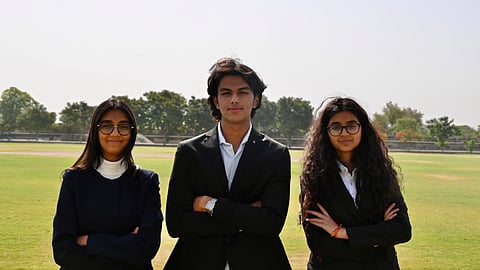
Avyana Mehta, Ariana Agarwal, and Vivaan Chhawchharia became the first Indian team to win The Earth Prize, the world’s largest environmental competition for teenagers, after being named Global Winners in Geneva on May 29. Their project, Plas-Stick, is a biodegradable tamarind seed-based powder that binds microplastics in water into visible clumps that can be removed with a handheld magnet, offering a low-cost, electricity-free solution for underserved communities with limited access to filtration systems.
At a ceremony in Geneva on May 29, three Indian teenagers made history by becoming the first team from India to win The Earth Prize, the world's largest environmental competition for young people aged 13 to 19. Sixteen-year-olds Avyana Mehta, Ariana Agarwal, and Vivaan Chhawchharia were named Global Winners after receiving the highest number of votes in a public poll that drew around 23,000 participants from across the world. The trio had already won the Asia regional category before advancing to the global stage, where they competed against six other regional finalists.
Their winning project, Plas-Stick, tackles one of the fastest-growing environmental concerns of our time: microplastic pollution in water. The idea emerged after the students visited rural communities and saw families relying on shared water sources without access to advanced filtration systems. They began looking for a solution that could be used in places where electricity, expensive equipment, and large-scale infrastructure are unavailable. The result was a biodegradable powder made from discarded tamarind seeds, an agricultural waste product commonly found across India.
When added to contaminated water, the powder binds with microscopic plastic particles and gathers them into visible clumps. These clumps can then be removed using a simple handheld magnet. The process requires no electricity and can be carried out with minimal resources, making it particularly useful for underserved communities. The team developed the technology with support from researchers at the Indian Institute of Technology Guwahati (IIT Guwahati), where the idea underwent further testing and refinement.
The recognition comes with significant international attention and funding to help advance the project. According to The Earth Prize, Plas-Stick has already reached more than 8,000 students and teachers through demonstrations and awareness programmes. The team plans to expand that impact to between 35,000 and 40,000 people by the end of 2026. Their achievement highlights how young innovators are finding practical responses to global environmental challenges using locally available materials and simple scientific ideas. For India, the victory marks a milestone in youth-led climate innovation, placing three teenage inventors at the centre of a global conversation about clean water and plastic pollution.
If you enjoyed reading this, here's more from Homegrown:
Mumbai’s Mangrove Crisis: The Versova-Bhayander Road Threatens Ecosystems & Livelihoods
'The Understory' Is Reimagining The Future Of Conservation Through Indigenous Knowledge
Learn About 'Natural Building' & Permaculture At Geeli Mitti’s Intensive Workshops
