
- HOMEGROWN WORLD
- HGCREATORS
- HGEXPLORE
- HGVOICES
- HGSHOP
- CAREERS
- ABOUT US
- CONTACT US

Indian scientists, including Ashoke Sen, Neena Gupta, and Deepak Dhar, are making significant strides in global science. Sen’s 2026 Oskar Klein Medal for string theory highlights India’s contributions to enormous scientific breakthroughs, though questions remain about the nation’s investment in research and development to sustain such achievements.
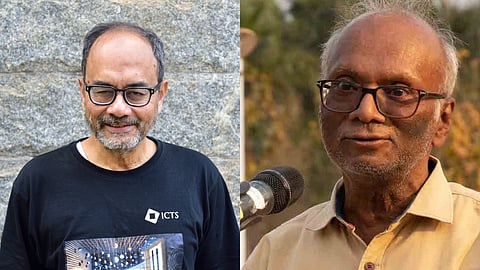
On 22 October 2026, Indian theoretical physicist Ashoke Sen received the 2026 Oskar Klein Medal, making history as the first Indian physicist to receive the honour. The medal is awarded annually by Stockholm University and the Nobel Committee for Physics of the Royal Swedish Academy of Sciences.
Established in 1988, the Oskar Klein Medal recognises distinguished contributions to physics; earlier recipients include Nobel laureates Chen-Ning Yang, Steven Weinberg and Hans Bethe. Sen was recognised for his foundational contributions to modern string theory, including S-duality, which links apparently different formulations of string theory; black-hole entropy, or the precise calculation of microscopic states; and String Field theory, a framework for describing interacting strings. Sen’s work has helped clarify connections between gravity, black holes and quantum theory.
The news was announced on 22 October by the International Centre for Theoretical Sciences (ICTS) where he is ICTS–Infosys Madhava Chair Professor. His previous distinctions include the 2012 Breakthrough Prize in Fundamental Physics, the 2014 Dirac Medal, the Infosys Prize, the Shanti Swarup Bhatnagar Prize, and the Padma Shri, and Padma Bhushan. He was elected a Fellow of the Royal Society in 1998.
Sen is not alone. In recent years, Indian scientists have made incredible contributions to their chosen fields. In 2014, mathematician Dr. Neena Gupta, professor in the Theoretical Statistics and Mathematics Unit at the Indian Statistical Institute, Kolkata, proved that a three-dimensional affine variety constructed by Teruo Asanuma provides a counterexample to the Zariski Cancellation Problem in positive characteristic. She received the 2024 Infosys Prize in Mathematical Sciences for her work.
In 2022, theoretical physicist Deepak Dhar shared the Boltzmann Medal with John Hopfield; in 2026, he received the Dirac Medal from the International Centre for Theoretical Physics, sharing the honour with Bernard Derrida, Marc Mézard and Haim Sompolinsky. Eshan Chattopadhyay, an IIT Kanpur alumnus and associate professor of computer science at Cornell University, shared the 2025 Gödel Prize with David Zuckerman for their work on randomness extraction. In 2025, CERN’s ALICE, ATLAS, CMS and LHCb collaborations received the Breakthrough Prize in Fundamental Physics for their work on Higgs boson properties, the discovery of new strongly interacting particles, rare processes, matter–antimatter asymmetry and other fundamental questions. The collaborations include researchers from India and numerous other countries.
These are only a few examples of Indian scientists whose work has expanded the frontiers of human knowledge. From Satyendra Nath Bose, Meghnad Saha, Homi Jehangir Bhabha, and C. V. Raman to researchers working at the cutting edge of science today, their contributions have helped shape our understanding of the world. But their scientific achievements also raise questions about the conditions that make sustained research possible. Whether India can sustain and expand its scientific contributions depends in part on the resources, institutional support, and opportunities available to researchers, including those working in fundamental and theoretical science. Yet India’s gross expenditure on research and development stood at merely 0.84 per cent of GDP in 2023–24, according to the Department of Science and Technology’s latest published statistics. Rather ironic for a country where the Constitution identifies the development of scientific temper, humanism, and the spirit of inquiry and reform as a fundamental duty of every citizen.
