
- HOMEGROWN WORLD
- HGCREATORS
- HGEXPLORE
- HGVOICES
- HGSHOP
- CAREERS
- ABOUT US
- CONTACT US

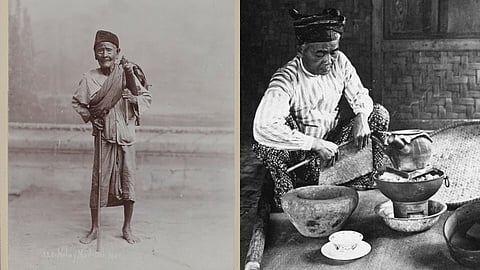
In early modern Malaya, pawangs served as spirit mediums, ritual specialists, and rainforest mystics who helped farmers, miners, and hunters navigate the dangers of the tropical frontier. Emerging from centuries of Indian Ocean cultural exchange, their syncretic practices combined Islam, Sufism, Hindu cosmology, and Malay animism into a unique spiritual tradition.
As peasant farmers, hunters, miners, and other agrarian workers struggled to clear the dense, tropical rainforests of Malaysia for ricefields in the 18th century, they turned to esoteric Muslim shamans known as ‘pawang’. According to religious historian Teren Sevea, the pawangs were “Muslim miracle-workers, ritual specialists, and spirit mediums.” Many of them specialised in negotiating with malicious spirits, demons, jinns, and Iblis — the devil himself — to aid in the difficult task of cultivating ‘ladang’ or unirrigated ricefields reclaimed from the rainforests.
In early-modern Malaysia, these miracle-working men and women were venerated for their esoteric knowledge (‘ilmu’ in Malay, from the Arabic ‘ilm’) of the spirit world and of the porous, spiritual forest terrain in western Malaysia.
According to Sevea, “...a traveller ploughing through the interior of nineteenth-century Malaya would have encountered a variety of pawangs. This traveller would have met pawangs in mines, pawangs who trapped elephants for their Asian and European clients, pawangs who crafted guns and bullets, and the rice pawangs” who communicated with spirits and mobilised them for agrarian labour. Among the entities the pawangs claimed to communicate with were Abrahamic prophets such as Noah and Muhammad; Hindu deities such as Shiva, Indra, Vishnu, and Krishna; demons; and jinns. The spiritual world of the pawangs reflected the layered cultural history of the Indian Ocean itself.
In their oral and written accounts, such as the Darihal Pawang, pawangs like Abdullah bin Pilleh claimed descent from Abrahamic prophets, including Noah and Muhammad, whom they credited with creating Malaysia’s forests and ricefields. This was less a theological claim than a professional one dressed in prophetic genealogy. They used their supposedly sacred lineage to establish occupational legitimacy as interlocutors between humans and divinities.
In reality, Pilleh was a Tamil orphan from the village of Chembong in Malaysia’s Rembau district. Historically known as ‘Chulia’, Tamil-speaking Marakkar merchants from Tamil Nadu, Kerala, and Sri Lanka established permanent settlements across the Malay Peninsula, Singapore, and the Indonesian archipelago long before the colonial period. The Marakkars were present in Southeast Asian trading ports as early as the 14th century, and by the time of the Portuguese conquest in 1511, they had become one of the largest trading communities in the Strait of Malacca.
Most of these early Tamil Muslim settlers were men who married local Malay women and created creolised communities later known as ‘Jawi Pekans’. This was the community which, four centuries later, would produce the pawang tradition.
The Tamil Muslims who eventually became pawangs inherited a syncretic tradition from their ancestors, who had brought it from the Indian subcontinent. They did not necessarily abandon a 'pure' Islam as they moved eastward from South Asia to Malaysia — their idea of Islam was already altered by centuries of cultural exchange and co-existence with non-Muslims, primarily Hindus, in India. In Malaysia’s agrarian interior, these communities absorbed and reshaped pre-existing Malay ritual traditions, contributing to the development of the syncretic pawang tradition documented in the 19th century.
Syncretism in India usually refers to social, economic, and cultural exchanges between Hindus and Muslims, and to the convergence of the spiritual aspects of the Bhakti and Sufi traditions within Hinduism and Islam, respectively. The Malabar coast, from which many of the Marakkar settlers originated, lay on the Indian Ocean maritime trade route and was shaped by centuries of cultural exchange among Hindus, Arab Muslims, and Syrian Christians. The early settlers who crossed the Bay of Bengal were therefore already comfortable navigating between Hindu and Abrahamic folkloric frameworks.
The syncretic pawang tradition emerged from these cross-currents. Their invocation of Hindu deities such as Shiva and Vishnu was not an aberration. They were not reconciling Islam, Hinduism, and animism — they were instrumentalising all three theological frameworks simultaneously. It was an occupational use of a spiritual grammar that had already existed in South Asia for centuries.
As the pawangs — descendants of the early Tamil Muslim settlers of the Malay Peninsula — moved from commerce and trade into agrarian labour, and from the coastal trading ports to the tropical interior, they developed a new ritual vocabulary that combined Islamic tradition, Sufi mysticism, Tamil devotion, and Hindu cosmology with Malay animism, creating a spiritual framework for people who had learned, across centuries and shifting coastlines, that the world contains more powers than any single tradition could account for, and that surviving in it requires knowing how to speak to them all.
To learn more about the pawangs, read religious historian Teren Sevea’s Pawangs on the Frontier.
