
- HOMEGROWN WORLD
- HGCREATORS
- HGEXPLORE
- HGVOICES
- HGSHOP
- CAREERS
- ABOUT US
- CONTACT US

Long before Satyajit Ray adapted ‘Pather Panchali’ in 1955, Bibhutibhushan Bandyopadhyay had already transformed Bengali literature with his deeply observed worlds: from rural Bengal to imagined African landscapes. Almost a century later, his work remains a radical archive of memory, ecology, and everyday life in rural Bengal. ‘পথের দেবতা – God of the Little Road’, a landmark exhibition curated by the author’s grandson, reveals the man behind the literary legend.
In 1944, while working as a junior visualizer at D.J. Keymer & Co., a young Satyajit Ray received a commission from D.K. Gupta, the founder of Signet Press, to illustrate a Bengali book titled ‘Aam Aatir Bhepu’. Ray designed the cover and illustrated the interior of the book, an abridged children’s edition of a landmark Bengali novel titled ‘Pather Panchali’. Eleven years later, he’d make his directorial debut with an adaptation of the novel, followed by two more films based on Bandyopadhyay’s Apu trilogy. Today, when we talk about the Apu trilogy, most of those outside Bengal inevitably think of Ray’s landmark film adaptations of the novels. But long before Ray took Apu to the world, Bandyopadhyay’s novels took over Bengal’s hearts and bookshelves.
Although Bandyopadhyay is best known for his nuanced narratives of pastoral Bengal in the Apu trilogy, his was an unusually wide canvas for a writer so associated with a single register today. The dusty lanes of Bongaon, the dense old-growth forest of Jharkhand in ‘Aranyak’ — one of India’s first major works of climate fiction — the African wilderness of ‘Chander Pahar’, a world Bandyopadhyay built entirely from imagination based on travelogues and research without ever setting foot in Africa, the slow-moving Ichamati river that gives his late novel its title, and the famine-hollowed Bengal of ‘Ashani Sanket’ — these are not variations on a theme but starkly different worlds, each rendered with the same quality of unhurried attention. Bandyapadhyay was a restless storyteller who somehow always wrote with stillness.
What stands out in Bibhutibhushan’s oeuvre, almost a century later, is his refusal of idealization, more than mere pastoral sentimentality. The Bengali village, or ‘Gram Bangla’, is romantic in his retelling, but never innocent; it is cramped, gossiping, and casually cruel to the dispossessed, like Indir Thakrun in ‘Pather Panchali’. The forest in ‘Aranyak’ is a sovereign presence, indifferent to the logging operations and administrative ambitions of those encroaching upon it. Shankar’s adventures in ‘Chander Pahar’ carry genuine danger and dislocation alongside their romance with the spirit of adventurism. And ‘Ashani Sanket’, written in the aftermath of the 1943 Bengal Famine, refuses to reduce its subject to either propaganda or elegy — it documents how ordinary people struggle to comprehend a catastrophe already consuming them. Across it all, the natural world comes alive as a character with its own interior life, its own claims on the narrative.
Bengali readers return to him because he holds something that modernization has rendered structurally impossible: the sensory grammar of lived realities lost to time. The smell of rain-soaked earth, the distinct character of silence in an open field on a dewy spring morning, the specific texture of a sky before the monsoon breaks. These are not things that can be recovered, only grieved for — and Bibhutibhushan is, among other things, a great writer of grief that does not announce itself as such. That Satyajit Ray canonized his world in the Apu trilogy, and a landmark exhibition curated by his grandson now commemorates the man behind the pages, are both attempts to do what Bandyopadhyay accomplished with his prose: to hold a world still for long enough that we understand what it meant.
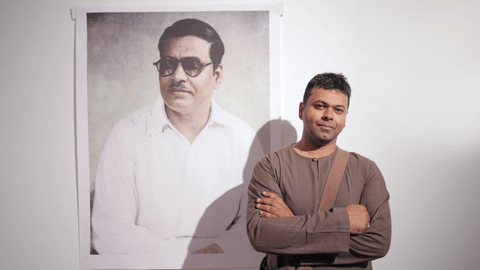
‘পথের দেবতা – God of the Little Road’, curated by the author’s grandson Trinankur Banerjee, brings together rare archival photographs, original manuscripts, handwritten letters, early editions, and treasured family heirlooms for the first time. The exhibition will be on view till 19 April 2026 at the Kolkata Centre for Creativity. Learn more here.
If you enjoyed reading this, here’s more from Homegrown:
Inside Wes Anderson’s Love Affair With Satyajit Ray’s Cinematic Universe
The Living Legacy Of Madhabi Mukherjee, Satyajit Ray’s Most Complex Heroine
Film Posters Designed By Satyajit Ray – A Peep Into His Lesser-Known Past
