
- HOMEGROWN WORLD
- HGCREATORS
- HGEXPLORE
- HGVOICES
- HGSHOP
- CAREERS
- ABOUT US
- CONTACT US

Before standardized calendars, time was measured by observing celestial movements. This guide returns, in a small way, to that older, slower, more attentive mode of timekeeping.
Before the widespread adoption of standardized calendars worldwide, time was primarily measured by observing the natural world. The equinox — when day and night are of equal length — served as a key marker in annual cycles, signalling renewal and the transition between seasons. For agrarian societies, it determined planting and harvest schedules; for sailors, it indicated changes in winds and currents in the high seas; and for religious and philosophical traditions, it marked the completion of another solar cycle.
Across cultures, the sky functioned as a practical system for timekeeping and navigation. Stars and planetary movements were used to structure calendars, guide travel, and organise ritual life. Many civilizations aligned temples and monuments to solstices, incorporated celestial cycles into myth and cosmology, and tracked years through the predictable movements of the Sun, Moon, and planets. In the absence of standardized borders or synchronized clocks, the heavens provided a shared temporal framework.
That relationship has largely faded in modern life. The calendar year now begins on a fixed date, disconnected from astronomical events and governed by standardized time. The sky, however, continues to follow its established patterns. Planets still reach opposition, eclipses continue to alter light and shadow, and meteor showers recur annually, regardless of human attention.
This guide revisits an earlier mode of timekeeping — one rooted in observation of the night sky — and situates contemporary astronomical events within a longer human history of looking to the sky in wonder and curiosity.
Jupiter at Opposition: Opposition happens when two celestial objects appear directly opposite each other in the sky, especially when a planet is opposite the sun. The points of greatest elongation and opposition are perfect for observing the planets. In 2026, Jupiter will be at opposition on January 10, shining at its highest and brightest for the year. It will be visible to the naked eye, and with optics, you’ll also see its four largest moons.
Mercury at Greatest Elongation East: Mercury will reach its greatest elongation in the east — its farthest point from the Sun — for the first time in 2026 on February 19. As it’s an eastern elongation, this will be best seen in the morning.
Planetary Alignment: On February 28, a rare six-planet alignment will be visible after sunset, with all planets except Uranus and Neptune observable to the naked eye. The planets will align again on August 12.
Total Lunar Eclipse: On March 3, the Moon will pass completely through Earth’s shadow and turn a deep red — an event colloquially known as ‘Blood Moon’.
March Equinox: This year, the March equinox will fall on March 20.
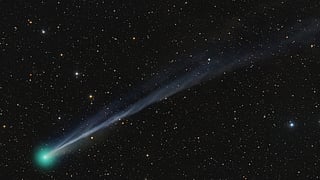
Comet C/2025 R3 at its brightest: Comet C/2025 R3 (PanSTARRS) will reach maximum brightness on April 25 and might become bright enough to be seen with binoculars or even with the naked eye from the Northern Hemisphere.
Blue Micromoon: The second Full Moon in May will be a Blue Moon, which will also be the smallest Full Moon of the year. It will be visible worldwide on May 31.
Venus near Jupiter: Venus and Jupiter — the two brightest planets in our solar system — will appear near each other in the evening sky. Both planets will be visible to the naked eye worldwide.
Moon near Pleiades and Mars: The Moon, Mars, and the Pleiades will align in the pre-dawn sky on July 11. They are visible to the naked eye under ideal conditions, but using binoculars will make it easier to see the Pleiades.
Total Solar Eclipse: On August 12, a total solar eclipse will be visible from Greenland, Iceland, Portugal, and Spain.
Perseids Peak: The Perseids are a prolific meteor shower associated with the comet Swift–Tuttle that are typically visible from mid-July to late August. The meteors are called the Perseids because they appear from the general direction of the constellation Perseus and, in more recent times, have a radiant near Cassiopeia and Camelopardalis. The Perseids are one of the most popular meteor showers to watch, with as many as 60 meteors per hour at their peak. In 2026, the Perseids will peak on August 12. The shower is best seen from a dark location after midnight.
Venus at its brightest: On September 22, Venus will be brighter than at any other point in 2026. Though it will only be visible as a thin crescent through a telescope, it will be brightest because of its proximity to Earth.
Saturn at Opposition: Saturn will be at its largest and brightest on October 4. The planet is visible with the naked eye, but a telescope will allow you to see its brilliant rings.
World Space Week: The world’s largest annual space event, World Space Week is the United Nations’ official celebration of space and the use of technology to help humanity. This year’s theme is “Rocket Revolution”. The event will take place from 4 to 10 October in 2026.
Mars near Jupiter: Mars and Jupiter will shine side by side and their contrasting colours — red and golden yellow — will make the conjunction especially captivating.
Geminids Meteor Shower: The Geminids, radiating from the constellation Gemini, is the MVP of meteor showers. It is considered by many to be the best shower to observe, producing up to 120 multicolored meteors per hour at its peak. It is produced by debris left behind by an asteroid known as 3200 Phaethon, which was discovered in 1982. The shower runs annually from December 7-17. In 2026, the shower will peak on December 14.
