
- HOMEGROWN WORLD
- HGCREATORS
- HGEXPLORE
- HGVOICES
- HGSHOP
- CAREERS
- ABOUT US
- CONTACT US

This article is about Social Saheli, a flagship initiative of PLUC.TV, implemented in partnership with the Self-Employed Women’s Association, that brings together women’s livelihoods, clean energy, and grassroots storytelling. By turning smartphones into tools of work and visibility, the programme is quietly reshaping who gets seen, heard, and paid in India’s rural energy economy.
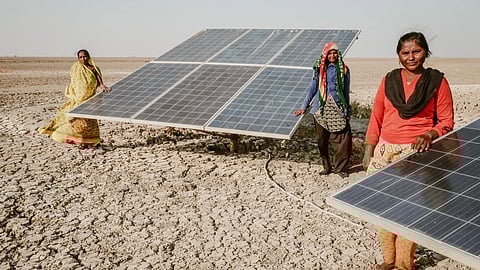
When Manguben’s elder brother died, the course of her family’s future shifted overnight. Grief gave way to responsibility, and responsibility to resolve. Today, she harvests salt under the scorching sun of the Rann of Kutch and climbs rooftops to install and maintain solar panels — work that few women in her village once imagined doing. Trained as a Solar PV Technician, Manguben now manages the vital technology that provides clean energy to her community. Her journey — from the punishing salt flats to sunlit rooftops — is emblematic of a much larger transformation unfolding across rural Gujarat.
Manguben is part of Social Saheli, the flagship programme of PLUC.TV, implemented in partnership with the Self-Employed Women’s Association (SEWA). The long-term initiative brings together women’s livelihoods, clean energy, and grassroots storytelling — placing rural women at the centre of India’s clean-energy transition as workers, technicians, and narrators of their own labour.
Originally conceived to help women strengthen micro-enterprises through digital storytelling, Social Saheli trained participants to use smartphones as tools of work and visibility — documenting their labour, sharing it online, and accessing markets directly. That model has since expanded into the solar and clean-energy sector, where the need for skilled, last-mile workers is both urgent and growing.
In 2023, India committed to reaching 500 GW of non-fossil fuel electricity capacity by 2030, with nearly half of its installed power coming from renewable sources. Achieving these targets will demand more than just infrastructure; it will also require a significant workforce. An estimated 3.4 million solar and wind jobs are needed by the end of the decade. However, women only make up about 11% of India’s renewable energy workforce. Social Saheli’s clean-energy campaign, ‘Under The Same Sun’, directly addresses this gap, arguing that the problem isn’t a lack of capability but rather a lack of opportunity, recognition, and intent.
What sets Social Saheli apart is that storytelling here is not simply used as social advocacy or awareness-building. Instead, It functions as a form of economic infrastructure: a way for women to be seen as legitimate workers, to circulate proof of skill, and to create income opportunities linked to their labour. Participants learn both technical skills, whether in enterprise or energy work, and narrative skills — producing their own videos, photos, and first-person accounts.
‘Under The Same Sun’ follows rural women trained as solar technicians through SEWA’s long-running initiatives, including its ‘Surya’ Solar PV Technician programme and Building Cleaner Skies campaign. Over the years, SEWA has trained more than 1,000 women to install, repair, and maintain solar parks, rooftop systems, solar pumps, and solar fencing — often in villages where energy access is critical and reliable maintenance scarce.
“I was once a trainee myself,” says Ankurben, now a solar technician trainer. “Back then, choosing this training was a bold step. No one in my village had done it before, and people questioned how I would earn a living. Today, I train young girls from my village and earn my livelihood through the same work. That journey makes me proud.”
The campaign also traces quieter, deeply personal shifts. Payalben grew up watching her mother survive on irregular daily wages after her father’s death. Determined to avoid the same uncertainty, she enrolled in solar training after learning about it in her village. She learned to use a smartphone, cleared technical exams, and today earns her livelihood repairing and maintaining solar systems. “When a solar panel stops working, and no one understands the problem, I can,” she says. “I fix it, explain it, and that makes me feel confident.”
She says that her work is constantly observed. “When I go to different houses to fix solar systems, people are astonished to see me. They wonder how a woman can do a man’s job and I think this reinforces that I am making a change.”
By documenting their labour, women like Ankurben and Payalben circulate proof of skill, build credibility, and claim professional identities in spaces where their work has long been invisible. Recognition, many participants say, matters as much as income.
As India invests billions in clean-energy infrastructure, ‘Under The Same Sun’ makes a grounded argument: the workforce needed for this transition already exists in rural India. Women have the skills, the experience, and the willingness to do the work. What they need are sustained opportunities, formal recognition, and a seat at the table. As the programme unfolds across multiple districts, Social Saheli offers a model for strengthening women’s livelihoods at the intersection of labour, technology, and visibility — showing how who gets to tell the story can directly shape who gets to work, earn, and be recognised.
Watch Social Saheli episodes here and follow @socialsaheli on Instagram to learn more about the initiative.
If you enjoyed reading this, here’s more from Homegrown:
From Clean Water to Autism Support: The Six Winners Of The Unlock Her Future Prize 2025
How DMSC Transformed Sonagachi: The 30-Year Legacy Of India's Largest Sex Worker Collective
Help Rehabilitate The Displaced Survivors Of The Punjab Floods With 'Prints For Punjab'
