
- HOMEGROWN WORLD
- HGCREATORS
- HGEXPLORE
- HGVOICES
- HGSHOP
- CAREERS
- ABOUT US
- CONTACT US

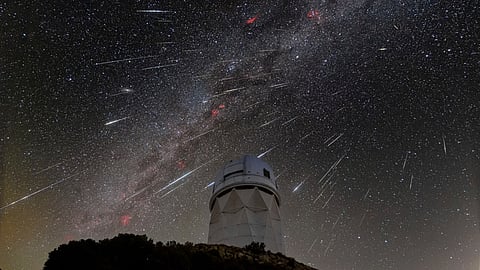
Every December, the Geminids meteor shower lights up the night sky with brilliant streaks of cosmic debris from the unique 3200 Phaethon Apollo asteroid. First recorded as a distinct annual astronomical event in 1862, the Geminids return this week with ideal viewing conditions across India.
For as long as humans have existed on planet Earth, we have looked to the stars to make sense of ourselves and the world around us. Long before the invention of telescopes and spacecraft, we looked at the night sky and saw our reflections in the constellations: we made stories about gods, monsters, and ancestors. We projected our endless imagination on the boundless canvas of the night sky to explain myths of creation, destiny, and the restless mysteries of the world.
On a December night like that in 1862, Robert Philips Greg, an English observer from Manchester, England, looked to the sky and recorded the Geminids — a cloud of cosmic debris shed by 3200 Phaethon, a unique, potentially hazardous asteroid-like celestial body that behaves suspiciously like a defunct comet — as a distinct annual astronomical event for the first time. Although initially faint and unimpressive, the Geminids’ activity has intensified dramatically over the last century and a half. Each year, they light up the December sky in a spectacular display of light. Today, the Geminid meteor shower is considered one of the most reliable and dazzling meteor showers of the year, outshining even the famed Perseids.
This year, the Geminids will peak on the nights of December 13 and 14, offering ideal conditions for stargazers across India. Moon interference will be minimal until around 2:30–3:00 AM, creating a window of dark, clear skies from roughly 11 PM onward. Under clear skies and low light pollution, you can expect to see 50–60 meteors per hour, sometimes more. The meteors of the Geminid shower are very bright, moderately fast, and uniquely multi-colored — mainly white, with some yellow, green, red, and blue. These colors are partly caused by traces of metals like sodium and calcium, similar to what makes fireworks colorful.
The meteors in the Geminid shower appear to come from the radiant in the constellation Gemini (hence the shower’s name). However, they can appear almost anywhere in the night sky. The key is to give your eyes time to adjust: at least 20 minutes in darkness, no screens, and ideally in a reclining position on a terrace, rooftop, or an open field. A warm jacket, some chai, and patience will go a long way. As the old adage goes: good things come to those who wait.
“The Geminids are best viewed during the night and predawn hours and are visible across the globe due to a nearly 24-hour broad maximum. This shower is considered one of the best opportunities for young viewers since this shower starts around 9 or 10 p.m. To view the Geminids, find an area well away from the city lights or street lights. Come prepared for winter temperatures with a sleeping bag, blanket, or lawn chair. Lie flat on your back with your feet facing south and look up, taking in as much of the sky as possible. After about 30 minutes in the dark, your eyes will adapt and you will begin to see meteors. Be patient — the show will last until dawn, so you have plenty of time to catch a glimpse.”
Learn more about the Geminids meteor shower here.
If you enjoyed reading this, here’s more from Homegrown:
Eyes On The Skies: A Homegrown Astronomical Calendar For 2025
Witness The Night Sky Like Never Before At The Jim Corbett Park's New Observatory
Nakshatra Sabha: Reach For The Stars With India's First Astro Tourism Experience
