
- HOMEGROWN WORLD
- #HGCREATORS
- #HGEXPLORE
- #HGVOICES
- #HGSHOP
- CAREERS
- ABOUT US
- CONTACT US

French-Tamil artist and architect Abirami's multidisciplinary practice moves between sculpture, installation, film and architecture to explore what home, memory and belonging mean across generations shaped by migration. Drawing from her experience as the daughter of Sri Lankan Tamil parents who fled the Tamil genocide, her work brings together domestic spaces, miniature houses, shrines and nostalgic digital aesthetics to reflect on inherited histories, care and identity. From glitter-covered sculptural homes inspired by family in Sri Lanka to films recreating the visual language of early Tamil television, Abirami continues to build immersive worlds where architecture becomes a vessel for remembrance, repair and the many ways diaspora communities imagine home.
French-Tamil artist and architect Abirami has always been fascinated by the worlds that spaces can create. As a child growing up in Argenteuil, a suburb on the outskirts of Paris, she spent hours immersed in The Sims, absorbing how architecture could shape the way people live and relate to one another. "I have always been interested in architecture, its power to shape spaces, domesticity and habits," she says. "Its ability to create universes and atmospheres. How politically these walls speak." She began by studying art before eventually training as an architect, drawn to the discipline's social possibilities. Today, alongside working with an architectural collective that designs dignified spaces for people living in poverty across France, Abirami has built an artistic practice that stretches across sculpture, installation, moving image, digital art and publishing, all circling the same question: what does home look like when it exists across countries, generations and inherited histories?
Born in France to Sri Lankan Tamil parents who fled the Tamil genocide in their thirties, Abirami grew up with Tamil culture deeply embedded in everyday life before she developed her own relationship with Sri Lanka. Her parents waited nearly fifteen years before returning, taking the family back during the ceasefire while the conflict wasn’t quite over. Since then, she has returned several times on her own, gradually building relationships with family members and places she had only known through stories. "I still feel both foreign and local at the same time," she shares. "It's a bit of an omnipresent sensation among the children of immigrants. A strange déjà-vu."
Abirami describes her Tamil identity as a meeting point between Argenteuil, where she grew up, and Little Jaffna, Paris' South Asian neighbourhood. Her work brings together those worlds through sculpture, architecture and installation, filling them with domestic objects, devotional references, glitter, beads, dried flowers, wax and family heirlooms. Over the past few years, sculpture has become the centre of her practice, with miniature houses, shrines and immersive environments offering space for stories about migration, belonging, family and personal histories. “Everywhere, all the time, I want to recreate spaces, places of repair and care, warm, and protective atmospheres,” she notes.
Across projects like Mettre les daronnes à l'abri, where idealised miniature houses become imagined shelters for loved ones she cannot house or protect, and Kasalam, which commemorates those who died during the Tamil genocide while exploring the fragility and transmission of memory across generations, Abirami repeatedly builds spaces shaped by family histories and inherited experiences. In Mettre les daronnes à l'abri, the glitter-covered miniature houses carry the visual language of devotional shrines while also recalling childhood craft projects and the decorative excess of early internet culture.
The houses were conceived during a trip to Sri Lanka shortly after she graduated as an architect. Visiting relatives, she found herself confronting the precarious conditions many of her family members were living in. "I felt powerless," she says. "These houses were a cathartic way to process this emotion. It was a way to accept that I cannot save everyone." She imagined them as dream homes for her aunts and uncles, even hoping that selling the sculptures could directly support them. Like much of her work, everyday objects become vessels for much larger emotions. "Sublimating stories and everyday objects gives me a feeling of calm, almost meditative," she says. "The materials used come to talk to my inner child. Sometimes, I feel like a child with a thirty-year-old bank account."
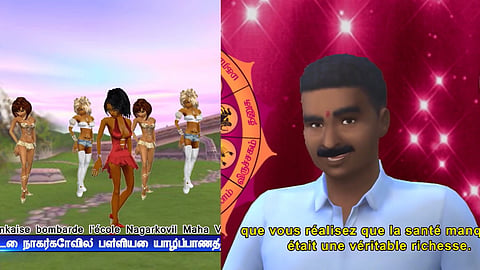
The same nostalgic lens appears in 'Sunday TV', her recent short film that recreates the visual language of Tamil television from the late '90s and early 2000s. Drawing from childhood memories of watching Tamil music videos on Sun TV and replaying the same five cassette tapes in her family's Golf MK1, the film is described in her portfolio as "an ode to those forgotten moments, those moments of musical carefreeness that stand alongside the violence of a distant war becoming rooted in our daily lives. Wireframe globes, glowing gradients, saturated colours and primitive computer graphics all return, echoing aesthetics she has explored through GIFs and digital works over the years. For Abirami, those references naturally connect her French and Tamil worlds. "It's where a bridge can be created," she says. The work also returns to a period she associates with innocence and carefreeness. "I don't feel like I consciously chose those colours, that aesthetic. That's what grabs me."
Looking ahead, Abirami is eager to revisit painting and video games, two mediums she has temporarily set aside while her sculptural practice has grown. She also hopes to build even larger immersive installations that incorporate furniture, readymade objects and architectural scenography. “In terms of themes, some Tamil mythologies and legends call me, notably that of the Kumari Kandam,” she notes. “I would like to explore these topics from a scientific and dreamlike perspective. Bridges can be imagined with current stories.”
Follow Abirami here.
