
- HOMEGROWN WORLD
- HGCREATORS
- HGEXPLORE
- HGVOICES
- HGSHOP
- CAREERS
- ABOUT US
- CONTACT US

This article looks at Divya Balivada’s practice, tracing her journey from dentistry to art practice shaped by experiences of abstraction, and shaped by experiences of displacement, gender conditioning, and trauma . It explores how her work engages with themes of cyclicity, repetition, and impermanence, using the body, material processes, and abstraction as a way to process inherited and personal memory.
Divya Balivada is an artist working across painting, photography, installation, and performance whose work moves through cyclicity and impermanence, looking at how patterns of repetition and rupture show up within the psyche and in society. Her practice draws from lived experiences of gender bias, displacement, and PTSD, using her own body and emotional states as reference points. Nature and meditation, too, feed into how she works through repetition and sustained attention.
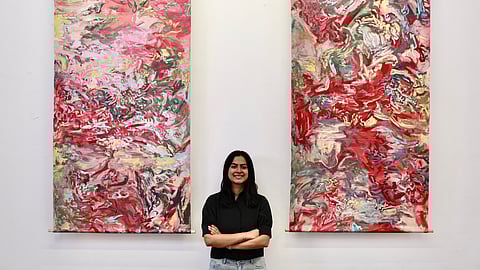
Growing up in India meant high sensory stimulation for the artist — visual overload and constant movement across cities, homes, and schools — with continuous learning and unlearning, adapting to new surroundings. Goa, however, brought a different rhythm; its slowness, which she initially resisted, became a space to express in a more grounded way, with nature and meditation anchoring her. “Colour in my work doesn’t come from one place or time,” she says. “It is intuitive and enables me to express how I feel, and the intensity and saturation come from a broader sensory landscape. It holds both movement and stillness, shaped as much by internal states as by external environments.”
Earlier, Divya’s practice was rooted in monochromatic drawings on 5–10 meter long fabrics and paper, allowing for an immediate, often cathartic release. Over time, she felt the need to bring in colour to hold subtleties like her surroundings, memories, past experiences, and emerging anxieties and instability. Colour, along with gesture, became a way to hold these layered, often conflicting realities simultaneously.
Before her MA in Painting at the Royal College of Art and exhibiting internationally, from the Bombay Arts Society in Mumbai to Flowers Gallery in London, and the Royal Society of Artists in London, Divya was a trained dentist. The transition into painting demanded a complete restructuring of how she understood value and stability. It meant confronting internalised ideas of being “good,” successful, or acceptable within gendered expectations shaped by Indian society, and unlearning obedience, approval-seeking, and external validation.
Leaving a prescribed profession, she tells us, required committing to a practice without material guarantees, adapting to a different rhythm of labour and time, and existing within unpredictability. Psychologically, it involved embracing uncertainty, facing fear, doubt, and choosing herself without a fixed framework, while recognising art as a deeper necessity — something she kept gravitating towards, sustaining a state of transience without immediate resolution, trusting the process even when it felt unstable, almost as if the work chose her.
Divya works primarily with abstraction, which she finds vast and fluid enough to hold the intensity of being human. But that sensibility didn’t arrive as a conceptual decision; it emerged out of necessity, through unlearning, and became a language that she was speaking before she fully understood its grammar. Through more exposure and research, she came to believe that abstraction has been a part of the South Asian lineage and dates back to 250–300 BC through symbolism in tantric art. “Abstraction allowed me to move beyond legibility, to inhabit ambiguity, contradiction, and fluidity,” she notes, returning to the idea of witnessing growth as something non-linear, full of hesitation and discomfort of the unknown.
In the earlier phase of her practice, Divya was still recovering from PTSD, and was working more directly with portraits, “which probably comes from my background in dentistry, where I learned human anatomy and could read micro-expressions of pain, tension, and discomfort,” she muses. But over time, being tethered to recognisable anatomy was something her body couldn’t stay with anymore. “Perhaps it resolved things too quickly without adequate time to reflect. And my experience of memory, conditioning, and trauma was never that singular or stable. Instead of asking who this figure is, the work began to ask: what is this state? Where does it come from? How does it move?”
This allowed her to engage more deeply with the idea that what we experience isn’t purely our own; “it’s shaped by familial histories, cultural expectations, and gendered conditioning. Especially within the culturally entrenched “good-girl” socialization, where so much is internalized and goes unexpressed, abstraction became a way to surface those accumulations without having to narrativize them directly,” she shares.
For her series, Ananta, the artist built a wooden loom with two rollers and a guiding handle that rotated the fabric for a sustained, cyclical mark-making. It emerged from earlier works made on saree fabric as an act of disobedience, where she drew over a material deeply tied to gendered expectations. “The saree carries layered cultural politics: how it is worn, who wears it, and under what conditions - full sleeves or sleeveless, the Ghunghat system, widows need to wear white in some cultures - each marking control, respectability, and surveillance,” she states. “For genders other than female at birth, wearing the saree is often met with ridicule. I became interested in how this fabric holds the weight of patriarchal structures.”
While being in London at the RCA, Divya mentions that it felt necessary for her to engage with the histories of labour, gender, and colonial industry through the loom, especially within the context of the historical entanglement between India and UK. For the artist, it also became a body-led process through which generational memory could be worked in. "My grandfather’s position in the British Indian Army sits within this history, and accumulating marks through the loom in the UK began to feel cyclical, like a return and reworking of time," she notes.
Yeats described life as a journey up a spiral staircase: repetitious and progressive, covering ground as we grow older but higher up, looking down on the places we were but no longer are. In her work, Divya intends to inhabit and embody the same space. When she thinks about cycles in nature and life, they feel very much intertwined with inherited patterns and conditioning. “These repetitions move through us collectively, shifting slightly each time, yet persisting,” she notes. “I believe repetition is not stagnation, but a site of potential change. When it comes to processing trauma, it requires time, energy, and a willingness to return, again and again, in order to move through it differently.”
Follow Divya here.
