
- HOMEGROWN WORLD
- HGCREATORS
- HGEXPLORE
- HGVOICES
- HGSHOP
- CAREERS
- ABOUT US
- CONTACT US

From Benode Behari Mukherjee’s radical paintings, murals, and collages, and Leela Mukherjee’s cross-cultural sculptural language, to Mrinalini Mukherjee’s large fiber works, the Mukherjee family transformed Indian modern and post-modern art. Their pivotal work — across painting, sculpture, and textile installations — blurred the lines between tradition and modernity, and between fine art and craft.
In 1940, after graduating in Economics from Presidency College in Kolkata (then Calcutta), Satyajit Ray went to Shantiniketan to study painting at the Visva-Bharati University founded by Rabindranath Tagore. In the latter half of the 20th century, Santiniketan emerged as an epicentre of India’s modern art movement. Rooted in Tagore’s humanist vision for Visva-Bharati, Santiniketan fostered a form of modernism grounded in indigenous craft traditions, rural life, and material experimentation. By the 1950s and 1960s, Santiniketan had already witnessed the formative contributions of artists such as Nandalal Bose and Ramkinkar Baij. Their pedagogical emphasis on drawing from nature, rural life, and Indian mural traditions helped shape a distinctly Indian modernism, neither derivative of Europe nor narrowly nationalist.
It was at Shantiniketan that Ray met Benode Behari Mukherjee, a member of the visual arts faculty at Visva-Bharati. Benode Behari was severely myopic in one eye and blind in the other, and he became completely blind in his 50s after an unsuccessful cataract operation. Despite his blindness, he remained an outstanding artist, continuing to produce remarkable work. Ray was deeply inspired by Benode Behari’s art, and many years later, as a tribute to his teacher, he made a documentary film about his life and works, titled ‘The Inner Eye’.
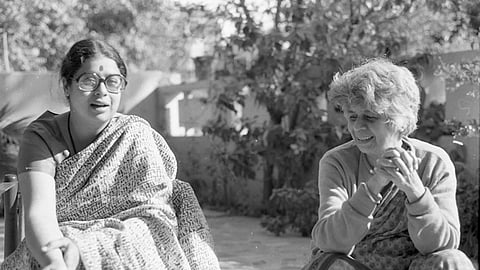
Along with his wife, Leela, and their daughter, Mrinalini, Benode Behari Mukherjee stood at the heart of Santiniketan’s interconnected arts ecosystem in the latter half of the 20th century. Across painting, sculpture, textile, and pedagogy, the Mukherjees shaped the modernist ethos of Kala Bhavana in the post-Tagore period and, in turn, were shaped by it. Through their multifaceted practices, they demonstrated how Indian modern art evolved through dialogue among generations, media, and the land itself.
Benode Behari developed an intensely spatial way of seeing despite the loss of his vision or perhaps precisely because of it. His murals at Santiniketan — especially his frescoes — reimagined narrative painting as an unfolding landscape rather than a fixed image. Drawing on East Asian scroll traditions, Mughal miniatures, and everyday rural Bengal, he rejected spectacle in favour of continuity. Even after losing his vision in the 1950s, he continued to create through paper collages and tactile processes. His pedagogy, like his art, resisted formula.
If Benode Behari Mukherjee expanded the grammar of painting, Leela Mukherjee reshaped the language of Indian sculpture. Working mainly in bronze and wood, and later exploring different materials, she moved effortlessly between folk motifs and modernist abstraction. In 1948, the couple relocated to Nepal, where Leela learned traditional wood-carving techniques. Beyond Nepal, she also drew inspiration from the sculptural traditions of West Africa, South America, and Europe. Her practice left no room for hesitation; as an artist working in a traditional medium, she had no doubts about her methods or approach, allowing her to experiment freely with form.
Their daughter, Mrinalini, took their legacy to new heights. Mrinalini Mukherjee’s work challenged the very hierarchies that shaped the modern art movement. Working primarily with dyed hemp in the 1970s and 80s, she transformed a material traditionally linked to rope-making and crafts into monumental, anthropomorphic figures. Yakshi (1984), with its thick plaiting and drooping vertical form, not only referenced its mythical namesake; it commanded sculptural awe through a medium historically denied such gravitas. In her textile pieces, the effort of knotting became intertwined with meaning. For her, the process was both evidence of the work and the very foundation of its form.
Her education at Santiniketan and later at Baroda under K. G. Subramanyan shaped this refusal of disciplinary boundaries. In contrast to Western binaries that segregate ‘fine art’ from ‘craft’, Mrinalini Mukherjee inherited a pedagogical lineage in which paintings, murals, textiles, and sculptures coexisted. Yet her work cannot be reduced to nationalist revivalism. The “deities” her textile work evoked were always less citations of iconography than embodiments of a personal mythology — hybrid, vegetal, bodily, and faintly theatrical — drawing as much from performance traditions as from sculpture’s modernist concerns with gravity, mass, and tactility.
By the 1980s and 1990s, as India liberalised — both socially and economically — and the art market expanded, Santiniketan’s model of community-based art education began to seem almost utopian. Yet its influence endured. Many artists who passed through Kala Bhavana carried forward its emphasis on contextual modernism — a movement grounded in place but open to the world. Through painting, sculpture, fibre, and pedagogy, the Santiniketan artists demonstrated how modern Indian art was not shaped solely in metropolitan galleries or state-sponsored exhibitions. It also emerged from smaller, slower, deeply interconnected spaces. Santiniketan in the latter half of the 20th century was one such space, and the Mukherjee family was a microcosm of that history.
Learn more about the Mukherjees here.
