
- HOMEGROWN WORLD
- HGCREATORS
- HGEXPLORE
- HGVOICES
- HGSHOP
- CAREERS
- ABOUT US
- CONTACT US

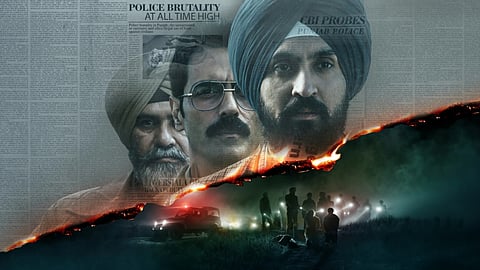
Honey Trehan’s 'Satluj' revisits the life and disappearance of human-rights activist Jaswant Singh Khalra, who exposed thousands of alleged illegal cremations in Punjab during the 1990s. Through the film’s censorship battle and its portrayal of state violence, the essay explores the wider history of enforced disappearances, counterinsurgency, and the lack of accountability that continue to haunt India.
At one point in Honey Trehan’s ‘Satluj’, a ghost speaks to a man. “When the river water freezes at night, I feel so cold, yaar,” the ghost says, choking and gurgling through pain. “From the outside, and from the inside too. The wound is open, you see?”
As the ghost unwraps his shawl to show the man the open wound that runs through his torso (a technique allegedly used by the Punjab Police to ensure the corpses of disappeared persons disposed of in the river do not float up), Trehan too forces viewers to look at one of the many open wounds of the country: the extrajudicial killings and forced disappearances perpetrated by Punjab Police during the militancy and counterinsurgency years between 1978 and 1995. Long delayed by the Censor Board’s demands of 127 cuts, a title change, and other minor modifications, the film originally titled ‘Ghallughara’ (meaning ‘holocaust’) and later ‘Punjab 95’ quietly released on streaming earlier this month, only to be removed two days later.
The film follows the disappearance of Jaswant Singh (based on Jaswant Singh Khalra), a Sikh human-rights activist who uncovered evidence of thousands of illegal cremations allegedly carried out by Punjab Police and his forced disappearance on September 6, 1995. But ‘Satluj’ is a film about more than this one man. It is about the machinery of disappearance that has periodically emerged at the edges of Indian democracy, and the State’s enduring refusal to reckon with what it has done in the name of national security.
In the 1990s, Khalra’s work revolved around a simple question: who were the unidentified persons being cremated by the police across Punjab? Through painstaking research, he uncovered records suggesting that thousands of people had been allegedly killed and cremated without identification or due process. Some were suspected militants. Others may have been civilians swept up in the brutal counterinsurgency campaign. In September 1995, Khalra himself was abducted outside his home by Punjab Police personnel. Months later, he was declared dead. Several police officers were eventually convicted for his kidnapping and killing, making his case one of the rare instances in which the State was held accountable for silencing one of its most vocal critics.
While critics of Khalra’s work and the film are quick to point out his separatist leanings and the film’s omission of his political beliefs, these criticisms hardly justify his abduction and murder. Accountability for Khalra’s killing never translated into accountability for the systemic police brutality he exposed. That is the tragedy of Indian democracy almost eight decades after independence — the tragedy Trehan retraces in ‘Satluj’ with the poise and the poignance of a poet.
The truth is, 1990s Punjab was not an exception or an aberration. Across India, enforced disappearances have accompanied counterinsurgency operations since independence. In Kashmir, families of the disappeared have spent decades searching for answers about relatives taken into custody and never seen again. In the Northeast, laws such as the Armed Forces (Special Powers) Act created conditions in which allegations of custodial killings and disappearances became recurring features of public life. Whether in Punjab, Kashmir, Nagaland, Manipur, or elsewhere, the chronology of events remains strikingly similar: extraordinary threats are invoked to justify extraordinary powers, while legal accountability is deferred indefinitely.
The language used to defend these actions often invokes security, stability, territorial integrity, and national unity, presenting them as necessities that supersede individual rights. But democracies are not defined by how they treat citizens during moments of peace. They are defined by how they exercise power during moments of unrest. When States claim the authority to disappear bodies, erase records, and suspend due process, democracy risks becoming a hollow procedural shell that conceals authoritarian practices beneath constitutional rhetoric.
As questions about accountability rage in New Delhi — where Ladakh-based scientist and social activist Sonam Wangchuk is leading a Gandhian hunger strike demanding accountability for recent examination irregularities, specifically the NEET-UG paper leaks — the ongoing suppression of ‘Satluj’ points to the shrinking space for dissent and civil rights in India. That despite the CBFC’s refusal to allow its release in cinemas and its subsequent removal from streaming, ‘Satluj’ continues to be screened across rural Punjab is a testament to the indomitable spirit of Indian democracy (or so one hopes!). As long as a country continues to oppress its own people, the ghosts of Indian democracy will continue to haunt it.
Here’s more from Homegrown:
Inside A Photo Series Capturing The Grim Realities Of Rural Punjab’s Farming Community
Sutej Singh Pannu’s Latest Photoseries Captures The Humility & Spirit Of Punjab’s People
‘The Punjab Collection’ By Brown History x Love Closely Is Drawing Attention Towards Punjab’s Plight
