
- HOMEGROWN WORLD
- HGCREATORS
- HGEXPLORE
- HGVOICES
- HGSHOP
- CAREERS
- ABOUT US
- CONTACT US

Manipur remains trapped in a cycle of ethnic conflict nearly three years after violence first erupted in May 2023. With over 50,000 displaced people, fresh attacks, road blockades, and internet shutdowns, here’s what’s happening in Manipur, why the violence continues, and why mainland India should pay attention.
Since violence erupted on 3 May 2023 between the Meitei community and Kuki and other tribal hill communities of Manipur over the High Court’s order directing the state government to consider including the non-tribal Meitei community in the Scheduled Tribe (ST) list, more than 50,000 internally displaced people (IDPs) from both sides have remained in relief camps across the state, where many continue to endure inhumane conditions with limited access to healthcare, sanitation, and adequate nutrition, according to a May 2025 report by the human rights watchdog Amnesty International. Manipur has been embroiled in intermittent violence since then, resulting in the segregation of the majority Meitei and the minority Kuki-Zo tribal communities, who are now confined to separate regions across the state.
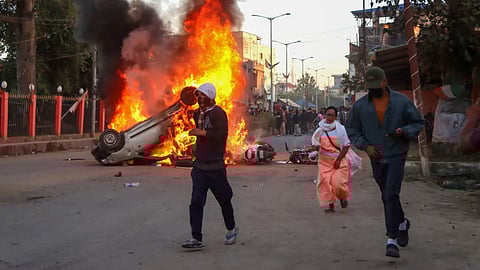
Following a tentative pause in violence earlier this year, a suspected rocket attack allegedly by tribal Kuki-Zo militants in Tronglaobi village in Manipur’s Bishnupur district resulted in the death of two children on April 7. It once again sparked widespread unrest across the northeastern border state. Protesters torched vehicles, vandalised public property, and clashed with security forces, leading to multiple injuries and at least five reported deaths as of April 20, according to The Hindu. Security forces have since intensified deployments and launched search operations after another rocket-propelled grenade was recovered near the site. The Manipur government has suspended mobile internet services in five districts and ordered a National Investigation Agency (NIA) probe, which has been hindered by the blockade of the Bishnupur-Churachandpur road for the last 12 days. The recent violence has also embroiled Manipur’s Naga population, following the killing of two individuals, including a retired Army personnel, who were shot dead along National Highway 202 in Manipur on Saturday, 18 April, after unidentified armed assailants opened fire on vehicles heading towards Ukhrul, according to The Assam Tribune.
Nearly three years after the first clashes of May 2023, Manipur remains trapped in a cycle of violence because the conflict was never only about one court order or one protest. The Manipur High Court’s direction on Scheduled Tribe status for the Meitei community acted as a trigger, but the deeper fault lines are much older: unequal political power between the valley and hill districts, competing claims over land and natural resources, demographic anxieties, narco-trafficking routes along the Myanmar border, insurgent histories, weak governance, and long-standing mistrust between the Meitei majority concentrated in the Imphal valley and Kuki-Zo tribal communities in the hills. Once violence began, neighbourhoods were ethnically divided, populations displaced, and armed civilian militias emerged, making reconciliation harder with each passing month as institutional safeguards failed to stop the violence.
The state’s geography is now marked by segregation, relief camps for the internally displaced peoples, militarisation, and parallel narratives of victimhood. In such conditions, every killing, rumour, road blockade, or rocket attack can reignite mass unrest, as seen in the recent wave of protests. Political responses have so far been reactive rather than pre-emptive, focusing on security deployments instead of sustained dialogue, justice, rehabilitation, and negotiations about resource sharing.
As Indian citizens, we should pay attention to what’s happening in Manipur because it is not a distant periphery but part of the Republic, and what happens there reveals how precarious our existence can become when institutions fail. Mainstream TV news choosing to by-and-large ignore the crisis has only normalised selective empathy: while some crises dominate headlines, others disappear. Ignoring Manipur also means ignoring questions central to India’s future, such as federalism, minority rights, border security, migration, and whether democratic states can protect plural societies in moments of deep fracture.
While mainstream Hindi and English news media have largely overlooked the recent wave of Manipur violence, the following regional media platforms based in Manipur have continued to report on the situation:
The Sangai Express: One of Manipur’s most established English-language newspapers, known for its extensive local reporting, editorials, and day-to-day coverage of politics, civil society, and conflict across the state. Read here.
Imphal Times: An independent news outlet focused on current affairs, governance, human rights, and public-interest reporting, with particular attention to issues often overlooked by national media. Read here.
The Frontier Manipur: A news outlet rooted in Ukhrul district, offering coverage of Tangkhul Naga society, hill district affairs, grassroots politics, and developments in Manipur from a regional perspective. Read here.
Ukhrul Times: A news outlet rooted in the Ukhrul district, offering coverage of Tangkhul Naga society, hill district affairs, grassroots politics, and developments in Manipur from a regional perspective. Read here.
