
- HOMEGROWN WORLD
- HGCREATORS
- HGEXPLORE
- HGVOICES
- HGSHOP
- CAREERS
- ABOUT US
- CONTACT US

Daal & Bass is a UK-based collective and record label founded by Nico to create a platform for South Asian artists working across underground electronic music. Drawing from his own journey from soundsystem culture to reconnecting with his heritage, the collective brings together garage, jungle, drum & bass, house, techno, folk and South Asian sounds. Through its Aisle by Aisle series, events, editorial work and new record label, the collective is building an ecosystem around South Asian music and culture, with the larger ambition of creating a global space where artists can represent their identities while being taken seriously within electronic music.
Nico, the founder and director of the UK-based collective and record label Daal & Bass grew up in a predominantly white working-class area, where the easiest way to get by was to blend in. Kids around him would make fun of anything to do with his culture, so he wasn’t really connected to anything South Asian. His two best friends were Caribbean, and his earliest relationship with music came from soundsystem culture — reggae, jungle, then garage and grime. For a long time, those two parts of his life existed separately. “It was only in my early twenties that the music I was building a career around and the heritage I was slowly working my way back towards started to meet,” he notes.
After spending fourteen years promoting dance music events and booking artists including Chase & Status, Sammy Virji and Kettama across the underground dance music spectrum, Nico noticed how almost nobody in those rooms who looked like him. “Not on the line-ups, not behind the scenes. Just me and my small crew,” he recalls. Daal & Bass came from recognising that he was in an unusual position to bring those two worlds together: his upbringing, his career in rave culture and a heritage he was beginning to know, love and feel proud to represent.
The collective was created around the huge amount of creativity happening where South Asian culture and UK electronic music meet, while recognising that there wasn’t necessarily a platform representing the full breadth of it. From the beginning, it aimed to celebrate South Asian dance music without reducing it to one genre, one sound or one idea of what South Asian culture is supposed to look like. Garage, jungle, drum & bass, house, techno, amapiano, folk influences and traditional sounds could all exist in the same universe. “The idea is for South Asians to see themselves represented and celebrated, while giving people who didn’t grow up around the culture a way into it,” says Nico.
Alongside him overseeing operations is Chelsea, who he calls his number two. As the only white English person in the core team, she tells us, becoming part of the collective has introduced her to South Asian music alongside its food, humour, family stories, films, and traditions. She now sees Daal & Bass as a doorway for others as well. Paul is the team editor who manages the socials, and Harun is their culture and editorial lead, who always found separate club nights for different genres odd. The Bhangra Nights he witnessed in Uni at Nottingham amazed him. “However, the edits and remixes we would play at the pre-drinks were never reflected in the club,” he notes. Having grown up in what he calls the golden age of UK Bhangra music, Punjabi Garage was the soundtrack of Harun’s childhood.
Now with Daal & Bass, he wants to create a new listening experience for people who grew up amidst the same sounds and music. “There are people who have done it before,” he tells us. “And there is going to be a new generation that pushes these sounds to a whole new level.”
Sukh Night, for example, was a big influence on Nico. “He's got numerous dubstep and grime records built on South Asian samples,” he shares. “Chase & Status with ‘Eastern Jam’ was another. Four Tet and Phaeleh were doing it too, more towards the ambient end of the spectrum.” Nico’s first real exposure to these two worlds meeting was at the raves in the North and Midlands Sheffield and Nottingham — “places where bass music is a big thing,” he notes. “So I didn't come to it through Bollywood or through weddings. I came to it through Soundsystem, in a dark room.”
The collective’s name came from a happy mistake too, when Nico was programming a South Asian event with his collaborator Connor, who was trying to say “dhol”, the drum, but pronounced it “daal”. Nico immediately thought, “Actually, Daal & Bass sounds better than Dhol & Bass. And everyone loves daal, right?”
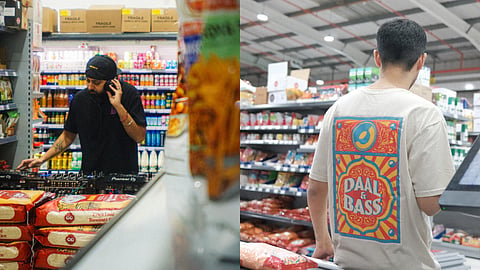
For its now-popular Aisle by Aisle series, Daal & Bass take a live set to a South Asian cash and carry, surrounded by bags of rice and other groceries; an image that’s nostalgic and still part of our daily lives. “These spaces, these people and these cultural references belong in contemporary music culture,” states Nico. We don't have to strip the South Asian context away to make the music feel global.” The series was also conceptualised as a reflection of Daal & Bass’ relationship with the artists, local businesses and the community at large.
While the line-up can go from UKG, garage and D&B to folk, amapiano, experimental electronic music and traditional South Asian sounds, the collective isn’t keen on a restrictive “Daal & Bass sound”. “We'd rather people recognise a Daal & Bass feeling — culturally rooted, forward-thinking, playful, sometimes unexpected, but always authentic,” shares Nico. Though he does credit finding the right artists as key in defining where Daal & Bass is heading musically.
Now with its own record label that feels like ‘the next logical piece’ for the founders, Daal & Bass aims to build an ecosystem where releases can connect with content, live opportunities, collaborations, audiences and community. They refuse to let a release die down after a hype-phase and urge on thinking about what happens afterwards: finding a new audience, appearing on a line-up, collaborating with someone they might otherwise never meet, being discovered internationally and becoming part of a much bigger musical conversation.
Daal & Bass is building towards becoming a lifestyle and a global cultural space that connects music, media, events, community and culture. “Ultimately, we want South Asian artists to have more spaces where they don't have to choose between celebrating their identity and being taken seriously within global electronic music.” The team is also looking into new ways to experience, represent and participate in Daal & Bass beyond listening to a record or coming to an event — “South Asian culture is the heart of Daal & Bass, but everybody is invited to the party.”
Follow Daal & Bass here.
If you enjoyed reading this, here's more from Homegrown:
‘My Mum Told Me Not To Marry An Atheist’: Inside Amina Beg's Stand-Up & DJ-Led Special
'Tributes' Have Become Both The Lifeblood & The Existential Crisis Of Indian Live Music
Attakkari Talks 'Kalyani Drip', Girlhood & The Future Of Indian Electronic Music
