
- HOMEGROWN WORLD
- HGCREATORS
- HGEXPLORE
- HGVOICES
- HGSHOP
- CAREERS
- ABOUT US
- CONTACT US

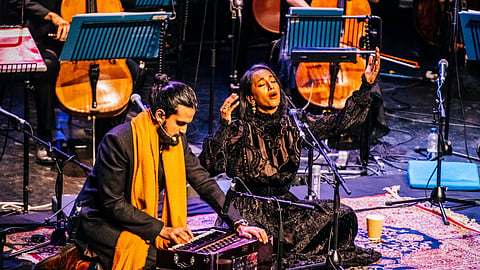
After taking their meeting of Sufi devotional music, Indian classical traditions, and Western orchestral composition to some of the world’s most prestigious concert halls, composer Rushil Ranjan and vocalist Abi Sampa are bringing the Orchestral Qawwali Project to India for the first time. Ahead of their four-city December tour, the duo reflect on the unlikely beginnings of their collaboration, the spiritual possibilities of music, and what it means to return to the audiences who have supported them from the beginning.
When Rushil Ranjan and Abi Sampa first met at Oxford’s Sheldonian Theatre in 2016, neither knew that their collaboration would eventually become The Orchestral Qawwali Project. “We were both playing qawwali in our own different ways,” Sampa says when we talk ahead of the duo’s four-city India tour in December. “I was playing it in a more traditional sense with harmonium and tabla, and Rushil was looking at ways to explore different styles of music to bring together.”
“We recorded the first few qawwalis in 2019,” Sampa says. “Then Rushil kind of went away saying, ‘I am going to make something.’ I didn’t really know what he was going to do. But then he went and composed lots of string melodies to go around it.”
One of their earliest collaborations was an orchestral interpretation of ‘Man Kunto Maula’, often attributed to the 13th-century Sufi mystic and poet Amir Khusrow and considered to be the first qawwali ever composed. The piece introduced audiences to the idea that qawwali’s devotional intensity could inhabit an expansive orchestral arrangement without losing any of its emotional intensity. Released in early 2020, the music video currently has over seven million views on YouTube. The rest, as the saying goes, is history.
The Orchestral Qawwali Project (OQP) as it exists today is an ambitious musical undertaking that has since taken Ranjan and Sampa from small recording sessions and single music videos on YouTube to some of the world’s most celebrated concert halls.
“It has been an iterative process,” Ranjan says. “We’ve discovered the sound ourselves, discovered the ability or the practical realities around delivering that sound live. So it has been this wonderful, organic process of working out how we bring these two art forms together.”
“When I first started doing this, I wasn’t a classical composer. I wasn’t someone trained in the art form,” he adds. “ So I did whatever I could to create the sound in my mind as best as I could. As I’ve gone on through experience and having the great privilege of working with some of these incredible orchestras and choirs, that vocabulary has increased. But the message and the goal has always been the same — to create that feeling of divinity and kind of ecstasy that you get from qawwali music.”
“I think the most important thing for us is trying to keep as much as possible the essence of true qawwali as much as we can,” Sampa says when I ask them about how they balance the improvisational nature of traditional qawwali with the structure of a Western orchestra. “Obviously, there’s always a compromise. But when we sit down to work together, we hash out a structure of the actual qawwali that we want to present. And then Rushil will write in areas where there will be a bit more freedom for the singers and for me to improvise.”
“For me, it comes down to what we consider the essence of both these musical forms to be. Is improvisation at the very heart of qawwali, or is it one of the means through which some of its greatest exponents, such as Ustad Nusrat Fateh Ali Khan Sahib, brought spirituality into the room with their audiences? I would argue it's the latter,” Rushil says. “At its core, qawwali is a way of embodying spirituality through the recitation of poetry. As long as that essence remains intact, which I believe it does in what we present, we’re simply using a slightly different musical vocabulary to communicate the same message. We still incorporate a great deal of improvisation, and Abi is a world-class Indian classical performer, but the essence of qawwali remains unchanged, even if it’s expressed differently.”
“It’s also important to understand that this music was never intended to supplant existing forms of qawwali or Western classical music. It’s meant to exist alongside them as our interpretation of these traditions,” he adds. “This is our way of expressing and experiencing that same spirituality. ”
Historically, qawwali was performed in the intimate spaces of Sufi dargahs (shrines) and khanaqahs (hermitages) across South Asia as a form of devotional music. The tradition has since gone through several evolutions as a distinctive genre of film music in Bollywood and now in its orchestral iteration through the Orchestral Qawwali Project. Abi and Rushil have taken qawwali to places where it had never existed before. How do they feel about the response from audiences who do not necessarily understand the poetry and the devotional nature of qawwali? I ask.
“We’ve played to so many people, and in some places we play, a majority of the audience is not from South Asian backgrounds,” Rushil answers. “They are not familiar with any of it, and they sometimes have the most profound reactions because they’re not expecting it. They may have a preconceived notion of what South Asian music is. And there’s a lot of exoticised South Asian music that has been prevalent in Western culture. So when they hear something like this, it’s really different.”
“The most wonderful thing to see is that even though they don’t know the meaning of the words, they have that profound reaction. And that’s really exciting,” he says. “Vice versa as well, when we play for largely South Asian audiences, it might be their first time seeing an orchestra and choir. And that’s always inspiring to see because they have a really profound emotional response to that music.”
I ask if the response has changed how they think about the universality of music as a language or as a mode of communication?
“I think it’s confirmed a hope that I’ve always had that music is really quite universal. And that kind of applies across genres. We’re seeing this everywhere, right? It’s like this giant K-pop movement in India, or whole swathes of China where people are obsessed with Bollywood movies. Look at what Diljit (Dosanjh) is doing for Punjabi music worldwide. If music is good, people just like it, you know? And that’s really cool. That’s really, really cool to see.”
As our conversation nears its end, I ask how they feel about bringing the Orchestral Qawwali Project to India, the birthplace of qawwali. “Do you feel any kind of responsibility in bringing Qawwali back to an Indian music audience with this India tour?” I ask.
“I think it’s wonderful for us to be able to come back and play this music for the people who supported it the most when it first came out,” Rushil says. “The biggest and strongest reaction that we always get when our music comes out into the world is from India. So we’re excited about that!”
Six years after its inception, Ranjan believes The Orchestral Qawwali Project has moved beyond the uncertainty that initially surrounded it. What began as an experiment has developed into a universal musical language with possibilities of its own. As the duo look towards exploring the sonic possibilities of the veena or the devotional sound of bhajans in the future, their first India tour arrives as both a homecoming and a new beginning. As Rushil says, “the point at which Western and Eastern classical music meet is genuinely a wonderful starting point to lots of different paths and lots of different interpretations.” All of those paths have led to this moment. The future of qawwali is here, and the future of qawwali is now.
The Orchestral Qawwali Project will tour India for the first time this December, with performances at Yashobhoomi, Delhi (December 5), Terraform Arena, Bengaluru (December 6), Ramoji Film City, Hyderabad (December 12), and JW Marriott Sahar, Mumbai (December 13).