
- HOMEGROWN WORLD
- HGCREATORS
- HGEXPLORE
- HGVOICES
- HGSHOP
- CAREERS
- ABOUT US
- CONTACT US

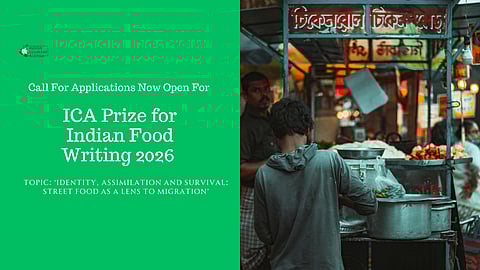
Migration has always shaped what and how we eat, but nowhere is this more visible than on India’s streets. As rapid urbanisation redraws the social and economic map of Indian cities, the third edition of the Indian Culinary Agenda (ICA) Prize for Indian Food Writing turns to street food as a living record of identity, assimilation, and survival at a time when critical food writing in India has become more necessary than ever.
Migration has always been one of the primary engines of culinary change: as people move, settle, and negotiate with local food cultures, they generate new, hybrid cuisines and informal food systems. What is cooked and sold on the streets today actively shapes how a country’s culinary identity is imagined, shared, and consumed beyond the street and the nation. The historical development of street food in Indian cities reflects shifting socio-economic hierarchies, regional exchanges, and long histories of migration and assimilation.
At the same time, the scale and speed of contemporary urbanisation make street food essential for understanding changing labour economies, population movements, and the politics of urban planning and policy. While food studies across South Asia and India have grown steadily, a significant gap persists in sustained research and critical writing on street food, particularly in state capitals and megacities where these exchanges are most visible and volatile. Street food does more than reflect urban life — it actively shapes the physical character of public spaces and the everyday interactions between communities across time. These layered histories and negotiations also open crucial pathways for examining foundational ingredients and practices, such as our evolving relationships with milk and dairy.
As India undergoes urbanisation at an unprecedented pace and migration continues to reshape the social and economic fabric of Indian cities, the third edition of the Indian Culinary Agenda (ICA) Prize for Indian Food Writing takes on the theme: 'Identity, Assimilation and Survival: Street Food as a Lens to Migration'. Open to Indian nationals, the prize invites paper proposals from writers, researchers, and practitioners working across disciplines.
ICA argues that despite an expanding body of South Asian food studies, street food — especially in relation to state capitals and megacities — remains under-researched. This is a critical omission in a country where informal food economies feed millions daily and offer some of the most accessible entry points into questions of migration, caste, gendered labour, and urban policy. By foregrounding street food as a research subject rather than a lifestyle accessory, the prize signals a deliberate move away from culinary romanticism toward political inquiry.
The call for submissions is broadly interdisciplinary, welcoming perspectives from history, anthropology, sociology, public policy, literature, and practitioners embedded in street kitchens. While the approaches may vary, ICA insists that all papers remain rooted in food and cookery, examining how they interact with forces like migration, survival, memory, and urban space.
Submissions opened on December 1, 2025, with proposals due by December 31, 2025. Selected authors will be notified by 10 January 2026, and final papers are due 10 April 2026 for presentation at the ICA Weekend. The winning author will receive a ₹50,000 cash prize.
Learn more about the ICA Writing Prize here.
If you enjoyed reading this, here’s more from Homegrown:
Indian Food Writers Are Using Their Work As Tools Of Cultural Connection & Preservation
Archana Pidathala’s ‘Five Morsels Of Love’ Defies The Flattening Of Indian Culinary Art
Shahu Patole’s New Book Serves Up A Powerful Critique Of Caste Through The Lens Of Food
