
- HOMEGROWN WORLD
- HGCREATORS
- HGEXPLORE
- HGVOICES
- HGSHOP
- CAREERS
- ABOUT US
- CONTACT US

This article is about The Kunj, a new craft-forward space developed by Cultre with the Office of the Development Commissioner (Handicrafts), and explores its core themes: craft as a living system, process-based display, mobility, material intelligence, and blurring the boundaries between gallery, workshop, and retail.
Indian handicraft may be one of the most prolific forms of cultural continuity in the world, yet its public presence is often reduced to static displays or tourist-oriented retail. Whats lost in displays like that is the reality that craft is a living system shaped by migration, material knowledge, regional identity and the everyday economies of making. The Kunj, a project developed by Cultre in collaboration with the Office of the Development Commissioner (Handicrafts), attempts to correct that gap by designing a space where craft is encountered as practice. It positions artisans not as keepers of tradition but as contemporary producers whose work belongs in active, evolving environments.
The Kunj’s approach begins with an architectural decision by rejecting the sterile divide between gallery, workshop and retail. Instead, the space operates as a continuous narrative where visitors move through zones that reveal how objects come into being. Here, colour, light and material are used deliberately; tools, textiles and production remnants become structural elements, turning the display into a form of storytelling. This ethos sets the foundation for every installation inside the project.
The Diya Wall, for instance, transforms a simple registration point into a participatory installation. Lamps sourced from Dokra metal casters, deepam makers and clay artisans line a green wall, creating an immediate encounter with regional techniques. Visitors 'light' a digital diya through a QR code, establishing both a symbolic gesture and a subtle reminder that craft can function within contemporary modes of engagement. From there, the space flows naturally into the Hand(i)crafted Garden — an oversized, modular landscape where bamboo, cane, terracotta and textiles are shaped into flora and fauna. Built to travel and reconfigure, it becomes a statement about mobility and adaptability.
The project’s curatorial core, Karigar Sangam, takes it into a more formal environment. Using the DC Handicrafts archive, Cultre selected around 100 National Award and award-participating works and placed them in a gallery that borrows equally from museum design and retail strategy. Deep-coloured walls, framed textiles and a mural of Indian postage stamps create a layered context in which the pieces can be read as both cultural documents and viable contemporary products. It is one of the clearest demonstrations of The Kunj’s intention: to cut the distance between appreciation and use.
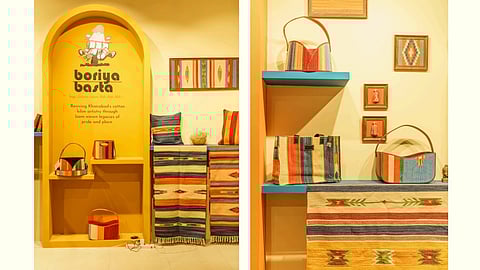
Adjacent zones continue building this connection. Khel Ghar, positioned at the mall entrance, uses traditional games and handcrafted toys to foreground play as cultural knowledge. Retail areas display brands through their own materials and processes, ensuring that context is never stripped from the commerce. Even demonstration spaces such as Kala Manch maintain this principle, giving artisans a visible, working presence. Photographic selections like 'Of Hands and Heritage' reinforce it further by placing process and portraiture side by side.
Across the project, Cultre’s design is less about the preservation of craft and more about keeping it in circulation. The Kunj is proof that that when craft is placed in environments that reflect how it is made, used and sustained, it regains its full dimension as the cultural force it is.
Follow The Kunj here.
