
- HOMEGROWN WORLD
- HGCREATORS
- HGEXPLORE
- HGVOICES
- HGSHOP
- CAREERS
- ABOUT US
- CONTACT US

Nepali filmmaker Abinash Bikram Shah made history at the Cannes Film Festival when his debut feature ‘Elephants in the Fog’ won the Un Certain Regard Jury Prize, marking a landmark moment for Nepali cinema and bringing stories of the Kinnar community from Nepal’s Terai plains to the global stage.
History was made at the Debussy Theatre on 23 May when Nepali filmmaker Abinash Bikram Singh’s first feature film, ‘Elephants in the Fog’, won the Un Certain Regard Jury Prize at the 79th Cannes Film Festival. A first for Nepal, it was a watershed moment for the Himalayan nation’s cinema, which has long existed on the margins of the global film circuit. It was also the first Nepali production ever to be selected for the Un Certain Regard section, which runs in parallel with the main competition for the Palme d’Or.
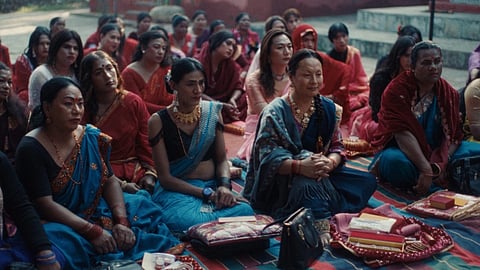
Set in Thori, a small village in Nepal’s southern Terai plains, the film follows a community of transgender and intersex women living at the edge of a society that rejects them. The film’s protagonist Pirati is a matriarch of the Kinnar community, whose dreams of escaping this ostracism with the man she loves are shattered when one of her daughters goes missing. Starring ushpa Thing, Deepika Yadav, Jasmine Bishwakarma, Shanti Giri, Gauri Malla, Maotse Gurung, Sanjay Gupta Dura, Mahima Nawabag and Akanksha Karki, and members of the genderqueer Kinnar community, the film is a co-production between Underground Talkies Nepal and Jayanthi Creations, with partners from France, Germany, Brazil, and Norway.
The Kinnar community at the film’s heart occupies a space deeply familiar to South Asian audiences. Revered in ritual and refused in daily life, they exist in an uncomfortable dichotomy — feared as cursed individuals and venerated for their supposed power to bless others with good fortune. In his acceptance speech, Shah gave voice to what the film had always been about. “For so long, the lives of Pirati and her daughters, the communities and all the persons who are in the East, have been kept invisible,” he said. “By bringing our story here and by recognising it with this award, we have pulled those margins into the light. We have made the invisible visible.”
Cannes is not an unfamiliar territory for Shah, whose earlier short film ‘Lori’ received a Special Mention at the 75th edition of the festival, widely considered by cinephiles as one of the most prestigious platforms for global cinema. ‘Lori’ was also the first Nepali film to earn that recognition.
For Shah himself, the prize was secondary to the platform. “Being here matters not just for the film, but for the subject. This community. This story,” he told Film Fest Report before the awards announcement. “Visibility at a place like Cannes changes what people are willing to consider, what stories they will sit with. That matters to me more than any prize.”
Follow @abinashbikramshah on Instagram.
If you enjoyed reading this, here’s more from Homegrown:
The Sattya Media Arts Collective Is Shaping A New Era Of Nepali Culture & Creativity
Queer Joy, Memory & Resistance Take Centre Stage At The Kashish Pride Film Festival 2026
‘No Way Out’: Tara Lily’s Gothic New Music Video Was Inspired By Nepali Folk Tales
