
On Painting With Light & Building Worlds: In Conversation With Photographer Rishi Raj

Rishi Raj, the Chennai-based photographer and trained Bharatanatyam dancer, has spent much of his life making room for the many sides of himself. Dance was his first language of expression, taking him from his early training in Bihar to the Kalakshetra Foundation in Chennai, where photography entered the picture during his college years.
Growing up, he was ofted told that he 'behaved like a girl' but Rishi could never find the shame in it given the beauty, grace and kindness he saw in women. The acceptance he received from his father and grandfather gave him further strength to follow his instincts, which now manifests as a femininity, grace and fluidity in his photographs — something that has always been alive within him.
Seeing men marry other men often gave a young Rishi the courage to imagine a similar possibility for himself. Now having recently married the love of his life in Switzerland, the artist speaks to Homegrown about the freedom to be yourself in art and in love, alongside his work that becomes a canvas for his inner child.
We spoke last year for our Editorial Photographers piece on how fashion editorial photography has given you a space to present your vision and imagination and explore your queer identity. Could we dive deeper into it a little bit? I’d love to know what a day in the studio looks like. Given that you’ve really developed your own visual language over the years, how does the collaboration with the design, wardrobe and makeup team go? Are you leading the ‘look’ for the editorial, or does everyone arrive at it over a brainstorming session? Also, do you think you can trace a journey from when you went from being an editorial photographer to a creative director yourself?
A studio day begins many days before the shoot. I spend time understanding the brand and its products, then develop the concept, mood board and overall look. My visual language comes from my culture and everything I’ve learnt through dance and the arts. For me, photography goes beyond picking up a camera—it’s about presenting my vision.
Once the client approves the direction, I bring the creative team together. I like to start around eight or nine in the morning and stay involved from hair and makeup onwards. I lead the overall look, while giving everyone room to contribute. I choose these artists for their creativity, just as a designer chooses me for my vision. That mutual trust matters to me.
During the shoot, we look at the images together and keep adjusting. The direction begins with me, but everyone’s ideas can help it grow into something even more exciting than the mood board.
I feel I’ve always been a storyteller and creative director first, even before I had those words for it. The vision comes into my mind first, and then I work with a team to bring it to life through photography. So, for me, it wasn’t a clear transition from editorial photographer to creative director. Photography became the medium through which I could express the stories and worlds I was already imagining.
You’ve also been vocal about how paintings inspire a lot of your images. And while it’s a medium where artists first began exploring the possibilities of light, from Rembrandt’s triangle to Vermeer’s treatment of natural light and the way it falls across a room, I’d love to understand how you translate some of these painterly techniques into photography. Given your admiration for Raja Ravi Varma, how do you approach your lighting setup, the placement of your subjects and the surrounding environment to recreate that same depth and balance through actual light sources? Also, how much of it is fine-tuned in post?
I learnt painting as a child, and that stayed with me—the richness of colour in oils and watercolours, and how light creates depth. Raja Ravi Varma is a huge inspiration. I remember seeing his painting of Ravana, Sita and Jatayu in Mysore and being absorbed by the movement, expressions, clothing, colours and emotion within one frame. I also love M. V. Dhurandhar’s work for how it reflects people and the society around them.
I often think of the camera as an empty box that you fill with everything you’ve learnt. For me, that includes Indian classical dance, painting, theatre, costumes, makeup and hair. All of these shape how I create an image.
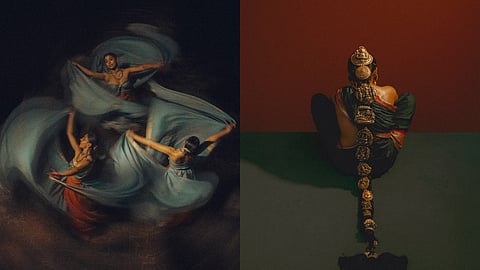
With lighting, I’m drawn to something natural and believable. I use natural light whenever possible; otherwise, I use flash or continuous light to recreate that feeling. I don’t usually use many lights, because I want to preserve shadows and midtones rather than light everything evenly. The colours, backdrop and the way the model stands all contribute to that painterly feeling.
Post-production is a big part of completing it. The foundation is there when I shoot, but editing is where I develop the final look—adjusting colours, highlights, midtones and shadows, including introducing colour into the shadows themselves. The painterly quality comes from all these decisions coming together, and post-production is what completes the image for me.
You’ve probably seen Szilveszter Makó’s work, with his editorials appearing across several major fashion publications. Although I love his work, I found myself having mixed feelings about the Hollywood publicity machine taking over an aesthetic that someone has spent years developing. He has cultivated an original visual language, putting a tremendous amount of art, thought and labour into his work, and he deserves the recognition and success that comes with it. But there is something worth questioning about how fashion publications repeatedly gravitate towards a recognisable style and commercialize it like this. Having been in the industry for a while yourself and worked with different brands, I’m curious what you think about this relationship between an artist developing a very personal visual language and the way it's consumed in an industry. Do you think there's a point at which that kind of visibility begins to work against the work itself, or is that simply an inevitable part of an artist reaching a larger audience?
Honestly, whether we agree with it or not, I feel like we’re living in Szilveszter Mako’s fantasy world right now, especially in fashion. Whenever I see his work, I think, “Oh my God, this guy is a genius.” I admire him enormously, and I understand why an industry that is always looking for something new is drawn to such a distinctive visual language.
I also think an artist deserves to earn from something they’ve spent years developing. Commercial success can support their life and give them the resources to keep creating. Reaching a larger audience is a great thing, and I feel repetition can help an artist reach more people.
For me, what matters is whether the artist continues to explore within that language. Recognition doesn’t have to be the end of experimentation. With Mako, I’m excited to see what comes next. I feel this could be just the beginning, and I believe his work will keep evolving.
You create an entirely new character with almost every editorial you work on. A lot of these go back to Indian mythologies, historical references and the visual language of older paintings, while others emerge from your collaborations with brands, which gives birth to more contemporary personas; sometimes there’s even a mix of both worlds. There's a considerable amount of world-building and character-building involved in this kind of work through composition, which makes Editorial photography so philosophically different from street or documentary photography. I think one of my very first experiences of understanding how rich a single frame can be, and how much it could communicate, came through movies — watching how one still shot, or the mise-en-scène, could tell you so much about a story. I'm curious whether cinema has been an influence on the way you approach your editorials. Do you think the films you’ve seen have informed your storytelling sensibilities in any way?
When I imagine an editorial, I imagine the whole world first—the backdrop, props, supporting characters and how everything will exist together. Then I imagine the character within that world: their clothing, hair, makeup and what feels right for them in that setting.
Cinema inspires me a lot in that sense. Watching The Colour of Pomegranates, I felt that every single frame was a piece of art. Dune also inspires me through its world-building. In Indian cinema, I’m drawn to the worlds Sanjay Leela Bhansali creates in certain films—the scale, colours and composition. I also love older Bollywood films like Pakeezah, where the spaces themselves are so beautiful.
Beyond cinema, John Galliano’s Fall/Winter 2005 haute couture show for Dior inspired me enormously. Every model felt like an individual character within a complete world. It taught me how clothing, hair, makeup and the way someone carries themselves can suggest a whole personality. These influences make me think about how much a single frame can hold, and how deeply I can develop the characters within it.
I also wonder… Do you ever find yourself imagining who these ‘characters’ are beyond the frame: what they dream about, what makes them sad, what their lives might look like? Do you see parts of yourself in them? Have there been particular editorials where a character you created began to feel almost like a real person to you, someone whose inner life you found yourself invested in?
Two characters particularly close to my heart are from Bird of Paradise and Midnight. I worked with the same wonderful model, Alois, for both. My characters come from many different influences, and these two brought together things that feel very personal to me.
Bird of Paradise was named after the flower I used in the editorial. It brought together Indian culture and my admiration for Frida Kahlo—her strong personality and the cultural symbolism in her work and how she presented herself. Bringing those worlds together in one character was exciting for me.
In Midnight, I imagined a blue goddess within a midnight world, wearing striking red. She wore my mother’s wedding sari with a corset, Indian jewellery and long, loose hair. I had wanted to create a blue character for a long time. Growing up, my uncle taught me stories from the Ramayana and Mahabharata, and I became curious about their imagery, especially Vishnu’s blue colour. I’m not very religious, but I admire the beauty within religious imagery.
I see parts of myself in these characters through the memories, culture and influences they carry. That is what makes them feel close to me, and I want to keep exploring this world-building and character-building in my future editorials.
You've been a Bharatanatyam dancer yourself, and on your other page you've built quite an extensive body of work with different dancers, often photographing them in beautiful historic locations. I'm curious about what these shoots mean to you personally. Do you feel a different kind of connection to your work when you're photographing dancers, perhaps something that takes you back to your own relationship with the art form? Is there something you find in these shoots that you don't necessarily get from your studio editorials? And have you ever thought about moving into video and documenting/directing dance performances, or do you feel there's something about the still image that video can never quite achieve?
Photographing dancers is very personal to me. Before pursuing it full-time, I taught dance to children at Isha Foundation for about a year and a half. Teaching showed me how differently each student understood and experienced dance. Around that time, I also began exploring dance photography with my colleagues.
Afterwards, I worked in wedding photography for almost a year. I enjoyed it deeply—I would sometimes cry behind the camera watching the couple get married. But I felt my own connection to dance had taken a back seat, and I missed it. Eventually, I left the company to pursue dance photography full-time. Bringing together something I had spent so much of my life learning with photography gave me a deep happiness and a way to express my creativity.
That said, I wouldn’t say dance photography gives me something my fashion editorials don’t. Fashion editorials fulfil my creative mind, heart and inner child too. Classical dance has conventions and boundaries that I respect when photographing it. In editorial storytelling, I feel freer to go wherever my imagination takes me. I enjoy both in different ways.
Before moving into fashion photography about three years ago, I also wanted to document senior dancers and teachers through video, including Ambika teacher and the teachers I learnt from during my Bharatanatyam degree. I didn’t have the money or resources then, but I would still love to do it.
Still photography and video each have their own beauty and offer different experiences. I’m interested in exploring video as a director and creative director in the future. Right now, though, I’m enjoying photography and creative direction, and that is where my focus is.
Follow Rishi here.
If you enjoyed reading this, here's more from Homegrown:
The Alchemy Of Thought & Image: Homegrown Editorial Photographers On Our Radar
‘The Loneliness Of Sticking To Your Guns’: Kira Issar’s Melancholic Image-Making Practice
Technicolor Nostalgia: Alia Romagnoli's Portraits Are Vibrant Expressions Of Selfhood