
- HOMEGROWN WORLD
- HGCREATORS
- HGEXPLORE
- HGVOICES
- HGSHOP
- CAREERS
- ABOUT US
- CONTACT US

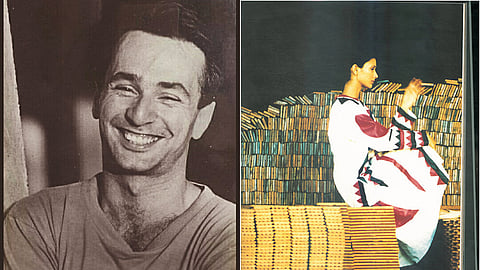
Rohit Khosla was one of the earliest Indian designers to imagine what Indian haute couture could be. Long before the industry took shape, he redefined fashion through craft, structure, and modernity. His short, brilliant career continues to shape how India understands style, image-making, and design today.
What should Indian haute couture look like?
In the 1980s, Rohit Khosla was one of the first Indian designers to ask this question. An alumnus of Kingston University, London, Khosla entered the scene when modern Indian fashion was still nascent. At the time, the fashion-conscious Indian wore either traditional saris and kurtas or imported western wear; there was no bridge between the two. Khosla’s vision was to use India’s vast craft heritage to create high-fashion garments that could stand alongside European couture. One could say that the journey of Indian fashion can be traced through the story of Khosla’s brief but luminous life.
In 1987, Khosla co-founded the Ensemble — India’s first multi-designer boutique — with designer Tarun Tahiliani and his wife Sailaja Tahiliani. Before Ensemble, “designer” clothing was limited to small boutiques selling the owner’s own wares, like Ravissant or Bina Modi’s Obsession. There was no retail space that curated multiple distinct voices. Ensemble was a departure from this model; it opened with five labels under the same roof: Rohit Khosla, Tarun Tahiliani, Neil Bieff, Amaya, and Abu Jani-Sandeep Khosla.
Despite initial struggles to educate the market on the value of design over mere material cost and tailoring, or the concept of “paying for a label”, Ensemble was the first step towards professionalising the Indian fashion industry. It was the fashion-historical equivalent of what we now think of as a “platform.” Khosla understood early that for individual creators — in this case, designers — to survive, they needed a collective distribution channel that elevated their perceived value.
Khosla’s work was characterized by a “contextualist” approach — rooted in Indian materials but executed with an international, often severe, sensibility. He rejected the “pretty” and “exoticised” aesthetic of traditional Indian formal wear in favor of a more structural, earthy aesthetic. He was the first to use jute rope as embroidery and crinkled cottons for voluminous kurtas, elevating humble materials to couture status. One of his most famous collections was ‘Dust and Coal’ (1991), which utilized a palette of muted earth tones, blacks, and charcoal, defying the Indian preference for bright, festive colors.
Khosla was also a pioneer in the evolution of modern Indian editorial photography. His collaboration with photographer Prabuddha Dasgupta was critical in this evolution. Khosla was arguably India’s first fashion stylist. He did not just make clothes; he curated “looks.” He worked closely with Dasgupta to create images that were moody, stark, and atmospheric, moving away from the smiling, commercial-catalogue looks of the time. He was instrumental in the careers of India’s first supermodels, such as Mehr Jesia, Madhu Sapre, and Shyamolie Verma. According to historian William Dalrymple, “Rohit Khosla and Rohit Bal, along with (Prabuddha) Dasgupta, invented glamour in India.”
Rohit Khosla died of cancer at the age of 36 in 1994. His premature death cut short a career at its peak, but his influence remains ubiquitous in contemporary Indian fashion. He is remembered by designers, editors, and fashion students as both a thinker and a creator — someone who saw fashion as a form of cultural expression rather than just an industry.
To learn more about Rohit Khosla's life and work, read Rohit Khosla: Vanguard (1998).
If you enjoyed reading this, here’s more from Homegrown:
How November Noon Is Rewriting The Notion Of Banarasi Weaves With Each New Collection
QUOD’s New Collection Personifies Their Founders Ikshit Pande's Slow Algorithm Rebellion
Divyam Mehta’s Latest Collection Was Shaped By Their Experiments With Shibori
