
- HOMEGROWN WORLD
- HGCREATORS
- HGEXPLORE
- HGVOICES
- HGSHOP
- CAREERS
- ABOUT US
- CONTACT US

India may be one of the world’s biggest film-producing nations, but millions still live far from a cinema hall. PictureTime is changing that with travelling inflatable theatres that bring films to rural India, reviving the spirit of the travelling bioscopewala for the modern age.
At the turn of the 20th century, as motion pictures arrived in India with the Lumière brothers’ 1896 showcase in Mumbai, another strange and sublime figure became a phenomenon in rural India: the travelling bioscopewala. The bioscopewalas were travelling projectionists who journeyed to the remotest villages and settlements of the country with hand-cranked film projectors showing early film reels of moving images, much to the delight of old and young alike. In the early decades of Indian cinema, from the 1890s to the 1950s, most of the moving images and motion pictures shown in India were not projected onto the silver screen of a dedicated cinema hall but on a travelling bioscopewala’s hand-cranked projector. Even now, a vast majority of Indian movies are consumed on the makeshift tents of India’s great travelling cinemas, far from the glamorous red carpets of Mumbai and the massive movie screens of air-conditioned multiplexes in major Indian cities.
Despite being one of the world’s largest film-producing nations, India has only around 9,000 cinema screens in a market believed to have the potential for more than 150,000. The result is both limited access for audiences, and limited opportunity for filmmakers. Of the roughly 2,000 films made in India each year, only a fraction secure theatrical release, while many others disappear unseen into the endless labyrinth of streaming services or studio storage. Conversely, although Indian cinema’s global reach has only grown with time, rural India’s access to cinema has been limited because of logistical and economic realities.
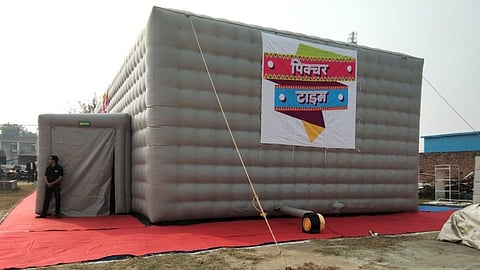
PictureTime was born out of the idea that cinema should not belong only to metros and Tier 1 cities. In 2015, entrepreneur Sushil Chaudhary developed what he describes as the world’s first mobile cinema with a small team working out of a garage. What began as an experiment has since evolved into a travelling exhibition model that has carried the big-screen experience to the remotest corners of the country — from Leh, Ladakh, to Sardarshahar in Rajasthan — reaching audiences who may never have entered a conventional theatre.
Instead of expensive brick-and-mortar multiplexes that often struggle to remain viable beyond major urban centres, PictureTime uses patented Acoustic Enabled Inflated Enclosure (AEIE) structures — portable, air-conditioned cinemas fitted with 5.1 Dolby sound and comfortable push-back seating. In practical terms, that means an empty ground in a moffusil town can become a cinema by nightfall, bringing back to life a quintessentially Indian pastime many assumed had vanished for good.
PictureTime frames its mission as one to empower, educate, and entertain underserved communities, while creating new, piracy-resistant theatrical avenues for filmmakers. It is reviving the cinema as a third space — a commons where stories travel farther than roads can take us, and where the promise of the first day, first show finally reaches the last mile.
Follow @picturetimedigiplex on Instagram.
If you enjoyed reading this, here’s more from Homegrown:
India’s First Filmmaker: The Forgotten Legacy Of Hiralal Sen
A Bold New Wave: 3 Indian Creators Who Are Reshaping The Way We Tell Stories Online
Apply For Netflix India’s Climate Scriptwriting Lab 2026: What You Need To Know
