
- HOMEGROWN WORLD
- HGCREATORS
- HGEXPLORE
- HGVOICES
- HGSHOP
- CAREERS
- ABOUT US
- CONTACT US

Set in a remote North Indian settlement, Yashasvi Juyal’s debut feature ‘The Ink-Stained Hand & The Missing Thumb’ follows a toll collector who mysteriously returns to the living after his accidental death. While Juyal offers an evocative blend of speculative fiction and social commentary, the film’s languid pacing and lack of narrative momentum ultimately undermine an otherwise fascinating premise.
On 11 December 2003, Santosh (Dheeraj Kumar), a toll worker stationed on the edge of a remote North Indian highway, dies after a truck crashes into his booth. A day later, he wakes beside a small stream and begins visiting the people he knew in life: the elderly tea seller, his drinking buddies, the local barber, and Rajji (Bhumika Dube), his colleague and lover. Is he an apparition? Or is this a resurrection? Filmmaker Yashasvi Juyal’s debut feature ‘The Ink-Stained Hand & The Missing Thumb’ uses this conceit to confront the invisible structures of migration, resistance, and accelerated development in the Himalayan foothills.
It’s a compelling setup. The toll booth is an inspired metaphor: a place built to facilitate movement, occupied by workers who remain permanently suspended between destinations. Juyal’s interest in liminal spaces, ecological transformation, and spectral memory aligns his film with a new wave of South Asian speculative cinema that has used folklore and the supernatural to explore contemporary realities.
Unfortunately, the promise of the premise rarely materialises on screen. Juyal clearly favours an observational mode of filmmaking. But his attempts at evoking stillness and poignance through long, lingering shots of people and places make for a mind-numbingly slow two hours without the requisite emotional payoff one would expect from a feature film of this length. A village where nothing happens can be fascinating in itself; but a film where almost nothing happens is another matter altogether. Again and again, the film trades stillness for depth, withholding narrative progression without replacing it with psychological insight or visual revelation.
As an admirer of South Asian speculative short films and features — like Cargo, Bulbbul, Debi, Hawa, and Moshari — which use the supernatural to comment on contemporary issues such as climate change, gender politics, and migration, I wish I had better things to say about ‘The Ink-Stained Hand & The Missing Thumb’. Those films understand that atmosphere and narrative are not opposing forces but complementary ones. Their supernatural conceits continually generate new emotional, philosophical, or dramatic possibilities.
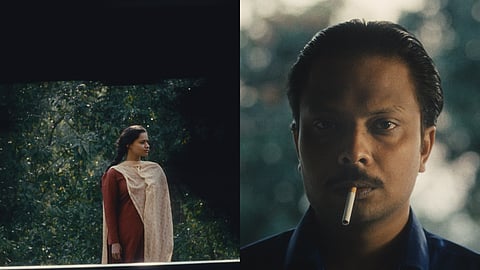
Juyal’s film, by contrast, too often slows to a pause. Its ghost story rarely accumulates mystery, its romance struggles to deepen beyond suggestion, and its political concerns remain largely implicit. It’s a beautiful film to look at, but the cinematic medium is not simply a collection of beautiful, evocative images, and Juyal’s debut is sadly missing an essential quality of the moving image: momentum. All its potential is lost in its slumbering pace.
The American author Kurt Vonnegut famously had eight fundamental rules of creative writing. The first one was: Use the time of a total stranger in such a way that he or she will not feel the time was wasted. It is perhaps an unfair standard to apply literally to cinema. After all, many great films deliberately resist conventional pacing. But they reward patience with discovery. Yashasvi Juyal’s ‘The Ink-Stained Hand & The Missing Thumb’ sadly asks for that same patience without offering a commensurate return. For a film about lives suspended in transit, it spends too much time standing still.
