
- HOMEGROWN WORLD
- HGCREATORS
- HGEXPLORE
- HGVOICES
- HGSHOP
- CAREERS
- ABOUT US
- CONTACT US

The article looks at 'Barber of the Gods', Sushant Nagpal’s debut fiction short, which draws from Hindu cosmology and the myth of Savita Maharishi to build a mytho-urban narrative around a family of barbers. It explores how the film uses parallel timelines and a supernatural premise to examine generational conflict, inherited professions, and the burden of tradition, framing it as a critique of blind faith and the idea of sacredness.
How come barbershops are never open at night in India? When Sushant Nagpal, the theatre director and filmmaker from Haryana started questioning that, it led him to Hindu cosmology. Barbershops are intimate communal spaces where men from all walks of life gather under flickering tube lights, soothed by old Bollywood melodies and the promise of a head massage. Yet, culturally, these spaces are surrounded by taboos — in Hindu tradition, cutting hair on certain days like Tuesdays is avoided, many shops shut on religious festivals, and even a haircut after sunset is considered inauspicious.
These seemingly arbitrary rituals pushed Sushant toward a deeper, stranger relationship between hair, Hindu cosmology, and a lesser-known mythological figure: Savita Maharishi, the divine barber of the Gods. Savita Maharishi is said to have performed Ayushkarma — a life-extending ritual service — to Shiva himself, who was so satisfied that he blessed the Maharishi in return. The collision of that mythology with the image of a nighttime barbershop became the seed for his latest short film, 'Barber of the Gods', a mytho-urban fable exploring legacy and the cost of blind faith. The short film was selected for the Dharamshala International Film Festival 2025 and marks Sushant Nagpal's debut as a writer-director in a fiction.
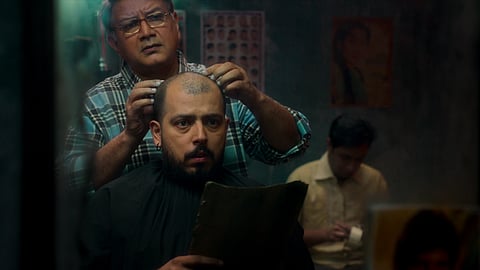
Starring Kumud Mishra and Jaivardhan Lakhera, 'Barber of the Gods' is built on two timelines tied by the same premise. A father and son run a barbershop under the cover of darkness, possessing a magical power that can grow anyone’s hair for a few years off their life in return. In a parallel, mythological realm, two divine barbers, the guru and his young apprentice Tenali, tend to the gods themselves.
Both timelines have the same conflict: the younger one wants to do more than what has been assigned to them, clashing against their authority figure, who sees that as a threat to everything they've built and believed in. Tenali, the apprentice, wants to invent a potion to help anyone without hair, out of both a compassion for the shame they feel and the glory of healers and surgeons, which barbers are rarely accorded. The son in the present-day timeline, too, wants a life outside the family trade entirely to pursue an internship elsewhere. Both the guru and the father respond to that with contempt and punishment.
Nepotism has often been a point of debate in popular culture; to question the privilege that comes from one’s reach within an industry. 'Barber of the Gods' uses a generational vocation to examine the flip side of that coin. In India, taking over your parents’ business is often a choice you don’t get to make. Trying to find your own path ends up translating to a rejection of the family’s identity and an abandonment of duty. The father in the short film threatens his son into falling in line and learning the work because it is ‘important and sacred’.
Through a questionable ritual that gives the father and son their powers, the film questions the true nature of all that we deem sacred — even religion itself. So many of the wars that have taken place and continue to be perpetrated on this planet are done so in the name of religion. Yet, all this history of violence never seems to penetrate the shells of the practice of its followers. For them, the sanctimony of religion exempts it from accountability for centuries of bloodshed and casteism.
By rooting it in mythology, Sushant pushes his debut film into an important examination of the chains of tradition that bind us and our devotion to corrupt gods, whom or whatever they may be.
Follow Sushant here.
If you enjoyed reading this, here's more from Homegrown:
Queer Life Is Always Political: The Radical Power Of ‘Don’t Interrupt While We Dance’
Documentary ‘i see myself in you’ Explores Punjabi Immigrant Life & Belonging In Brampton
In ‘I, Poppy,’ A Mother & Son Navigate Survival & Resistance In India’s Opium Economy
