
- HOMEGROWN WORLD
- HGCREATORS
- HGEXPLORE
- HGVOICES
- HGSHOP
- CAREERS
- ABOUT US
- CONTACT US

'I, Poppy,' Vivek Chaudhary’s documentary on a poppy-farming family in rural Rajasthan, uses their daily life to examine how India’s legal opium cultivation system operates through licenses, quotas, and bureaucratic control. Centred on Vardibai and her son Mangilal, the film explores tensions between survival and resistance, as his activism against corruption puts the family’s livelihood at risk, while also highlighting the politics that surround labour, caste, and generational divides.
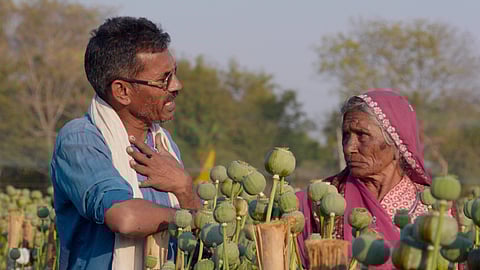
Across five years in rural Rajasthan, in a tale of labour and negotiation, Vivek Chaudhary’s 'I, Poppy' follows a poppy-farming family and uses their everyday life to show how India’s legal opium cultivation system actually works on the ground. The film centres on Vardibai Meghwal, who grows poppy under a government license, and her son Mangilal, who has become increasingly involved in organising farmers and speaking out against corruption in the system. The documentary premiered at the Hot Docs Canadian International Documentary Festival in 2025, where it won Best International Feature, and much of its strength comes from how closely it stays with this one family while gradually revealing the larger web they are caught in.
In India, poppy cultivation is allowed but tightly regulated, which means farmers depend on licenses, inspections, and government procurement to continue working. The film shows how this system creates a lot of uncertainty and pressure, because farmers have very little control over decisions that directly affect their income. Officials decide whether a license is granted or renewed, the amount of produce is accepted, and whether a farmer has met the required quota. Over time, this leads to informal payments becoming part of the process, since many farmers feel that paying bribes is the only way to avoid losing their license or facing penalties. Vardibai has learned to navigate this system through experience and sees it as something that cannot be changed easily, especially when the family depends on a stable crop cycle to survive.
Mangilal takes a very different approach, and the film spends a lot of time following his efforts to challenge these practices. He speaks to other farmers, files complaints, travels to meet officials, and tries to push for more transparency in how licenses are handled. His activism brings attention to the issue, but it also puts his own family at risk, because officials can respond by tightening scrutiny or threatening to cancel their license. This struggle and its risks run through the film, affecting the household’s income, the amount of land they can cultivate, and their ability to continue farming in the next season.
Visually, the film leans into a realist lyricism with soft, textured imagery that’s never aestheticised to the point of detachment. The poppy fields are central, but don’t turn into postcard landscapes. They’re tactile and vibrant with flowers, but intertwined with the subtext of labour. A recurring contrast of close-ups in the fields, where bodies and labour dominate the frame, versus more static, distanced compositions at home — people boxed in by doorways, pillars, and architecture subtly reinforces the idea of entrapment.
The pink of the poppy flowers and the Ambedkarite blues bring the themes of the film into the frame, building layers of storytelling. A strong undercurrent of generational and gendered labour politics runs through everything. The film shows how the physical labour that runs the house is done by the mother, while resistance is taken up by the son. And neither is enough on its own.
Vivek shoots the film in a fly-on-the-wall, observational style, without a voiceover, so most of the narrative comes from conversations, phone calls, and daily routines. The camera stays with the family in their home and in the fields, through decisions made and how disagreements played out. Cinematographer Mustaqeem Khan, who also comes from a farming background, focuses on the physical details of the work as well as the administrative side of it, while editors Tanushree Das and Camille Mouton rely on a journalistic unfolding of events that also informs the emotional sensibility of a film that cradles heavy themes like bigotry through a humanistic lens. The relationship of Vardibai and Mangilal, too, which moves between tenderness and frustration, lends itself as the sensitive looking glass into what is an incredibly insidious socio-political landscape.
Follow Vivek here and watch the trailer for the documentary below:
