
- HOMEGROWN WORLD
- HGCREATORS
- HGEXPLORE
- HGVOICES
- HGSHOP
- CAREERS
- ABOUT US
- CONTACT US

This article covers Sustaina India 3, titled Bitter Nectar, an exhibition presented by the Council on Energy, Environment and Water (CEEW). It outlines the exhibition’s focus on food systems as a way to understand how climate change is already affecting everyday life in India, including shifts in agricultural cycles, taste, yield, and labour. The summary touches on the curatorial framework, the material and installation choices rooted in reuse and agricultural waste, and key participating works and artists such as Anuja Dasgupta, Mrugen Rathod, Harmeet Singh, Sidhant Kumar, Lakshita Munjal, and Vedant Patil.
The imprint of a place can be found directly on its food. Seasons, labour, soil, and water, and changes in climate affect how food is grown, harvested, transported, and consumed. Now with rising temperatures and irregular rainfall we are already seeing a shift in when crops ripen, how they taste, and how much they yield; causing a disruption of the agricultural calendars that communities have relied on for generations. These changes accumulate through everyday adjustments across farms, markets, and supply chains, shaping decisions that are often made out of necessity, not choice. ‘Bitter Nectar’, the third edition of Sustaina India, uses food as a way to examine how climate change is already unfolding in daily life across India.
Presented by the Council on Energy, Environment and Water (CEEW), Sustaina India 3 addresses the reality that climate change in India is no longer a distant concern. As Mihir Shah, Director of Strategic Communications at CEEW, states, “Amidst the turbulence of geopolitics and a reordering of the world order, climate change continues to remain a critical risk. 2025 was the third hottest year on record.” He points to how climate impacts are reshaping what India grows, consumes, and relies on, with disruptions to food systems and seasonal rhythms directly affecting communities, livelihoods, and labour conditions.
Shaped under the exhibition leadership of Thukral and Tagra, Sustaina India 3 emerged from an open call that received 232 applications grounded in Indian climate dialogue and a deep exploration of the ecologies around these artists. “Rooted in knowledge systems of milk, mango, and apricot, it is the pursuit of sweetness and the hidden intricacies and nuances well beneath it that stood out to us the most,” they share.
“Agronets are now a part of the interventions to protect fruiting in climate dialogues, and we use this materiality in our walls and on top of artworks as ‘our’ way of protecting the ideas that grow within,” share Thukral and Tagra. Untreated canvas and wood form the structural base of the exhibition, plinths and standees are produced from agricultural waste, and discarded towels and bedsheets sourced from hotel enterprises are used to shield artworks. Installation methods avoid plastic packaging and rely on tarpaulin made from textile waste for cushioning and flooring, keeping questions of material use, reuse, and protection present throughout the space.
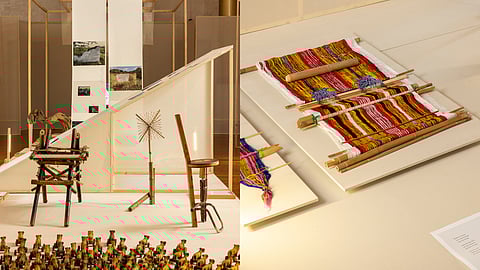
Among the works presented is རི་ (Rē)Frame by Anuja Dasgupta, which focuses on the apricot as a central agricultural presence in Ladakh’s Sham Valley. “Cultivating the fruit since centuries, Ladakh is India’s biggest producer of apricots, yet the public image of Ladakh rarely draws on the apricot or the age-old agricultural practices around it. Ladakh’s dramatic peaks often feature as spectacles for the climate emergency, but its actuality is felt immediately in the fate of the apricot,” she shares. In her installation རི་ (Rē)Frame, the 12-month annual cycle is increasingly shifting, with the disruption of seasonal rhythms that fundamentally shaped traditional agricultural systems. With repeated play, the soft poplar wood blocks chafe, creating more visible gaps and unevenness within the frame.
Thukral and Tagra emphasise the importance of moving beyond visual engagement alone. They hope the visitors can feel the intentions in the materiality; texture, taste and other physical dimensions, that are integral to understand sensibility and sensitivity of ecologies and climate discourse. Across the exhibition, apricot kernels produced through repeated engagement, Mrugen Rathod’s 550 aam-sher made from the soil of Gir, Harmeet Singh’s poetry inscribed on keekar bark and created with his father, films and sound works by Sidhant Kumar, Lakshita Munjal’s two-person chair made from waste, Vedant Patil’s documentary tracing milk economies and the works of other artists like Abhinand Kishore, Ankur Yadav, Pooja Kaloy, and Smita Minda collectively place environmental knowledge within bodily experience and inherited responsibility.
They also address how urban living has distanced many people from the systems that sustain food production and ecological balance. Thukral and Tagra point to how convenience-driven lifestyles often obscure labour, interdependence, and ecological processes. Through Bitter Nectar, they aim to redirect attention toward the conditions that sustain everyday life. “It invites reflection on the tensions between sustainability and sustenance, while foregrounding how climate change generates uncertainty and consequences that are collectively borne by bodies, species, and systems, including those that were not implicated in the decisions or actions that initiated these disruptions.” they note.
Alongside the exhibition, Sustaina India 3 features a public programme of talks, workshops, performances, and hands-on sessions designed to encourage participation across age groups. The exhibition also offers practical prompts related to eating seasonal food, diversifying diets, and waste segregation. CEEW situates these actions within longer histories of reuse, repair, and sharing that shaped everyday life in India as practical responses to limits.
The exhibition is up till February 15 at Bikaner House in New Delhi. Follow Sustaina India here.
