
- HOMEGROWN WORLD
- #HGCREATORS
- #HGEXPLORE
- #HGVOICES
- #HGSHOP
- CAREERS
- ABOUT US
- CONTACT US
In classical India, art was almost always connected to the divine. The arts were seen as a gift from God, and artists were regarded as extensions and carriers of that divinity. But somewhere along the line — through colonialism and capitalism — art began to lose its perceived worth. It was reduced to a “hobby” or a “fantasy,” while artists were dismissed as “dreamers” or “hippies.”
Art has also always been deeply classist and casteist. Access to certain art forms was historically limited to privileged sections of society, while the labour involved in creating the instruments for these forms was delegated to marginalised communities. For instance, a tabla player is celebrated as an ustad — a maestro, often a man from an upper-class, upper-caste background. Meanwhile, the person who makes the tabla, traditionally working with goat skin, is from a lower caste. After all, how could a Brahmin man handle raw animal skin while crafting the instrument?
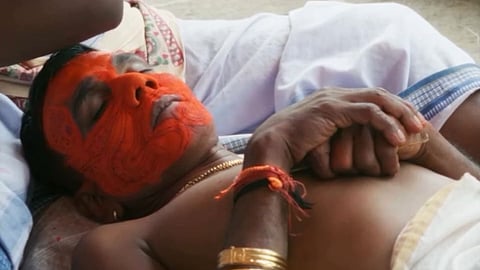
There are some art forms that bring the gods to you. 'Theyyam', found across North Kerala and parts of Karnataka, is one such tradition. A folk ritual rooted deeply in tribal animism, it involves men painting their faces in vivid reds and oranges, adorning themselves with elaborate crowns, and dancing in a trance-like state. It is similar to Bhoota Kola, seen in Karnataka and depicted in the film 'Kantara'.

The practice of Theyyam — a word that translates to “god” — predates Hinduism itself. It can be performed only by members of 15 select Dalit communities, and exclusively by men. It presents a striking paradox: for the duration of the ritual, these men are elevated to divinity, placed above even a Brahmin man. Yet, as soon as the paint fades and the performance ends, they are returned to the same social space they occupied before. Atharva Mhaske’s upcoming film 'Becoming God: The Art of Theyyam', aims to capture this same duality.
By positioning the artists in the centre of the film, it is an exploration of what goes into "becoming God”. “Capturing Theyyam in this way felt important because I wanted to hold both worlds together in the same frame, the divine and the deeply human. The film is an attempt to question why a community that gives society its gods is still denied dignity. I felt that if I didn’t document this, the gap between the ritualistic respect and the everyday neglect would remain invisible”, explains Atharva Mhaske, who spent 3 days in Kannur, Kerala with a small team of three people documenting the Theyyam festival.
It captures that moment of transformation: for a fraction of a moment, these people, who have been marginalised their whole life are put on an elevated pedestal. And even though they are given this ephemeral status, they are not compensated for their art equitably. The only thing they get is the crowd’s veneration and respect: “The tragedy, and the beauty, lies in how temporary it is. Once the makeup comes off, the reality of caste returns.”
As a country, we have always had a complicated relationship with religion and our gods. They are so intrinsically woven into our cultural fabric that it feels almost impossible to view the construct and hierarchy of religion separately from our faith in divinity. 'Becoming God: The Art of Theyyam' asks what it means to worship a body on stage while denying its dignity, and why reverence in ritual does not translate into respect in life. While watching Theyyam, we are confronted with a society that is willing to bow before divinity, but not before the people who embody it.
You can watch the trailer for the film here, and follow the director on Instagram here.
If you enjoyed reading this here's more from Homegrown:
'The Divine Hustle': Watch A Documentary On Faith, Survival, & The Business Of Religion
Documentary 'By The River' Is A Poetic Exploration Of Life, Death, & Faith in Varanasi
Almost Gods x FILA's New Collection Is A Brutalist Confluence Of Sport & Mythmaking
