
- HOMEGROWN WORLD
- HGCREATORS
- HGEXPLORE
- HGVOICES
- HGSHOP
- CAREERS
- ABOUT US
- CONTACT US
This piece traces the evolution of the koodai, a traditional Tamil basket, from its origins in palmyra palm weaving to its transformation into plastic wire forms in the late 20th century. Rooted in community and ceremony, koodai-making reflects the social and cultural rhythms of South Indian life. Today, brands like Koodai Kadaii and Knots Bag are reimagining the koodai through contemporary design, bringing renewed visibility to a once-overlooked craft. The story positions the koodai as more than a functional object, highlighting it as a lens to understand the resilience, adaptation, and evolving identity of Indian craft in a modern context.
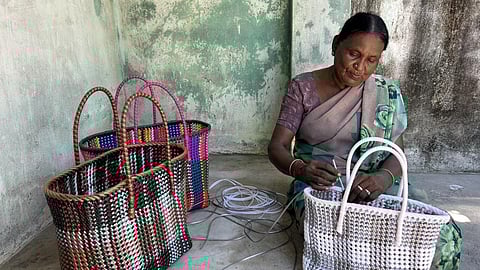
The word “koodai” simply means “basket” in Tamil, but its history stretches far beyond the brightly coloured plastic versions most people remember. Traditionally, these baskets were made from palmyra palm leaves, a material deeply embedded in South Indian life. The palmyra itself is often referred to as a “tree of life” in Tamil culture, valued not just for weaving but for its fruit, sap, and timber — making the koodai part of a larger, sustainable ecosystem of use.
In regions like Chettinad, women would gather in courtyards, slicing palm leaves into thin strips, dyeing them, and weaving them into baskets known as kottans or koodais. Over time, as materials evolved, so did the koodai. By the late 20th century, palm leaves gave way to plastic wire or tape, making the bags lighter, more durable, and weather-resistant. By the 80s and 90s, these woven wire koodais had become a staple in Tamil households, used for everything from school lunches to market errands. This transition wasn’t simply aesthetic; it reflected broader economic and material shifts, where accessibility and affordability began to shape everyday objects.

Today, brands like Koodai Kadaii and Knots Bag are reshaping the koodai into something both nostalgic and contemporary. Koodai Kadaii centres community, working with women from welfare institutions and creating playful, recognisable designs like its signature heart-motif bags, turning everyday utility into something emotionally resonant. In contrast, Knots Bag leans into design innovation, reworking the koodai into structured silhouettes with bamboo handles, metal accents, and experimental materials like apple leather. In doing so, both brands move the koodai into new spaces — boutiques, digital platforms, and global markets — without it entirely losing its local roots.
What ties them together is a shared intent to make the invisible visible. They are repositioning, the koodai not just as a functional object, but as a marker of craft, identity, and evolving Indian aesthetics, where tradition is continuously reimagined in response to the present instead of being in stasis.
Craft here operates in a space between utility and identity. It is domestic and communal, often gendered, frequently undervalued, and yet deeply resilient. Practices like koodai weaving were historically not 'industries' but extensions of everyday life, done in between chores, shared across generations, embedded in social rhythms. This also explains why many such crafts were never formally documented; they survive through repetition rather than instruction manuals; through inheritance rather than institutions.
At the same time, craft in India has always negotiated with change. The shift from palm leaf to plastic is one example, a pragmatic adaptation rather than a simple loss. But industrialisation and mass-produced alternatives did push many such practices to the margins, reducing both demand and visibility. What we’re witnessing now, however, is a renewed interest in craft as a way to rethink consumption and the value of labour. In that sense, the koodai is no longer just a basket; it becomes a lens through which to understand how tradition adapts, survives, and finds new relevance in a rapidly changing world.
If you enjoyed reading this, here's more from Homegrown:
How Coonoor & Co Works With Artisans In The Nilgiris To Develop Craft-Based Products
Groceries, Books, & Emotional Baggage: The Distinctly Indian Origins Of The Tote Bag
