
- HOMEGROWN WORLD
- HGCREATORS
- HGEXPLORE
- HGVOICES
- HGSHOP
- CAREERS
- ABOUT US
- CONTACT US

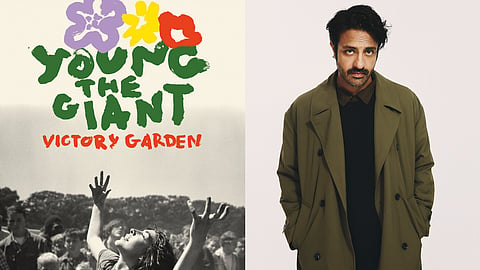
Homegrown speaks to Young the Giant frontman Sameer Gadhia about his journey through indie rock as a South Asian American, what the genre has lost as the music industry has changed, and how those questions of identity, belonging and survival have found their way into the band’s music — including their latest album, 'Victory Garden'.
“If pop music is GMO popcorn, indie rock is organic, single-origin, popping kernels,” says Sameer Gadhia, frontman of American indie-rock band Young The Giant, who are giants themselves in the alternative scene for their sweeping ‘anthemic alt rock’ voice. Made up of Sameer alongside Jacob Tilley, Eric Cannata, Payam Doostzadeh, and François Comtois, the band is a crew of first- and second-generation Americans who originally started out in Irvine, California, in 2004 and have since become an indie staple. In 2021, years after its initial release, you couldn't escape their track ‘Mind Over Matter’, which went viral online for its soaring, sentimental chorus that made everyone weak in the knees. Today we speak to Sameer about the mythos of indie rock and their latest album, ‘Victory Garden’.
From the ‘orange summery’ portrait of late adolescence that was their debut eponymous album to the bolder immigrant testimonials of ‘American Bollywood’, each album in Young The Giant’s discography is like a hypothesis the band is trying to test out. “The first album was just, do people find what we are doing naturally worth paying attention to? We did not think about it at the time, but upon review almost two decades later, that is mostly every artist’s debut question,” says Sameer. At the time, he didn’t think it was necessary to contextualise himself. “I was maybe in some sort of denial and did not delve into my origins,” he notes.
Sameer had been ‘lucky’ enough to be raised with plenty of other Indians, attending cultural enrichment programs or desi parties, and was always close with a large group of Indian friends. “But being a South Asian American as an indie rock musician, in a traditionally white space, was the equivalent of being dropped into an all-white school, where there was no longer any context for others to understand me,” he recalls. As his career continued, he felt the need to create a lexicon so that other Indian musicians could walk after him, with their third album ‘Home of the Strange’ in 2016, and eventually ‘American Bollywood’ in 2022. “Calling out this existence was perhaps to the detriment of my career, but I felt creatively compelled there. Like the sirens, I could not avoid it despite more sober judgement,” he tells us. Today, after having built that lexicon of an assimilated identity, he believes that just continuing to exist in the space is the work.
For me, Indie rock is what the black sheep of the family is into — the sensitive, introspective kind — the "slacker" generation that feels misaligned with mainstream culture. The genre is filled with themes of anxious perfectionism, existential dread and navigating adulthood while having the "miserable overachiever" complex — something a desi kid knows well, given the inevitable search for self within the enmeshments of a South Asian family. “I love this comparison!’ says Sameer after I posit this to him. “The yearning to carve out one’s own path is not dissimilar to growing up in a desi household, where the collective familial good supersedes that of the individual.”
However, he points out how this doesn’t quite fall in line with the Indie Rock excelsis, which is “not trying” or finding beauty in the mundane — a milieu Sameer was brought up in as well. Because of his childhood, and the sacrifices and choices he has had to make to get where he is, his music tends to “skew dramatic”. For him, this is in contrast to a lot of indie rock as a whole. “Even though indie rock was forged in the crucible of angst and yearning, there have been generations of indie rock musicians (primarily white ones) who do not find common ground with anything dramatic. Be it through different cultural values, generational wealth, art school education, or the glorification of those like Hemingway, the dramatic streak is not always there,” he says, which speaks to the reflective sentimentality the band has come to be known for as well.
Indie rock was a different beast in the 2000s and early 2010s. An evolution of sorts that combined the angst of grunge, the irreverence, and energy of pop punk and the pathos of 90s-era alternative rock and pop, it became the most prominent expression of rock; it was everywhere, from commercials to movies and television shows.
You had The O.C. turning bands like Death Cab for Cutie and Phantom Planet into household names overnight, Gossip Girl scoring with The Strokes and Vampire Weekend, 500 Days of Summer with its elevator scene on The Smiths, while Twilight had Muse, Radiohead and Iron & Wine. Heck, even Apple got Feist, whose “1234” soundtracked its 2007 iPod Nano campaign, and Volkswagen used Nick Drake to sell sedans. The genre was running the main stage of culture, holding its own against whatever mega-pop monster was on the radio, which isn’t the case today.
However, Sameer argues that streaming is a quantitative analysis, not a qualitative one, so the numbers that have become sacrosanct today don’t tell the whole story. “Indie rock has always been headphone music. Not party music,” he insists. “Higher-tier Indie Rock artists stream way lower than low-tier pop or hip-hop artists, because Indie Rock is often not a casual, light listen,” he notes. Which means that the data may show that it’s not performing well, and yet one listen can change a person’s life. “For example, Geese constantly hovers just above 1 million monthly listeners, and yet they are one of the most talked about bands of the moment,” says the artist.
Also, you can’t not blame the economy. Sameer points out that in the 2000s, there were still revenue streams or platforms that could make being a band financially viable. Today, the path to becoming profitable is almost insurmountable for young bands. “Unless you come from wealthy families, that is — which perpetuates Indie Rock as being inaccessible to the middle class,” he explains.
For Sameer, the infrastructure that upholds a music ecosystem is also being overshadowed by the celebrity and star-making culture of social media that has made us a self-obsessed society. “We see billion-dollar industries being built around that one person, failing to realize the team around the person that helps create it,” he muses. “We all believe we can do it all on our own, that we don’t need to compromise, communicate, collaborate, in order to see our vision through. Even though it is a false narrative, you still see solo artists dominating the charts.”
Alongside reevaluating the data, factoring in the ‘qualitative marks’ beyond just numbers, Sameer insists that bands need new platforms to be visible. “Instagram and TikTok do not suffice, where the individual artist will always win out,” he says.
Visibility doesn’t seem to be a problem for Young The Giant, though. Their songs have found their way into films and television shows including Teen Wolf, The Vampire Diaries, Outer Banks, 13 Reasons Why, Grey’s Anatomy, and Lucifer — something Sameer says he is ‘always in awe' of. He thinks the songs chosen for television speak to a universal experience or reference a moment in shared history that is now gone: nostalgia, which also proves the point he made earlier — indie isn’t dead or sidelined from pop culture — you just have to look beyond the noise, as you do for anything real.
Which is what the band was after too for their latest album. ‘Victory Garden’ comes 4 years after their last project, which was made during the pandemic. For this one, Sameer really wanted to “get back to being a part of a band, and experiencing air moving in a room”. “I don’t think these songs would have been made if we weren’t,” he says. They practised what they call ‘intuitive songwriting’ — allowing for the feeling of momentum to take precedence over the need to curate or analyse.’ “Songs like Evergreen, Ships Passing, Bitter Fruit, came very quickly without overthinking, and if we had stopped to analyse each sound or each phrase, it would not have flowed as easily,” reflects Sameer. “We realised that our limitations, being the five musicians that we are, is also our greatest strength.”
Perhaps it was the collective joy of doing what they do together that comes through as a shining optimism in the album, taking various shapes across each track — On ‘Evergreen’, there’s a mythic image of life as a garden you’re walking through. ‘Different Kind of Love’ has the hurt, but it tells you not to give up. On ‘Bitter Fruit’, you're bruised, you're a little faithless, but you still want a taste of it. But it’s also not a fool’s optimism; it doesn’t lose its wit and spice like in ‘Monalisa’ or its power and FTW-attitude in ‘God as Witness’.
Sameer reckons that the band needed something to hold on to in a time of turmoil. Blessed with music as an avenue to process heavy times, they created this beacon for themselves, hoping that it could be a salvation for others listening to it in the way it was making it for them. “I think it is the lowest form of human intelligence to be cynical. It’s so cliché,” shares Sameer. “I think it is much harder to have gone through chaos, darkness, to find hope; empathy. That is an earned optimism — these songs represent that. I have had my fair share of very dark moments, and nothing feels better than getting back into the light.”
Follow Young The Giant here and listen to 'Victory Garden' below:
