
- HOMEGROWN WORLD
- HGCREATORS
- HGEXPLORE
- HGVOICES
- HGSHOP
- CAREERS
- ABOUT US
- CONTACT US

BassFace is a Pune-based collective working to grow the city’s underground bass music scene, with sounds spanning Drum and Bass, Jungle, Dubstep, Neurofunk and Breakcore. Through its Bass Tapri series, the collective is creating an inclusive, immersive dancefloor culture with a 'Puneri' character, while finding creative ways to introduce more people to bass music.
“Why isn’t there an active bass music scene in Pune?” Is the question that brought Namita, Kailas and Laukik together. Coming from different backgrounds, they shared an interest in bass music and began thinking about what it would take to create a dancefloor that felt ‘safe, inclusive and genuinely present/grounded’. “What makes it rooted in culture? We realized one thing common about it is that when certain music is played, we all FEEL something,” they tell Homegrown. “That led to 'BassFace' as the collective and 'Bass Tapri' as an IP to push Bass music in the most Puneri way possible.”
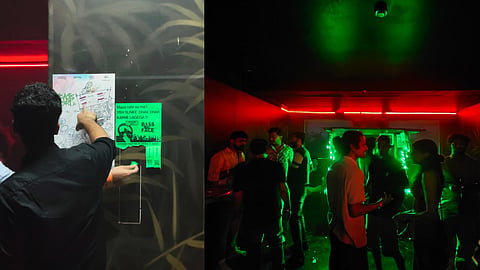
An underground music movement dedicated to bass music and its related subgenres, including Drum and Bass, Jungle, Neurofunk, Dubstep and Breakcore, BassFace’s first event ‘Bass Tapri’ took place in May 2026 at antiSOCIAL on FC Road, Pune, featuring Three Oscillators, Rajah Betta, Beeptya and SPYR. The series aims to bring together local and national artists for nights centred on bass music, with room for enthusiasts, newcomers and seasoned listeners alike.
The collective was intentional about choosing antiSOCIAL as its venue. The team felt that the venue had a strong vision of including the cultural aspects of each location it operates in, and that this aligned closely with what BassFace wanted to do. Bass Tapri takes that local connection further with its tapri theme: for the second edition, there will be a proper tapri inside antiSOCIAL where people can buy the things they would usually find at one. The night also comes with a no-phone, no-reel-browsing, and no-video-recording policy, encouraging everyone to stay with the music and the people around them.
For Kailas, the connection to bass music began with reggae and dub. “My zillenial brain also connected the dots with Powerpuff Girls OST and Prodigy and NFS 2 that I used to listen to as a kid,” he shares. “My little stint in Goa exposed me to the sound system culture, 10000 Lions, Reggae Rajahs, Ananda Tandava Sound System and big butt audio.” His parallel exposure to Drum and Bass and Jungle changed how he understood the genre, and he has been pushing bass music for several years. At the time, he was still learning the ropes, and he feels an idea like Bass Tapri would have been difficult to do justice to then. Now, he is part of making it happen.
“It tickles a playful, mischievous side of me,” says Namita, who in 2024 was standing right in front of a female DJ called Baby Diwata at a rave, “and the way she was playing something so hardcore with a straight face almost felt like she was doing an operation on me,” she recalls. “When I asked her about the music she was playing, every single one pointed to bass music. That's when I started developing a vocabulary for the sounds."
Laukik, a music enthusiast and promoter, traces his introduction to the sound back to 2009, when he was playing FIFA Street 2 and came across a track by SHY FX. The music was new to him, and it made him curious. “Bass music makes me feel on the go and energetic. I have been curious since. I love when music is rooted and authentic and stands for something,” he notes.
The three founders also see room for bass music to reach more listeners in India. Kailas points out that bass music has been around here for years, including Rabbi Shergill using a breakcore beat in “Heer” in the early 2000s and NH7 having a stage called Pepsi Dubstation. The sound was eventually masked under the wider EDM boom, though it continued to survive underground. Across the country, crews and collectives such as DnB India, Junket, Low End Therapy, the Swadesi movement and Skank It have continued to push it. Pune has also had people working to keep the sound alive, including Wobblehead, Mr. Green and Kartik Chettiar.
Namita feels this is a great time for people to explore bass music. India is ready to accept electronic music in all its varieties, including regional variations, and new and surviving sounds are finding exposure across different media, especially Instagram. For her, exposure is everything: the more dedicated spaces people create and the more they stand their ground, the more listeners will find their way in. Quitting is not an option.
The second edition of Bass Tapri takes place tonight, at antiSOCIAL, Pune, from 7 PM to 1 AM. The lineup brings together four artists working across different corners of bass music. Pune-born Beeptya, also known as Manas, returns to India after playing and curating events across Australia, where his experiences shaped his approach to sound and community. Goa-based Mr. Green draws from Afro, global bass, hip-hop, Jungle and dub, blending deep sub-bass and hypnotic percussion with Indian sonic influences. Mumbai-based Drum and Bass producer Keltic pairs high-impact neuro sounds with immersive, cinematic production and also runs unrestricted.ent, an independent platform supporting the city’s high-BPM scene. Nihala, whose interest in electronic music began after hearing Skrillex in 2010, brings together groove-driven house and high-impact dubstep, drawing on years of exploring dancefloors in India and abroad.
For BassFace, the longer-term ambition is to take Bass Tapri to more places and give Pune a dancefloor that feels the way a dancefloor should: something you can feel and shake to. The tapri is central to that idea because it connects the music to an everyday, local heart of the city’s culture: “No matter how much fancy coffee you drink, it’s a good thing; we drink it too. But cutting chai and conversations at the katta, these two things are the Puneri person’s comfort zone.”
Follow BassFace here.
If you enjoyed reading this, here's more from Homegrown:
We Spoke To 4 Homegrown Artists About The Resurgence Of 'DAWless' Electronic Music
On Our Radar: 4 South Asian Women DJs That Are Reshaping Dance Floors Across The World
On Acid House & Disco Beats, An Interview With Musical Legend Charanjit Singh
