
- HOMEGROWN WORLD
- HGCREATORS
- HGEXPLORE
- HGVOICES
- HGSHOP
- CAREERS
- ABOUT US
- CONTACT US

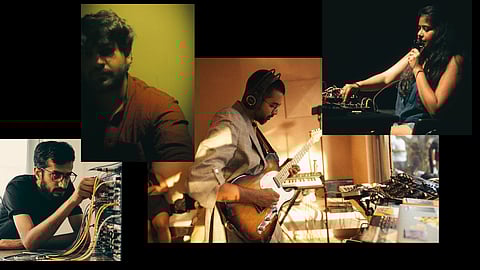
This article looks at the growing shift towards analogue and DAWless music-making, situating it within a larger cultural turn away from digital excess and towards tactile, hands-on practices . Through the perspectives of Surbhi Mittal, Sakre, Shiv Ahuja, and Hemang Duggal, it explores how hardware-based workflows, live performance, and physical media are reshaping electronic music, framing this movement as a response to digital burnout and a renewed focus on intention and real-world engagement.
This is the only time in human history where fidget clickers have become an industry, feeding the sensory needs of millions of people (estimated at around $9–9.5 billion in 2025–2026, and projected to nearly double to $17.6 billion by 2034) What does it say about our mental well-being and touch starvation that we are compensating for community and human embrace with a lust for ASMR just to feel something? Y2K’s promise of the online and its endless possibilities has surely taken a strange turn. The digital burnout is real, and the younger generation is fighting it by going back to “grandma hobbies” — knitting, baking, pottery, gardening, and jewellery design — making stuff with their hands instead of scrolling, the way god intended.
In the electronic music scene, these off-screen necessities are showing up as a shift towards analogue, DAWless music-making and performances. Modular synth sales have been growing over the last decade, with Eurorack becoming one of the fastest-expanding segments in music hardware, and companies like Moog, Teenage Engineering, and Make Noise seeing a surge in demand for compact, hands-on gear. At the same time, 'DAWless' has become its own category online — thousands of videos of artists building full tracks using samplers, drum machines, and synths without touching a laptop, just the way it started.
Early pioneers in electronic music were literally wiring circuits together. The first widely used synths, like the Moog synthesizer in the 1960s, was a massive, voltage-controlled modular setup with oscillators, filters, and amplifiers connected through patch cables. Through the ’70s and ’80s, drum machines and sequencers pushed that further with Roland boxes driving early hip-hop, house, and techno. Then the computer took over. By the 2000s, DAWs had made production cheaper, faster, and more accessible. Funny how something that initially fostered creativity arguably stagnated it just the same over time (Cut to a dead-eyed producer going through 10,000 kick drum sounds looking for the “perfect” one.)
Today, more and more artists are seeking hardware instruments for a better workflow, improvisation, jamming experience and a Pavlovian feedback of blinking LEDs and soft clicks. But what is it about these analogue devices that draws people in, beyond just the tactility? We spoke to four homegrown electronic artists to find out.
Delhi-based sound artist Surbhi Mittal AKA Pale Blue Dotter, known for her drone, ambient, noise and experimental electronics, started making music on Ableton, but the two-dimensionality of the DAW limited her imagination to a linear scale. When she came across modular synths at Free.Wav, a sound-focused residency in Kerala, and integrated hardware into her setup, it allowed her to work with DAWs more cohesively and look at them through multiple dimensions. She was also introduced to the Deep Listening tradition of composer Pauline Oliveros — the practice of listening to everything, all the time. “As I charted my trajectory with synthesizers and music production, the philosophy of Deep Listening acted as my lodestar,” she shares.
Bangalore-based musician and producer Sakré, who makes lo-fi, experimental hip-hop that samples vintage South Indian cinema and ambient city sounds, came to hardware through frustration. The DAW had given him everything and, in doing so, it had given him too much. Endless presets, endless possibilities, a process that had become entirely predictable. A hardware sampler was the way out. "Hardware synths and samplers have limited capabilities and are clunky, that force you to make decisions with intent and strictly only do what is necessary," he says. The slowness of the process, the absence of a GUI (Graphical User Interface), the fact that every decision is made purely based on what you hear — all of it pushed him toward sounds he wouldn't have arrived at otherwise, and into making more music than he ever had before. He describes the limitations as strangely liberating, taking the same workflow into his DAW sessions as well. And it has changed everything.
Delhi-based ambient artist Shiv Ahuja known for his project ‘Songs For A Tired City’ had been playing keyboards in bands since he was a teenager, using ROMplers or MIDI controllers with Mainstage. “I didn’t want to spend my entire career playing plastic keys without ever touching the ‘real’ thing, so I suppose that’s one of the reasons I got more into hardware,” he shares.
The artist was deeply influenced by players like Jon Lord, Rick Wright, Rick Wakeman, Keith Emerson, Bernie Worrell and Jan Hammer. Over time, he began looking closer to home, and discovering musicians like Kersi Lord, Viju Shah, Zubin Balaporia, Benjamin Pinto, Anindo Bose and Karan Joseph left him genuinely taken aback. That phase pushed him into working as a session player for several years, before studying contemporary photography, which eventually led him toward experimental music and new ways of thinking about sound and images.
Hemang Duggal, based in Delhi, can be seen on his Instagram, blending Indian classical with electronica, deep house, and rap. As a live instrumentalist, he already came from an analog world of playing things with his hands. His first instrument was a guitar, and as a student of Indian classical music, he performed with his harmonium in college street plays.
Today, the drum machine is his drug of choice. “I feel like drum machines are the best way to put soul in a song in a sense where you can really control everything in the moment," he explains. "There's just something very magical about it.” Feeling the groove inside of you and playing it with your own hands is something irreplaceable for Hemang in both his own craft and the artists he admires, like Fred Again. He dabbles with both digital and analogue instruments and is currently figuring out how to incorporate both of them together.
Sakre’s go-to fly rig setup is the Roland SP404. “I record, sample, produce all on this little machine. I love it because of how portable it is,” he notes. “My extensive setup includes a Guitar, Teenage Engineering OP1, Yamaha YC61, EP133 Sampler, a Boss RC505 looper, and an assortment of other synths and analogue FX pedals I mix and match. I perform live and write music with this setup. Some artists that inspired me to go this route are Thundercat, Tom Misch, and FKJ, to name a few”.
Shiv has been playing a rare reissue of the Buchla Music Easel. He pairs it with an Elektron Octatrack loaded with field recordings and tape loops he has processed through various half-broken machines. He believes in designing a system that allows you to sink into a particular iterative way of working, and is drawn to the history and philosophy behind these tools — where they come from, who made them, and how they’re used. Right now, he gravitates toward sounds without a clear point of reference, focusing on how they feel rather than what they remind him of, trying to strip away familiar markers and uncover new textures.
For Surbhi, Make Noise Strega, one of the earliest hardware synths she acquired continues to be the backbone of her sound, having spent time learning how to work with it and how to listen to the sounds it is making. “I’m not a fan of maximalism and stick to minimal gear that can be used to really zero in on a particular sound and explore it,” she notes.
While performing, she’s excited by the space that locks the audience and herself into a moment where the performance becomes a call-and-response between both. “In that moment, the unique characteristics of the instrument make it feel like it is alive, and I am channelling some life from it, passing it to the audience and the same in the other direction,” she shares.
The fact that this kind of music isn’t mainstream is part of the appeal for Shiv — the spaces feel rawer, closer to punk than ultra-processed club shows in Delhi, with audiences open to something different, pushing performers to experiment and embrace the unexpected, “...glitches in the matrix,” as he puts it. “There’s also so much electronic music that isn’t dance music, and I think audiences are starting to seek that out more." However, he isn’t fully convinced by the visual aspect of his show. What he does value is bringing whatever he’s currently exploring to an audience. The tension that comes from the audience not knowing where he is going is what he builds upon until a path reappears.
Hemang, too, loves the adrenaline of a live performance. His honest read on what draws audiences to DAWless electronic acts is watching music being made right in front of them. “ It's like those restaurants where the chef cooks at your table,” he notes. But as the artist, he insists, that doesn't let you off the hook. You still have to make it sound good, even if an audience might find a mistake exciting, even human. Opening up the track live, taking its pieces apart, also gives him the ability to take a two-minute song and stretch it to six, to bring in all the ideas that didn't make the final master. That liberty to reshape a track is one of the most fun things about an analogue performance for the artist.
The chances of failure when sequencing live beats have made Sakre very nervous as well. He has also failed many times in terms of what he wanted to create, but in the end, it always turned out well. The most ‘live’ part of his setup, though, is his guitar, which adds a flair of showmanship and spontaneity that can be tweaked to gain better audience engagement.
It is a lack of this intentionality, care and attention in building a world that has given DJing a bad reputation in the last few years. With the rise of social media and short-form content, we have come to perceive drops as synonymous with DJing. But mixing is just the first step. The real work is in putting a set together, which comes from hours of listening, curating and envisioning a story in sound. And artists around the world are still doing that. “Anyone who thinks of DJing as button-pushing is either not a DJ or a bad DJ!,” says Surbhi. Hemang, on the other hand, believes that DJs aren't getting the respect they deserve because they’re not focusing on the right things.
Analogue live performances, hence, often do much better in giving the audience a show. “Five synths and a drum machine look way cooler, you know, rather than someone on a laptop, automating slopes with their mouse,” he says. But performance aside, the medium may be irrelevant for many in-studio. The analogue versus digital question doesn't interest Surbhi as a debate, for example. There are things a digital workflow makes possible that analogue cannot, and the reverse is equally true. "At the end of the day, hardware or software — both are just tools — and the art one will create with them is dependent on many factors that go beyond their materiality," she says.
We are, nonetheless, children of capitalism, and we love our collectibles. It’s all we can afford, actually. Many culture and economic journalists have pointed out how Gen Z can’t buy houses anymore, so they invest instead in experiences and objects — Labubus, vintage clothes/shoes, pottery, even one of those bags of random trinkets someone fills up for you on their Instagram shop, with their little scoop. This reflects in the rise of physical media as well. Gen Z has become the biggest group in Vinyl sales in recent years. People are building film libraries with DVD and Blu-rays. Print too, which was presumed dead, has come alive with a growing indie zine culture across the world.
This current hunger for physical media, Sakre believes, comes directly from the subscription economy. “We don’t own copies of our favourite music, films etc., everything is under a platform that you pay every month. CDs, cassettes and vinyl give you something tangible that gives you a sense of ownership.” Shiv sees it as cyclical — with analogue synths, vinyl, 70s/80s fashion, and film photography coming back — and expects a shift toward 90s rave, cheap digital synths, and burned CDs next. For him, older tech represents a time that no longer exists, creating a sense of longing, especially if you haven’t lived through it. This collective pull we're feeling towards physicality and simpler times may just be another symptom of a sensory stagnation caused by our hyper-online lifestyles. Even if we got here after being overstimulated, our desire to touch grass, or anything that's not a screen is a reassuring sign of life.
If you enjoyed reading this, here's more from Homegrown:
Beyond Open Mics & DJ Sets, Cafés Across India Are Building Music-Centric Communities
Run It’s The Kid’s ‘Abracadabra’ Traces The Emotional Terrain Of A Relationship
Horses, Highways, & Haunted Romances: 5 Homegrown Music Videos To Watch This Month
