
- HOMEGROWN WORLD
- HGCREATORS
- HGEXPLORE
- HGVOICES
- HGSHOP
- CAREERS
- ABOUT US
- CONTACT US
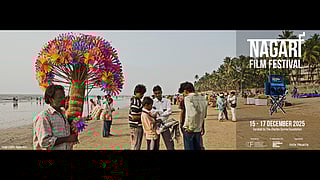

For six years, the Nagari short film competition has supported emerging filmmakers, highlighting issues like housing crises, labour precarity, ecological stress, displacement, and inequality in Indian cities. Now, it launches the Nagari Film Festival from December 15–17, 2025, at Maquinez Palace, Panaji, Goa. Presented by the Charles Correa Foundation and Serendipity Arts Festival, it features landmark films, new Nagari shorts, and filmmaker discussions.
For six years, the Nagari short film competition has been steadily building one of the most incisive moving-image archives of India’s urban present. Curated around the 7-minute format, Nagari has supported emerging filmmakers in documenting how Indian cities are shaped by housing crises, infrastructure failures, labour precarity, ecological stress, and everyday struggles over access and belonging. Now, for the first time, the project steps into a full-fledged public showcase with the inaugural Nagari Film Festival, set to take place from December 15–17, 2025, at the Maquinez Palace, Old GMC Complex, Panaji, Goa. The festival is an initiative of the Charles Correa Foundation and is being presented in collaboration with the Serendipity Arts Festival.
The three-day programme will open with the Nagari 2025 Award Ceremony and the premiere of this year’s anthology of short films, which focuses on the idea of the public realm in Indian cities. Two landmark anniversary screenings will anchor the festival: 'City on the Water' by Charles Correa, marking 50 years, and 'हमारा शहर (Bombay: Our City)' by Anand Patwardhan, which turns 40. Across the festival, feature films, Nagari shorts from multiple Indian cities, and public discussions will come together with filmmakers and cultural practitioners like Saeed Mirza, Kani Kusruti, Sameera Jain, and Sachin Chatte, among others.
As Indian cities undergo rapid and uneven transformation, the Nagari Film Festival positions cinema as both documentation and intervention. Here are five films to watch at the first-ever Nagari Film Festival in Goa:
‘हमारा शहर (Bombay: Our City)’ is the story of the daily battle for survival of the 4 million slum dwellers of Bombay who make up half the city’s population. Although they are Bombay’s workforce — industrial labourers, construction workers, domestic servants — they are often denied city utilities like electricity, sanitation, and water. Many slumdwellers must also face the constant threat of eviction as city authorities carry out campaigns to “beautify” the city. ‘हमारा शहर (Bombay: Our City)’ is an indictment of injustice and misery, and a call to action on the side of the slumdwellers. Four decades after its making, a dialogue with director Anand Patwardhan will reflect on the film’s enduring relevance, exploring cinema’s power to question urban inequality and reclaim collective space.
Date & Time: 16 December, 11:00 AM - 1:00 PM
An attempt to document displacement and resettlement due to the Kashi Vishwanath Corridor, ‘Udta Banaras’ centres the experiences of Rinku Kannaujia, a former resident of the Dalit Basti near the Kashi Vishwanath temple. The film looks at his experience of displacement while questioning what development means for a culturally rich city like Banaras. ‘Udta Banaras’ will be screened as part of ‘The City Through Many Lenses’ — a selection from 60 short films made across 12 Indian cities under the Nagari initiative between 2020 and 2024.
Date & Time: 16 December, 2:00 PM - 4:00 PM
Salim, born with a disability and living with his family, searches for a suitable groom for his sister and meets Aslam, who is rejected due to low wages. He then meets gangsters promising wealth if he incites religious riots between Hindus and Muslims. Salim has always wanted wealth but must decide if he will take this risky chance. ‘Salim Langde Pe Mat Ro’ is a powerful social drama that explores the life of Salim, a young Muslim man navigating the challenges of unemployment, marginalisation, and communal tensions in Mumbai. The film critically examines urban poverty, identity, and the pressures of modern city life on marginalised communities.
Date & Time: 17 December, 4:00 PM - 7:00 PM
The journey of water doesn’t end at the toilet when you flush it. The journey of ‘wastewater’ or sewage begins here. ‘The Many Journeys of Water’ is a story about the wastewater of a town that relies on septic tanks to store its wastewater, which needs emptying, or desludging, periodically. The film follows two women, Parameshwari and Aravalli, who are desludging entrepreneurs in Tiruchirapalli. ‘The Many Journeys of Water’ will be screened alongside Payal Kapadia’s ‘All We Imagine As Light’, followed by a discussion with actor Kani Kusruti, reflecting on performance, emotion, and poetic realism in cinema.
Date & Time: 16 December, 4:00 PM - 7:00 PM
‘In Search of Humans’ drifts through a trembling Kolkata, where digital shadows and human lives overlap. Between protest and silence, fear and hope, the film gathers fragments of memory and disappearance — searching for traces of humanity amid the city’s flickering lights and restless noise. ‘In Search of Humans’ will be screened as part of the Nagari 2025 Award Ceremony, premiering this year’s anthology of short films and initiating a dialogue on the role of the public realm in Indian cities.
Date & Time: 15 December, 4:00 PM - 7:00 PM
Learn more about the full Nagari Film Festival schedule here. The festival is free and open to all, but registration is mandatory and session-wise.
If you enjoyed reading this, here’s more from Homegrown:
Here’s Everything You Have To See At The All Living Things Environmental Film Festival 2025
Watch A Homegrown Documentary Exploring The Unseen World Of Delhi’s Night Travellers
Atin Bajaj’s Films Build Meaning Through Non-Linear Collisions Of Image & Sound
