
- HOMEGROWN WORLD
- HGCREATORS
- HGEXPLORE
- HGVOICES
- HGSHOP
- CAREERS
- ABOUT US
- CONTACT US

The article centres on photographer Kalpesh Lathigra and his first solo exhibition in India,' The Lives We Dream in Passing', at Mumbai’s NCPA Photography Gallery. Bringing together three long-term projects — 'Mémoire Temporelle', 'The Indian Photo Studio' and 'Junagadh' — the show explores migration, inheritance and the idea of belonging through images shaped by his British-Indian background.
When Kalpesh Lathigra first picked up a camera, law school was still on the table. Growing up in East London as the son of a Gujarati family that had moved to the UK via Kenya and Zanzibar, he stumbled on a book of photographs by Henri Cartier-Bresson and everything shifted. He quit law, took evening photography classes, and eventually completed a postgraduate diploma in photojournalism at the London College of Printing.
Kalpesh worked as a photojournalist in the 1990s and won first prize in the World Press Photo Awards in 2000. In the years that followed, he moved toward long-term, idea-driven bodies of work, shaping a practice between documentary and personal inquiry.
Now, in 'The Lives We Dream in Passing', his first solo exhibition in India at the NCPA Photography Gallery in Mumbai, those threads are on full display. Curated by Veeranganakumari Solanki, the show brings together three distinct projects made over the last several years: 'Mémoire Temporelle', 'The Indian Photo Studio', and 'Junagadh'. Together, they map themes of migration, identity, and positionality.
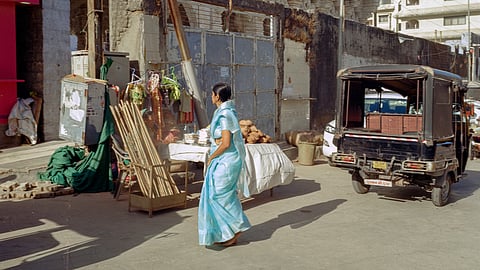
'Mémoire Temporelle' was shot in Mumbai over about three years. In the project, Kalpesh was tracing what his life could have been like if his family had never left India. He made multiple trips, walking, observing, and responding to the city through imagery that mixes people, streets, reflections, objects and fragments of urban life. The series is an attempt to give form to the emotional resonance of memory and imagined possibility tied up with family history. Many images from this series reference fleeting personal associations as a way into the deeper, unclaimed parts of experience.
In 'The Indian Photo Studio', Kalpesh works with studio portraits he found in a street market. These are ordinary, vernacular identity photos made by local studio photographers — faces of people unknown, moments captured for passports, families, documentation. The photographer brings them into the gallery as cultural artefacts of the many lives lived. In the gallery, they’re shown in a single long line, eye-level, much like a string of identification images. The arrangement pushes the viewer to meet each person’s gaze directly. The series pokes at the bureaucratic mechanics of identity and raises questions about how institutional frameworks shape what a face means.
The third body of work in the show, 'Junagadh', comes from Kalpesh’s visits to his father’s hometown in Gujarat. Junagadh is a small seaside place, very different from the bustle of Mumbai or the life he knows in London. In these images, he works from hotel rooms and edges of public spaces, photographing streets and scenes from a distance or through windows. The perspective signals an observer acknowledging the awkwardness that comes with being an ‘outsider’. These images are attempts to unearth his position as a photographer looking into the world, aware of how his own history, education and cultural distance inform what he sees and how he makes photographs.
This exhibition marks a significant moment in Kalpesh's career. After decades of working internationally and publishing books abroad, this is his first solo presentation in India. The show brings his stories of migration and evolving visual language into one space — and places it in the country that has remained central to his thinking throughout his life.
The Lives We Dream in Passing is on show at NCPA Mumbai until 06 March. Follow him here.
If you enjoyed reading this, here's more from Homegrown:
The Alchemy Of Thought & Image: Homegrown Editorial Photographers On Our Radar
Photographs As Relics Of Feelings: The Ethereal Image-Making Practice Of Vijay Sarathy
In Our Own Backyard: Sheba Chhachhi’s Photographs Of Women's Movements In The Eighties
