
- HOMEGROWN WORLD
- HGCREATORS
- HGEXPLORE
- HGVOICES
- HGSHOP
- CAREERS
- ABOUT US
- CONTACT US
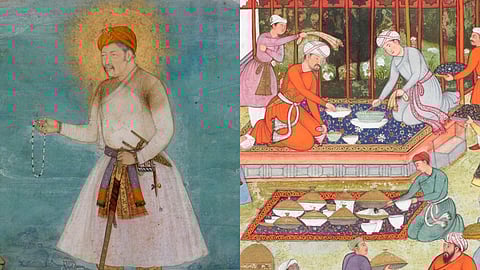
Mughal emperor Akbar’s royal table was never just about indulgence. Governed by physicians, guarded against poison, and shaped by religious diktats, the Mughal emperor’s eating habits reflected an empire built on balance and control. From silver-coated rice and rosewater-watered vegetables to an army of tasters and cooks, Akbar’s strange regal diet reveals how food functioned as medicine, ritual, and statecraft in Mughal India — leaving a legacy that continues to shape Indian cuisine today.
That the Mughal Emperors were filled with uniquely driven eccentricities is not news to any of us, although a recent enlightened decision by NCERT to remove the Mughals from Class 12 history books has raised questions in all of our minds as to how long we'll be able to assume that knowledge about the Mughals is truly ubiquitous.

While Shah Jahan showed a particular preference for architecture and Aurangzeb exhibited a keen desire for expeditions, none come close to the culinary eccentricities held forth during the rule of Emperor Akbar. While some of these are creations of his own preferences, a number of culinary processes have been passed down from one generation to another; through the perils of trial and error. As state governments like Maharashtra and Uttar Pradesh try to remove all traces of the Mughal dynasty from school textbooks in a move to eradicate this part of Indian history forever, we bring to you culinary traditions of Emperor Akbar that have long since influenced Mughlai cuisine and the gastronomical landscape of India. Also, who knows, all this digging might just end up showing us what "a meal fit for a king" truly means!
Salma Hussain, a celebrated food historian notes that, “The daily meals were usually served by eunuchs, but an elaborate chain of command accompanied the food to the table. The hakim (royal physician) planned the menu, making sure to include medicinally beneficial ingredients. For instance, each grain of rice for the biryani was coated with silver oil, which aided digestion and acted as an aphrodisiac.” But this was only just the beginning of the peculiarities that coloured this cuisine.
According to ‘A History of Food In India’ (2014) by Colleen Taylor Sen: “The palace chickens were fed by hand with pellets flavoured with saffron and rosewater, and massaged daily with musk oil and sandalwood.” The book also states that Akbar’s royal kitchen housed “...a head cook, a treasurer, a storekeeper, clerks, tasters, and more than 400 cooks from all over India and Persia. Food was served in gold, silver, stone and earthenware dishes, tied in cloths. Ice, used for cooling drinks and making frozen desserts, was brought daily from the Himalayas by an elaborate system of couriers.”
Hussain also says that Akbar was a vegetarian thrice a week, drank only Gangajal “and had his own kitchen garden which he nourished with rosewater so that the vegetables would smell fragrant when cooked.” Some of the dishes prepared with gusto during his time were Sanbusas or Samosas, sag — a spinach dish prepared with ghee, fenugreek, ginger, cardamom and clove, Harisa (meat cooked with cracked wheat, ghee and cinnamon), Halim (the same dish but with vegetables and pulses added), Yakhni which was a meat stew, and of course whole lambs roasted to perfection, as mentioned in ‘The Empire of the Great Mughals: History, Art and Culture’. It’s important to note that during Akbar’s rule, he banned the eating of beef and other items offensive to his Hindu and Jain subjects.
Being an Emperor of any part of the world at any given time usually meant one thing — a lot of people wanted you dead. And so it was with the Mughals. During a feast, “...an abrupt, violent spasm of nausea was choking Babur as he began to vomit in convulsions of agony and retching” as written in ‘Babur: The First Mogul in India’ (1997). After learning that the Emperor had been poisoned, a number of culinary processes were put in place that continued down to Akbar’s reign.
When it came to serving the food, there was a system in place. According to this report, the cooks and the Bakawals tasted the dishes, after which the Mir-Bakawal (kitchen overseer) attached “...his seal to them while a clerk made an inventory of the vessels sent to the royal dining room. This was a precaution to guard against the dish being changed on the way.” The kitchen staff were escorted all the way, and a tablecloth was spread out on a carpeted floor on which the food was placed. “Even bread, pickle and other savouries were sent sealed in bags. When the seals were opened, the Mir-Bakawal tasted the food again before the emperor began his meal, usually with curds after setting aside a portion for mendicants,” the report says.
The great Mughal emperors hold an important place in India's cultural heritage, and their history must be preserved and depicted with accuracy. Our tables and our palates have a long lineage of kings to thank, with Akbar being as revolutionary and impactful as one can be.
If you enjoyed reading this, here’s more from Homegrown:
Maharashtra Education Board Omits Mughal Empire From Its History Books
