
- HOMEGROWN WORLD
- HGCREATORS
- HGEXPLORE
- HGVOICES
- HGSHOP
- CAREERS
- ABOUT US
- CONTACT US

Pero has always treated space, time, inspirations, processes and storytelling as extensions of the garment itself, just as important to their business as the clothes they make. I was reminded of this while walking into 108 by Save The Loom in December, where the brand’s long-running Hello Kitty collaboration was in its last leg. The old converted Kerala house, typically with an unassuming façade, had been transformed; Hello Kitty figurines and plushies perched across shelves, with one even sitting in a big chair, peering out at the Christmas processions of Kochi, while panels of Hello Kitty patterns took over a primary space within the store. There was the unmistakable feeling of a péro takeover in the air - it was immersive, playful, and expansive.
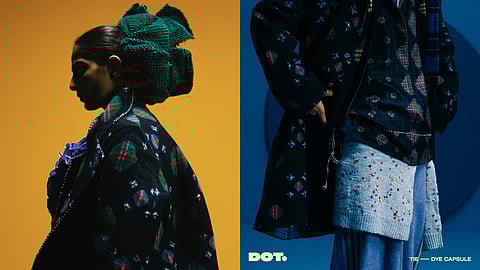
But even as I was getting a small, temporary Hello Kitty tattoo applied, my mind was already elsewhere. Not in the store, but on what had appeared most recently on péro’s social media: Dot., their first capsule collection. The capsule has already made its way to several of péro’s stockists across the world, though not yet to Kochi. I encountered it through campaign images, short lines of text, and a quiet sense of intent that radiated through them. In many ways, not having seen it in person yet felt appropriate. Dot. is not a collection designed to overwhelm, but one that reveals itself slowly.
The capsule came into being while péro was doing what it has always done: researching textiles nearly two years in advance for its Fall/Winter collection, Bonnie. During this period, the team was deeply immersed in Scottish tartans, interpreting them through Indian handloom clusters across the country. What emerged from this process was not planned as a collection, but as an unexpected technical discovery.
“We were already developing a lot of Scottish tartans,” founder and designer Aneeth Arora tells me over a virtual call. “Since India has so many weaving clusters, we were making interpretations of tartans in different weights of textiles.” Lighter silks and cottons were developed in Maheshwar, cotton checks in West Bengal, and heavier wool versions in Himachal and Punjab. This, Arora explains, is how péro always works. A theme is identified, textiles are developed across clusters, and once they come in-house, they become a living archive. She refers to this as her textile library, a resource she continually returns to. A space where motifs, techniques, and learnings from péro’s past and present are stored, revisited, relearned and reinterpreted for the future.
When Experiment Becomes Method
Traditional bandhani entered the picture alongside tartan during this research phase for Bonnie. The team soon encountered a familiar challenge. “We were facing a lot of difficulty trying to get coloured dots,” Arora recalls. Instead of forcing the textile to behave, they allowed the problem to become an experiment. The solution was simple in theory, but complex in execution. Patterns were resisted directly on already woven tartan fabric, and then dyed.
“When I was doing that, I realised that what we were doing was kind of reversing ikat,” Arora explains. Traditionally, ikat involves resisting and dyeing yarn before weaving, pre-imagining the pattern at the yarn stage. Here, the imagination came later. “We imagined the pattern on the tartans, resisted it, and then dyed it. ”The result felt both familiar and quietly radical. “It sounds like a very simple technique,” she admits. “Anybody could have thought of it and done it. But it hadn’t been done before.” What followed was not a one-off experiment, but a deepening of the process. After initial trials, the team began engineering tartans specifically for what would happen after dyeing. “Now we are controlling the warp and weft on the loom itself,” Arora explained. “We already know what we want to resist once the textile is woven.”
This kind of innovation, she emphasises, is only possible because of time. Péro’s practice of working two years in advance allows uncertainty to exist without pressure. “The advantage of working that way is that you get time for R&D, for trial and error, and for refining your thoughts,” she added on. Initial explorations took place at péro’s textile research department in Delhi before being taken to artisan clusters. By the time the team reached bandhani artisans, clarity had already been established. “We had a very clear idea of what we wanted them to do when the final textile reached them.”
Dot. as Pause, Assertion, and an Ongoing Practice
The capsule opens with a line that frames the entire collection: I was here. What comes next? The words feel contemplative. Arora traces them back to the name itself. “A dot is like a full stop,” she says. “It’s an assertion. You’ve said something. But you also know that something more is coming.”
That duality reflects where DOT. sits within péro’s larger journey. It is not an ending, and not a declaration of arrival. Instead, it is a moment of awareness. A pause that acknowledges what has come before, while leaving space for is to follow.
Calling Dot. a capsule is not only about scale or quantity. It is a structural decision. “Whenever we introduce a capsule,” Arora explains, “it’s because the technique is much more tedious compared to our other textiles. It’s not easy to produce a lot of it.” Separating it from the main seasonal collection allows the work to be styled differently, presented more simply, and understood on its own terms.
Normally, péro’s garments are layered compositions. “When you look at a péro piece, it never shouts one technique,” Arora says. “It’s the sum total that people remember.” With Dot., that instinct was intentionally set aside. “This was a conscious attempt because it’s something unusual that we’ve done. We wanted people to understand it.”
Importantly, Dot. is not intended as a one-off. Arora sees capsules becoming an ongoing aspect of péro’s practice, recurring across seasons rather than tied strictly to Fall/Winter or Spring/Summer cycles. “We want to launch a capsule every now and then,” she shares, “where we focus on a textile technique without mixing it in the usual way.”
This focus extends to silhouette. Because the bandhani is placement-driven, garments were designed to ensure patterns would not be interrupted. “We made sure the main pattern is not getting chopped off,” Arora says. Boxy, geometric forms beloved by péro loyalists still dominate, but now allow the motifs to stay in focus. At the same time, the capsule spans categories. Shirts, jackets, and layers ensure different kinds of péro wearers can experience the textile in forms they already love.
Letting The Textile Tell Its Own Story
The restraint of Dot. is perhaps most evident in its visual language. Compared to péro’s typically layered campaigns, this one is pared back. Backgrounds are minimal. Shapes are reduced. The circle becomes the only recurring motif. This was péro’s way of ensuring the textile remained the hero.
Even the decision to patent the work reflects this thinking. Ikat and bandhani are traditional techniques that cannot be owned. Instead, péro patented the process itself. The backward working, the planning of checks, and the sequence of resistance and dyeing. “It’s not about ownership,” Arora clarifies. “It’s about safeguarding the thinking.”
As our conversation comes to a close, Arora returns to what she considers the most meaningful aspect of Dot. Not the novelty of the technique, and not its limited availability, but collaboration. “For me, this is the biggest collaboration of 2025,” she says. Not with another brand, but with artisans. Bandhani artisans from Gujarat, and the learning carried over from ikat clusters, even when ikat itself is not directly visible. The Dot. capsule is now present across hundreds of péro’s stockists worldwide. More importantly, it has established itself in the founder/designer’s intent - a quiet assertion of presence, and raising the question of what comes next.
You can follow pero here.
