
- HOMEGROWN WORLD
- HGCREATORS
- HGEXPLORE
- HGVOICES
- HGSHOP
- CAREERS
- ABOUT US
- CONTACT US

This article looks at HōmAnAn, a residential showhouse curated by Anubha Aneja that brings together over 35 Indian design brands within a fully realised home environment. It focuses on the space’s approach to curation—placing furniture, textiles, lighting, and objects within lived-in settings to explore how design functions relationally —and also highlights The First Layer, an upcoming exhibition by Understorey centred on handcrafted rugs made through repurposed yarn and intuitive material processes.
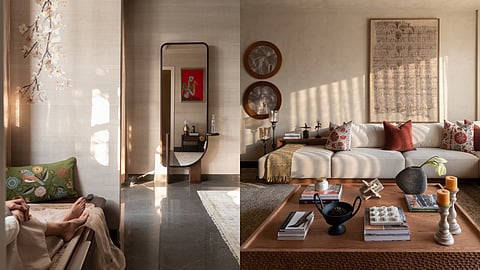
Designing a home takes a lot of imagination. From picking the right curtains to the ottoman and side table that goes with your couch, it requires envisioning the space the way you want to inhabit it with both the form and function in mind. Which is hard to to when you’re looking at an object in a showroom or on a website outside of the context it will live in. HōmAnAn in New Delhi is built around this idea. Conceived as a showhouse, the space brings together more than 35 homegrown Indian design brands within a fully realised residential setting, where visitors experience how furniture, lighting, textiles, carpets, and objects look and feel within an actual home.
Curated by interior stylist and brand consultant Anubha Aneja, the approximately 4000 sq. ft. residence unfolds room by room through living spaces, bedrooms, dining areas, and transitional zones that are meant to be inhabited and moved through naturally. Furniture is arranged for comfort, textiles are layered and tactile, and lighting is experienced in real time as it shifts across the day. The space is rooted in Anubha's practice of 'editing rather than adding', and allows visitors to experience scale, proportion, materiality, and the dialogue between objects in the way designers originally intended.
The experience at HōmAnAn is shaped by a rigorous act of curation that focuses on craftsmanship, longevity, and design integrity across categories including furniture, lighting, textiles, carpets, wall finishes, art, accessories, and objects. Heritage brands and contemporary studios share the same environment, connected through a shared, coherent design sensibility instead of trend-driven styling. Brands including Sarita Handa, Oorjaa, Jagdish Sutar, Beruru, Anantaya, Keus, UDC, Inherited Arts, and Kara Sabi coexist seamlessly across the home, where every object is available for purchase. Anubha describes the approach by saying, “A home is never a sum of individual pieces. It is built through relationships, between objects, materials, and the people who live with them.” That understanding sits at the centre of HōmAnAn’s, where visitors encounter interiors as complete ecosystems.
Positioning itself as a “a living anthology” of India’s evolving domestic landscape, material culture, and design intelligence, this month HōmAnAn is hosting Understorey for 'The First Layer', an upcoming exhibition running from May 9–10, with a preview on May 8. The exhibition presents one-of-a-kind rugs crafted from repurposed dyed yarn sourced from active looms, alongside Understorey’s signature handcrafted rugs produced by master weavers in Jaipur, continuing a legacy that dates back to 1916. Colours, textures, and variations emerge organically through an open and intuitive process where each rug evolves across multiple stages of making, shaped by accumulated yarn and innovative dyeing techniques. Founder Rahul Kapoor describes the carpets as “art on the floor,” speaking about their ability to shape the mood of a room while carrying the histories of their material.
At HōmAnAn, we’ve always believed that objects are best understood in context - within a space, within a home, within a way of living," shares Anubha. "When we started working with Understorey, it felt like a natural extension of that thought. Rugs, in many ways, are foundational to how a space is experienced, and yet they’re often treated as an afterthought. This exhibition was an opportunity to shift that narrative, by bringing the rug to the forefront, and allowing people to engage with it as the starting point of a space."
Follow HōmAnAn here.
