
- HOMEGROWN WORLD
- HGCREATORS
- HGEXPLORE
- HGVOICES
- HGSHOP
- CAREERS
- ABOUT US
- CONTACT US

The article looks at Priya Ahluwalia’s collaboration with PUMA, situating it within her broader design practice rooted in diaspora identity, archival research, and reconstructed materials. It focuses on how the collection draws from African football culture and fan communities, using sportswear as a lens to explore themes of belonging, movement, and collective identity, while blending PUMA’s archive with Ahluwalia’s graphic, culturally layered aesthetic.
Colour-blocked, archive-spliced, graphic-heavy, with references that move from Lagos to Southall is the aesthetic London-based designer Priya Ahluwalia has built her work around. Pulling from her Indian-Nigerian heritage and the visual language of diaspora communities and rooted in research, her collections are built from lived references — archival imagery, street style, and personal history — translated through reconstructed materials recycled and deadstock fabrics, treating them as a starting point for both design and storytelling. Over the past few years, she has extended this approach into sportswear, bringing her perspective into a space shaped by performance, movement, and global culture.
In her recent collaboration with PUMA, her design language meets the brand’s deep-rooted connection to football. The second drop of PUMA x Ahluwalia is framed around African football culture, positioned as a study of the sport’s energy, everyday presence, and the way it brings people together across different regions. The idea comes from her research into fan culture in countries like Morocco and Nigeria, where she observed how communities express pride and belonging through clothing and collective participation. The collection also draws from PUMA’s archive, using decades of football artefacts to inform updated versions of classic silhouettes, while staying close to the emotional and social role the sport plays across the continent.
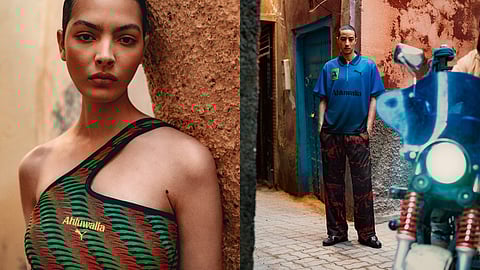
Across apparel, the collection reworks familiar PUMA pieces through print, texture, and colour. The T7 tracksuit appears with an all-over graphic that abstracts the movement of a stadium crowd, creating a sense of density and rhythm across the surface. A textured knit is used on the T7 top and skirt, referencing the green of the Nigerian flag and finished with embroidered logos. A graphic polo introduces oversized visuals with a gradient colour treatment, pushing a more expressive, statement-driven look. These elements sit alongside a broader palette that reflects pan-African colours, tying back to the collection’s central references.
Accessories and footwear extend the same direction. The Micro Grip bag carries a wave pattern that links back to the apparel and nods to PUMA’s formstrip, while a black baseball cap keeps things more minimal with a lightweight textured finish and subtle branding. Footwear centres on the V-S1, released in two versions — one in a pan-African palette of red, yellow, green, and black, and another in a more muted grey and black. The silhouette draws from early 2000s football design, referencing PUMA’s V1 boots, known for their speed-driven construction and stripped-back form. The entire collection is produced largely using recycled fibres, reflecting a continued focus on material innovation and responsible production, developed in close collaboration with PUMA’s teams.
The campaign was shot in Morocco, using its streets, architecture, and light as a backdrop to the collection. The visuals and accompanying short film focus on football as part of daily life, capturing how the sport operates across neighbourhoods, public spaces, and informal settings. The imagery looks at the collective nature of the game — how it connects people, builds shared identity, and moves across borders without losing its local specificity. Positioned as a ‘love letter’ to African football, the campaign centres the emotion, style, and community that shape the sport across the continent, and is available at PUMA’s London flagship store as well as on Priya’s website, followed by a wider release through selected stockists.
If you enjoyed reading this, here's more from Homegrown:
Yaghshiye Is Bringing Chitral’s Craft Traditions To Contemporary South Asian Fashion
How p é r o Turned Their Runway Into A Playground of Music, Craft and Comfort At LFW ‘26
Padani Kandagama x Rkive City Brought Sri Lankan Influences To The Paris Fashion Week Season
