
- HOMEGROWN WORLD
- HGCREATORS
- HGEXPLORE
- HGVOICES
- HGSHOP
- CAREERS
- ABOUT US
- CONTACT US

Kolkata’s neighbourhood libraries — modest, community-run reading rooms in working-class neighbourhoods — once embodied the city’s democratic reading culture. This story traces how deeply reading was woven into Kolkata’s social life and what is lost as these grassroots institutions fade.
There is a legend about the historic Nalanda university — an ancient centre of Buddhist learning in present-day Bihar. The story goes like this: the gates of Nalanda were guarded by some of the greatest scholars of the day. If you were an outsider, you had to first defeat them in a debate before you were granted entry into the university. I have always liked this story because of its emphasis on working-class intellectualism: the idea that even workers can be erudite, and the reverse, that even the most erudite can be workers.
Until recently, a similar culture of working-class intellectualism existed in Kolkata. You’d often find people engaged in unhurried adda — informal but no less intellectual debates — over endless cups of cha and cheap cigarettes at neighbourhood tea shoppes, cabbies reading newspapers, magazines, and even paperbacks inside their cab on slow afternoons, and second-hand booksellers in College Street boipara who could compete with the students they catered to on literary discourse. Despite de-industrialisation in the 1970s-90s and rising anti-intellectualism in recent decades, Kolkata remains one of the few cities in the world where reading is still publicly performed at scale.
This public reading culture was fostered, in large part, by the city’s numerous neighbourhood libraries. At its prime in the mid-20th century, Kolkata — often called the cultural and intellectual capital of India — had more libraries per capita than even London or New York. Known as ‘reading room’ and ‘para-r library’ (Bengali for neighbourhood Library), these institutions, often founded and funded by wealthy residents or civic associations for the local community served as third spaces for collective reading, self-education, and skill-building.
The Calcutta Reading Rooms and Literary Institute (estd. 1872), Baghbazar Reading Room (estd. 1883), Chaitanya Library and Beadon Square Literary Club (estd. 1889), Kalighat Library (estd. 1889), and Albert Library (estd. 1890) are some of the earliest examples of these institutions. According to Bookscapes — a research project by Swati Chattopadhyay, Aaheli Sen, Sounita Mukherjee, and Thomas Crimmel — Kolkata had as many as 295 libraries as of 1942, 222 of which were neighborhood libraries. They describe this phenomenon as the effect of the “library movement” initiated by Deshbandhu Chittaranjan Das and Rabindranath Tagore in the 1920s.
These neighbourhood libraries — often modest, single-room reading spaces tucked into working-class neighbourhoods — emerged from a very specific set of social needs and material conditions. In the mid-20th century, as the city absorbed waves of rural migrants, refugees, and an expanding industrial workforce, access to formal education remained sharply uneven. For families negotiating precarious incomes, books were luxuries and reading for pleasure was an unimaginable decadence.
These libraries, however, offered an alternative. They proliferated across Kolkata, shaped by the conviction that access to education was a right and a resource that could elevate and alleviate entire communities. Their wooden shelves bowed under the weight of well-thumbed editions of children’s magazines such as Anandamela, Shuktara, Bengali classics by Rabindranath Tagore, Sarat Chandra Chattopadhyay, and Bibhutibhushan Bandyopadhyay, political periodicals, newspapers, and exam guides essential for upward social mobility. At the same time, their target demographic — typically composed of blue collar workers, students, and women — saw them as democratic spaces where literacy and self-improvement could flourish despite systemic neglect.
By the 1970s–90s, neighbourhood libraries had evolved into multi-purpose community spaces. On weekends, volunteer doctors held free clinics in these rooms to conduct health check-ups and provide basic medical care. Similarly, in the evenings, college students waiting to crack competetive exams offered free tuition to underprivileged children whose parents lacked the means for private coaching. When computers became symbols of India’s burgeoning IT industry in the early 2000s, many libraries pooled resources to purchase entry-level desktops, providing basic digital literacy to the community. These offerings embedded these institutions deeply into Kolkata’s storied para culture.
Yet post-2000s, these same sociological changes rendered many of these libraries obsolete. Economic liberalisation led by the IT boom reconfigured aspirations, pushing younger generations toward private coaching for competitive exams, and the attention economy of smartphones and popular entertainment took over whatever leisure was left. Public funding for local libraries stagnated. Many neighbourhood libraries found themselves unable to maintain even their modest collections or replace obsolete equipment. The volunteer networks that once sustained them thinned as work shifted from stable public-sector jobs to precarious service economies, leaving little time for unpaid community labour. Meanwhile, rising real-estate pressures transformed many mixed-use neighbourhoods. Land that once housed libraries were converted into residential apartments or office buildings.
These neighbourhood libraries thrived because they were embedded in the collectivist spirit of Kolkata led by civil societies, labour unions, Left student bodies, refugee neighbourhood committees, and clubs that understood reading as part of a broader social and cultural project. As these networks weakened, the libraries’ ecosystem strained. Still, a handful survive, run by ageing caretakers or revived by local youth seeking alternatives to hyper-individualised city life.
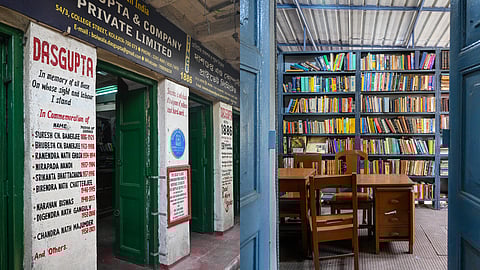
“This institution was founded in 1886 when my grandfather came to Kolkata from Jessore (in present day Bangladesh) and decided to open a bookshop because it was a respectable trade,” Arabinda Das Gupta, the third-generation proprietor of Das Gupta & Company — a famed 140-year old College Street bookshop that runs a free library on its second floor — says. “We have survived through two World Wars, the 1947 killings, the Naxal movement, the Amphan super cyclone, and COVID. We opened the library last year so young students can come and read for free. I hope they will understand that e-readers cannot substitute the feeling of physical books. I hope we can continue to do the same in the future.”
In recent years, many have eulogized India’s declining culture of leisurely reading. Many — myself included — have defended it with the increasing popularity of literary festivals and growing footfall at bookfairs. But while literary festivals and bookfairs are ephemeral, these neighbourhood libraries offer something more sustainable and long-term. They're grassroots, adaptive, and materially grounded cultural institutions shaped by the needs of working people. Their decline mirrors larger shifts in how cities imagine public life, but their memory continues to illuminate what a democratic reading culture once made possible. Today, these libraries may feel like the past of Kolkata’s reading culture, but they are also the blueprint for its future.
