
- HOMEGROWN WORLD
- HGCREATORS
- HGEXPLORE
- HGVOICES
- HGSHOP
- CAREERS
- ABOUT US
- CONTACT US

A deep dive into the historical and cultural connections between flamenco and Bharatanatyam, exploring Romani migration, shared rhythmic systems, and embodied musical traditions.
Between the 8th and 15th centuries CE, much of present-day Spain was part of Al-Andalus, an Islamic empire that encompassed most of the Iberian Peninsula. At its greatest extent, it occupied most of Spain and Portugal, and parts of southern France — a melting pot of Arab, Berber, Jewish, and Christian cultures. One of the many migrant communities that arrived and settled in the region during this period was the Romani people, known in Spain as ‘Gitano’. Originally from India, the Gitanos carried their song and dance traditions through the Middle East and Europe and were pivotal in the evolution of the Andalusian folk music and dance form known as flamenco.
The Gitanos’ contribution to flamenco was a sharpening of rhythm, vocal expression, and improvisation. The deep song, or ‘cante jondo’, the purest and oldest style of flamenco, for example, traces its origins to the community. Its raw, almost fractured vocality is often linked to their layered histories of migration, marginalisation, and survival.
Similarly, the Carnatic dance and music traditions, broadly known today as Bharatanatyam, also trace their origins to oppression and othering. The earliest forms of what would become Bharatanatyam can be traced to temple traditions in Tamil Nadu, where dance functioned as a form of ritual service. Originally performed by Devadasis, or oppressed caste women dedicated to temple deities, this dance was part of a larger ecosystem of sacred arts linked to the Natya Shastra, a Sanskrit treatise on the performing arts composed and compiled between the 2nd century BCE and the 2nd century CE.
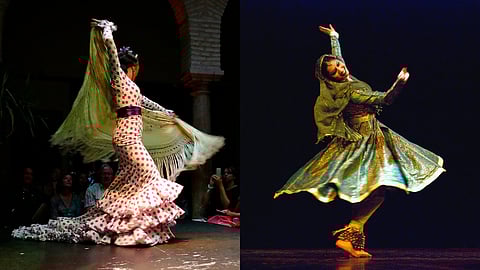
Although flamenco and Bharatanatyam seem as disparate as salt and sugar at first glance, they share many structural and cultural commonalities. When one looks closely at how both dance and music forms evolved over time to emphasise on rhythm, vocal expression, and embodiment of yearning, both spiritual and corporeal, the many threads that connect these distant cousins become unmissable.
This is best illustrated by how both traditions build on cyclical rhythms as foundations: while flamenco follows ‘compás’, or rhythmic cycles, often in complex counts such as 12-beat cycles, Carnatic music and dance forms follow the rhythmic framework of tala with intricate beats. In both traditions, the performers embody rhythm through clapping (‘palmas’) in flamenco and hand gestures (‘mudra’) in Carnatic dance. Improvisation also plays an important role in both traditions. Neither form is fully fixed. While cantaores or flamenco singers and guitarists improvise melodic lines and vocalisations within established modes, Carnatic musicians and dancers play with raga alapana, neraval, and kalpanaswaram within melodic frameworks.
The same similarities extend to vocalisations: while cante jondo relies on ‘melisma’, or sliding between notes with raw intensity, Carnatic music uses ‘gamaka’, or nuanced oscillations and microtonal inflections to convey emotional intensity.
Other similarities include a reliance on footwork to keep count and maintain rhythms, such as ‘zapateado’ or feet stamping in flamenco, which functions as percussion, and footwork with ghungroo or acoustic anklets in Carnatic dance, which serves a similar purpose. Both traditions are also deeply conversational, featuring call-and-response interactions between musicians and dancers.
While these similarities do not prove a direct lineage connecting flamenco and Bharatnatyam, they point to parallel traditions that evolved under similar pressures of migration, devotion, marginalisation, and improvisation. To look for shared origins, then, is perhaps to ask the wrong question. Flamenco is not Indian in any direct sense. But neither is it untouched by that distant beginning of the Gitanos, the Romanis, or the Gypsies — the people who shaped it. It is a form shaped by movement across geographies and histories, in which fragments of different worlds persist as echoes of one another.
